
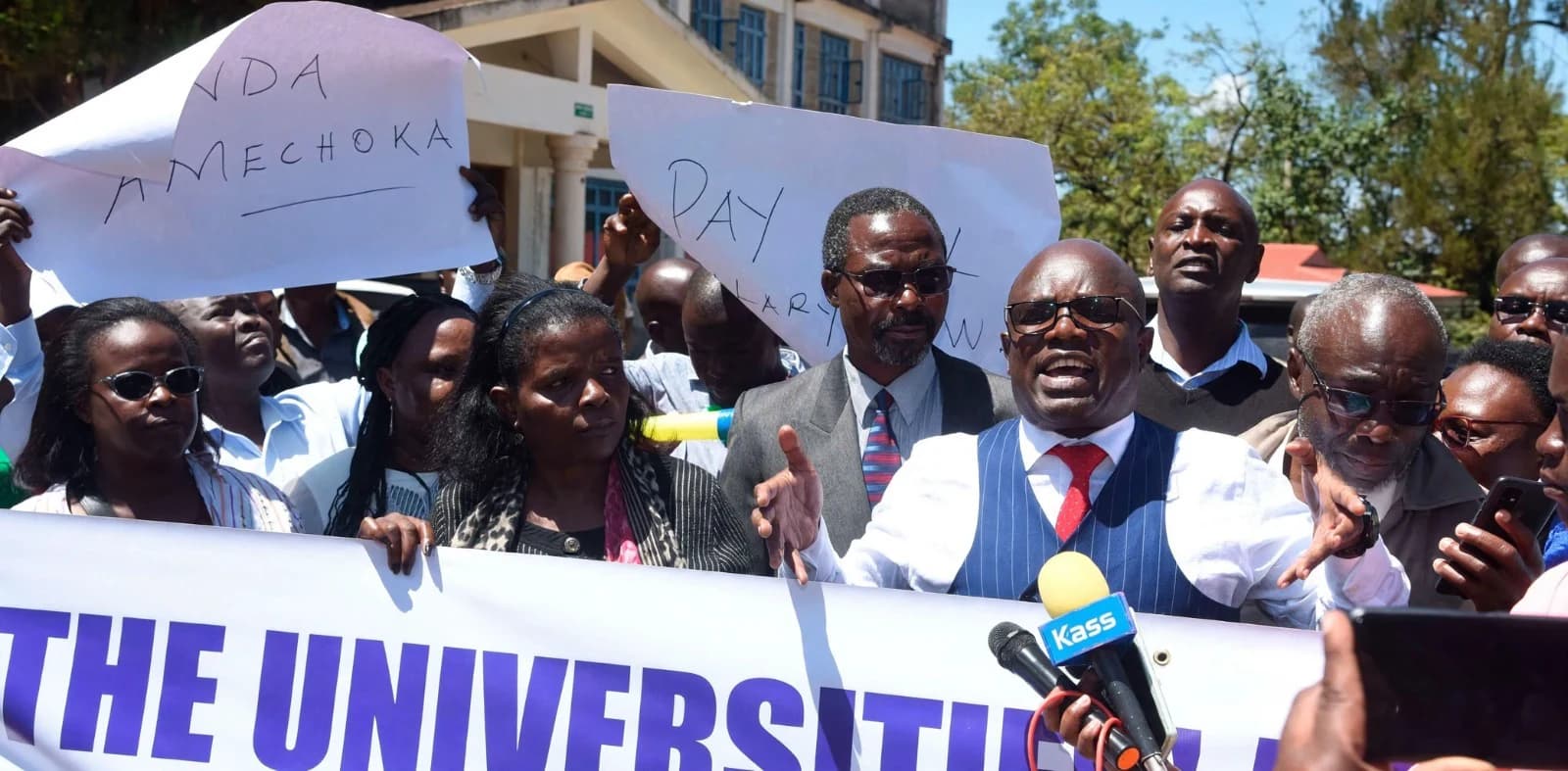
Universities Academic Staff Union (UASU) Secretary-General Constantine Wasonga’s reported confrontation with a part-time lecturer conducting an online class has exposed tensions over whether teaching should continue as university staff pursue a strike over employment terms.
According to reports, Wasonga joined the lecturer’s virtual class and questioned why part-time tutors were continuing to teach while their colleagues were on strike. The lecturer reportedly responded that part-time staff did not benefit from the issues the union was pursuing and claimed she had gone about four years without receiving payment for her teaching work.
The reported exchange shifts attention from the strike itself to a difficult question facing Kenya’s public universities: can a union sustain collective industrial action when some lecturers continue teaching under different employment arrangements?
The strike began on October 2, 2026, amid a dispute over the implementation of the 2025–2029 Collective Bargaining Agreement (CBA). The union has maintained pressure on the government and university employers to resolve outstanding issues affecting lecturers’ remuneration and employment benefits.
Part-time lecturers' employment conditions come into focus
The dispute also intersects with longstanding concerns about universities’ reliance on part-time lecturers. UASU has previously called on universities to prioritise full-time, permanent and pensionable employment, raising questions about the working conditions and job security of academic staff engaged on temporary or part-time arrangements.
The central issue is therefore bigger than a heated virtual exchange. It concerns the relationship between union solidarity, the employment insecurity of part-time lecturers and students’ need for continuity in learning.
The lecturer’s reported claim of years of unpaid work, if substantiated, would raise serious questions about employment practices and the treatment of academic staff. However, the allegation requires independent confirmation, and the full circumstances surrounding the reported confrontation remain unclear.
Government and UASU differ over unresolved CBA demands
Meanwhile, students face uncertainty as the industrial dispute continues to disrupt normal academic activities in public universities. Interrupted lectures, uncertain examination schedules and delayed academic programmes can affect students’ progression, graduation plans and financial arrangements.
Education Cabinet Secretary Julius Ogamba has urged striking lecturers to resume work, maintaining that the government has addressed most of their demands. The union, however, continues to press for the resolution of outstanding concerns.
The disagreement reflects a fundamental difference between the government’s position that progress has been made and the union’s insistence that unresolved commitments must be addressed before normal teaching can resume.
Balancing lecturers' rights and students' academic needs
For part-time lecturers, the situation may be particularly complicated. Their contractual arrangements, income security and relationship with university management may differ from those of permanent academic staff. These differences can make participation in collective industrial action a difficult professional and financial decision.
Nevertheless, the continuation of teaching by some lecturers should not automatically be interpreted as opposition to their colleagues’ grievances. Equally, the decision to strike should not obscure the need to protect students from prolonged academic disruption.
A lasting solution requires transparent negotiations, clear implementation timelines and credible commitments from the government and university employers. It also requires universities to address employment practices that leave academic staff uncertain about their remuneration and professional security.
Ultimately, the significance of Wasonga’s reported encounter lies not merely in the confrontation itself, but in the deeper tensions it illustrates. Kenya’s university sector must find a way to reconcile lecturers’ employment rights, collective bargaining and students’ right to a reliable education.


Reader Discussion (0)
Sign in to comment