

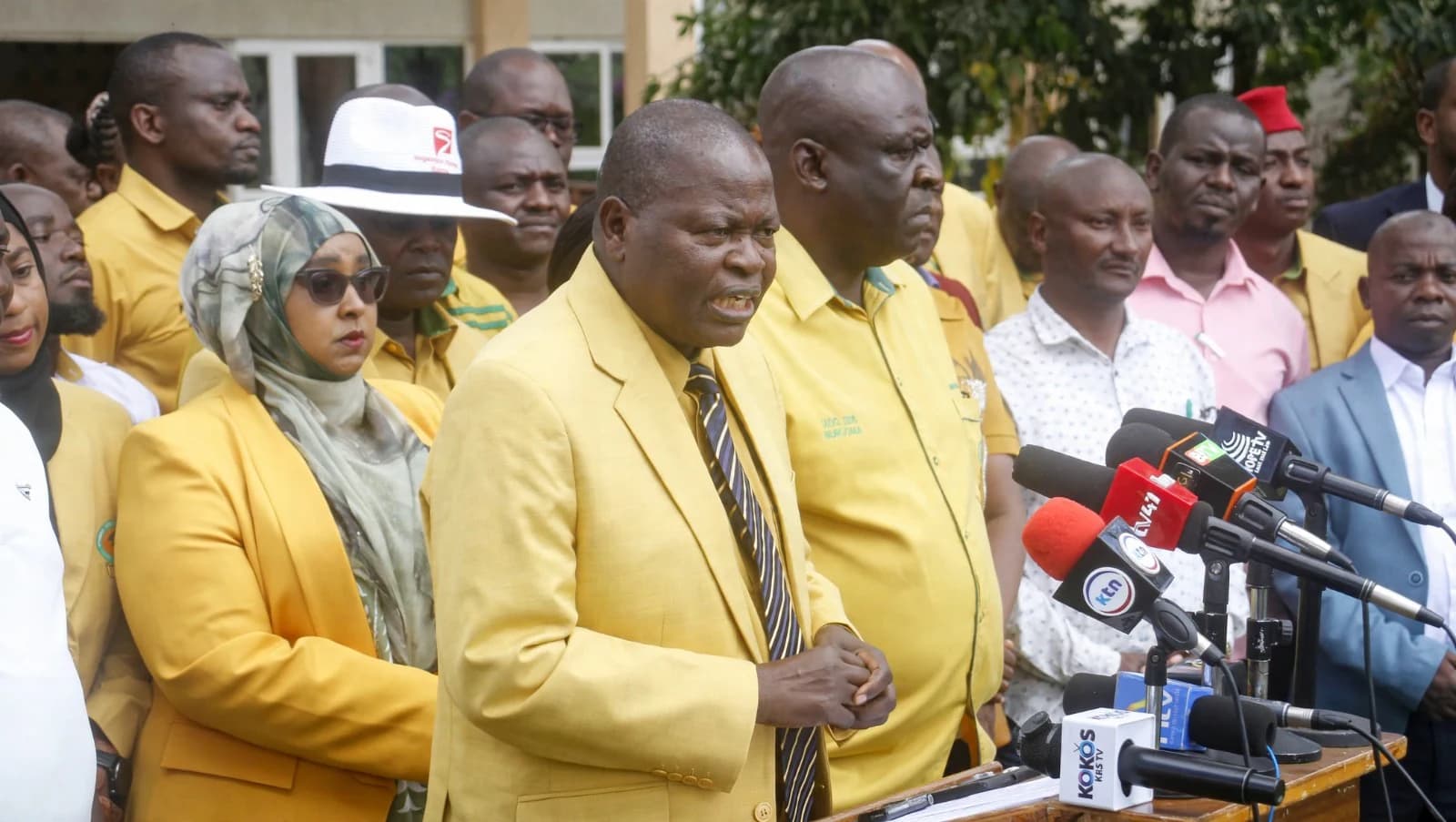







The Kenya Union of Post-Primary Education Teachers (KUPPET) wants the structure of Kenya's education system, from Early Childhood Development Education (ECDE) to senior school, firmly anchored in legislation. The union argues that this would protect institutions, teachers and learners from policy uncertainty, administrative interference and inconsistent government priorities.
At the centre of the union's position is the argument that education should not operate on ministerial circulars, policy declarations and administrative arrangements that can change whenever a new government takes office. Instead, KUPPET wants Parliament to set a clear legal framework defining the identity, management, financing, staffing and professional responsibilities of every level of basic education.
The debate has become important under the Competency-Based Education (CBE) reforms, which have introduced new institutional arrangements, learning pathways and demands for specialised teachers, infrastructure and learning resources. For KUPPET, creating new education levels without clearly defining their legal status, administrative independence and financial responsibilities risks institutional confusion that could undermine the reforms.
Ending the cycle of policy uncertainty
Kenya's education sector has seen repeated policy changes, restructuring and administrative adjustments. KUPPET's concern is that institutions should not have their operational identity decided mainly by changing government directives. Legal entrenchment, it argues, would give a more stable framework within which future governments must operate, since substantial changes would have to follow the legislative process and not be introduced through administrative instructions alone. That would offer greater continuity in education planning, teacher management, infrastructure development and resource allocation, and give parents, teachers and administrators a clearer understanding of each institution's responsibilities.
ECDE and primary education
ECDE occupies a critical position because it lays the foundation for later learning. KUPPET's concerns include preserving specialised teacher preparation and recognising the particular demands of early childhood education, since young children need age-appropriate teaching methods, learning materials, classrooms and professional support. The union has previously raised concerns over proposals that could merge ECDE and primary teacher training, arguing that early childhood education requires distinct professional preparation.
Legal recognition, it says, would define institutional responsibilities for ECDE, including teacher qualifications, curriculum implementation, infrastructure standards and financing. It would also clarify the respective roles of national and county governments, since counties have constitutional responsibility for pre-primary education, and would prevent ECDE from being treated as an extension of primary education without recognition of its distinct needs.
Primary education remains the main stage for building literacy, numeracy, communication, problem-solving and other foundational skills. KUPPET's argument is that primary schools should have clearly defined responsibilities, suitable management arrangements and predictable financial support. The move from primary to junior school has raised questions about administration, staffing, infrastructure and the use of shared facilities, and a clear legal framework would help separate the responsibilities of the two levels while allowing cooperation where facilities are shared. It would also help establish accountability for learning outcomes, teacher deployment, infrastructure and public spending.
Junior School at the centre of the controversy
Junior School (JS) has become one of the most contested parts of the CBE reforms. The central disagreement is whether JS should operate as an independent level with its own leadership and management structures or remain administratively integrated with primary schools.
KUPPET has advocated greater institutional autonomy for JS, arguing that its teachers, curriculum demands and professional responsibilities are closer to secondary education. The union questions whether a primary school headteacher should hold overall administrative authority over teachers deployed to teach at the junior level, and says JS needs clearly defined leadership, operational planning, accountability and professional supervision. The argument is not simply about the title of a school administrator. It concerns who makes decisions, who supervises teachers, who controls resources and who takes responsibility for learning outcomes. Where primary and junior schools share physical facilities, the law would need to set practical arrangements for managing them without unnecessary duplication, and independent recognition would help clarify the allocation of teachers, learning materials, infrastructure and operational resources.
Senior school pathways
Senior school adds another dimension, because learners are expected to pursue different pathways according to their interests, abilities and career goals. The three broad pathways under CBE need specialised teachers, equipment, infrastructure and planning. STEM education requires laboratories, workshops, ICT facilities and learning equipment; Social Sciences require suitable instructional resources, and Arts and Sports Science demand specialised facilities and opportunities for practical development.
KUPPET's concern is that these requirements should be reflected in a legal and administrative framework recognising the distinct responsibilities of senior schools. Without clear arrangements, schools could struggle to plan programmes, recruit or deploy specialised teachers and acquire the facilities needed to deliver the pathways effectively.
Teachers' professional identity and careers
Legal entrenchment also has implications for teachers' professional welfare. KUPPET wants reforms to recognise the different professional demands across ECDE, primary, junior and senior school, with clearly defined responsibilities, appropriate supervision and transparent career progression. The JS debate has exposed concerns about deployment, administrative authority and professional recognition, and a clear legal framework could help address disputes over deployment, promotion, supervision and leadership. Legal recognition, however, must come with matching human-resource policies and funding. It cannot by itself guarantee promotions, salary increases or additional teaching posts.
Funding: the most important test
One of the strongest arguments for statutory protection is financing. Each level has distinct financial requirements that cannot be met through a uniform approach. ECDE requires age-appropriate materials, suitable classrooms, sanitation facilities and trained teachers. Primary schools need classrooms, teaching personnel and resources for foundational learning. Junior schools need laboratories, workshops, ICT equipment, practical materials and enough teachers for the expanded curriculum, and senior schools need major investment in specialised facilities to support the pathways.
KUPPET's argument raises the question of whether the government should have clearly defined financial obligations towards every level of education. Legal entrenchment could set transparent funding responsibilities and accountability mechanisms, but declaring an institution legally recognised does not guarantee enough capitation. Parliament would still have to provide realistic budget allocations, and the government would have to release funds on time. The law must therefore go beyond recognition to address the financial obligations needed to make the reforms work.
Who is responsible when schools fail?
Where administrative boundaries are unclear, disputes can arise over staffing, infrastructure, supervision, expenditure and the delivery of education services. A comprehensive legal framework should state who manages each institution, who supervises teachers, who accounts for public funds and which agencies are responsible for infrastructure and quality assurance. It should also provide mechanisms for addressing institutional failure and ensuring that public resources reach their intended beneficiaries, which would strengthen accountability and reduce overlapping mandates.
KUPPET versus the integrated school model
The question has also exposed differing approaches within the sector. KUPPET's position on JS emphasises administrative independence and recognition of its secondary-level professional character. The integrated approach, associated with arguments for continuity between primary and junior education, favours shared management structures and coordination.
The disagreement goes beyond titles. It touches on the cost of running schools, the availability of infrastructure, teacher deployment, management efficiency and the quality of education delivered to learners. An independent JS structure could give clearer accountability but would require additional management arrangements and possibly higher costs. An integrated arrangement could promote resource sharing but would need safeguards to make sure junior school receives adequate attention, supervision and resources. Parliament must therefore weigh the practical implications of the competing models when deciding on the appropriate framework.
For legal entrenchment to achieve its purpose, legislation would need to clearly define ECDE, primary, junior and senior school as distinct levels with their own institutional mandates, and to establish suitable management and leadership structures, with coordination where facilities are shared. It would also need to protect teacher professionalism through clear provisions on qualifications, deployment, supervision and career progression, set transparent financing responsibilities including predictable capitation and infrastructure investment, and strengthen accountability by defining the responsibilities of national and county governments, education agencies and school managers.
KUPPET's call raises a fundamental question about the future of Kenya's education system: should the organisation and management of learning institutions depend largely on administrative decisions, or should Parliament set lasting legal protections defining their identity, responsibilities and financing? The debate matters beyond teachers and trade unions. It affects millions of learners, parents, taxpayers, county governments and the national government's constitutional obligation to provide education.
Kenya cannot successfully implement CBE by changing the names of school levels, introducing new pathways and deploying teachers without the institutional structures to support the reforms. It needs properly trained teachers, qualified institutional leaders, adequate classrooms, specialised facilities, predictable funding and clearly defined accountability. The real test of reform is not how many policies a government announces, but whether the institutions it creates are legally protected, adequately financed and able to deliver quality education long after the political leadership that introduced them has left office.



Reader Discussion (0)
Sign in to comment