
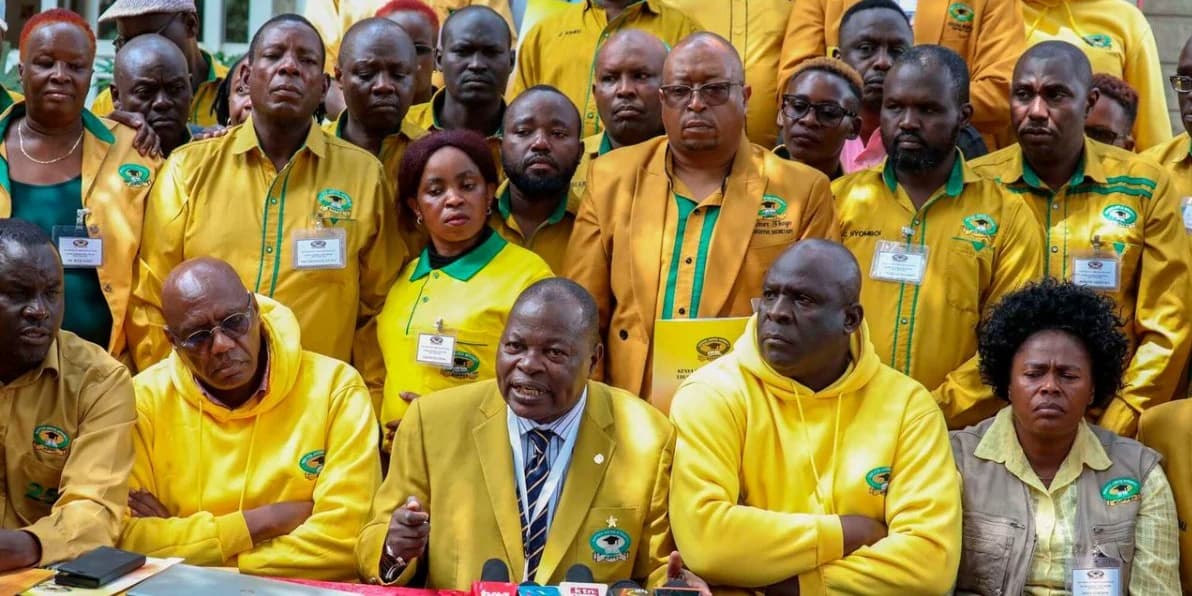








The threat by the Kenya Union of Post-Primary Education Teachers (KUPPET) to mobilise teachers for nationwide demonstrations in January 2027 over the administration of Junior Schools (JS) presents Kenya with an important moment of reflection. Beneath the threatened industrial action lies a fundamental question about professional recognition, institutional autonomy, administrative authority and the direction of education reforms.
The question is not simply whether teachers have a right to protest. They do. The more important question is whether the grievances advanced by KUPPET are substantive enough to justify nationwide industrial action, whether the proposed remedies are educationally sound and whether the government has shown a genuine willingness to address the concerns.
A mature assessment must distinguish between legitimate professional grievances and the politics of institutional control. It must also recognise that teachers can have genuine concerns even when their preferred solutions are not necessarily the most appropriate for the education system.
The grievances are not without merit
It would be intellectually dishonest to dismiss the concerns raised by JS teachers as mere trade union agitation.
JS occupies a distinctive position within Kenya's Competency-Based Education (CBE) framework. Its curriculum, pedagogical expectations, learning areas and assessment demands require an administrative structure capable of responding to its particular needs. Teachers handling Grades 7, 8 and 9 have legitimate reasons to seek professional recognition, clearly defined responsibilities, appropriate supervision and transparent career progression.
The controversy over their placement under primary school headteachers has consequently raised questions about professional identity and the extent to which specialised teaching responsibilities are adequately recognised. There are also broader concerns about employment security, internship arrangements, remuneration, promotion opportunities, teaching resources and the availability of appropriate infrastructure.
These matters cannot be dismissed as manufactured grievances. They directly affect teacher motivation, institutional stability and the quality of learning. However, acknowledging the legitimacy of these concerns does not automatically mean endorsing every demand advanced by the union.
Is administrative autonomy the real solution?
One of the most contentious issues is whether JS should operate independently or remain part of comprehensive institutions under a unified administrative structure. KUPPET favours greater institutional independence, while the Kenya National Union of Teachers (KNUT) has supported the comprehensive school arrangement.
The disagreement raises an important policy question: does educational specialisation necessarily require complete administrative separation?
Not necessarily. An institution can have distinct academic departments, specialised leadership responsibilities and clearly defined accountability structures without becoming a separate administrative establishment.
The government must therefore demonstrate that its comprehensive school model does not undermine the professional standing of JS teachers. Equally, KUPPET must demonstrate that independent administration would produce measurable improvements in curriculum implementation, teacher management, accountability and learner achievement. The debate should be informed by evidence rather than the institutional interests of competing organisations.
The danger of turning education reforms into a union power struggle
The disagreement between KNUT and KUPPET exposes a wider challenge in Kenya's education sector: the tendency to allow institutional interests to overshadow the national educational agenda.
Trade unions exist to protect their members, negotiate better working conditions and defend professional interests. They should perform these responsibilities without apology. However, trade union leadership also carries an obligation to appreciate the wider consequences of its decisions. Neither KNUT nor KUPPET should approach the future of JS as an opportunity to establish institutional superiority.
The Ministry of Education must similarly avoid treating support from one union as sufficient justification for imposing a contested policy on the entire teaching profession. Education reforms require intellectual maturity, professional consultation and an appreciation that different stakeholders can hold legitimate but competing positions. The country needs solutions, not institutional rivalries.
Teacher welfare must not be subordinated to administrative arrangements
An important weakness in the ongoing debate is the risk of concentrating excessively on who occupies the administrative office while overlooking the everyday challenges confronting teachers.
Whether JS operates independently or within comprehensive institutions, teachers still need predictable employment arrangements, competitive remuneration, adequate teaching materials, professional development and transparent promotion pathways. Administrative autonomy cannot substitute for improved working conditions. Similarly, a comprehensive school structure cannot succeed merely because it reduces administrative duplication.
The Teachers Service Commission (TSC) must provide clarity on teacher deployment, reporting relationships, professional development, promotion opportunities and the applicable employment arrangements.
The government must also understand that teachers are not merely instruments for implementing policy. They are central participants in the success or failure of education reforms, and a dissatisfied teaching workforce can undermine even the most carefully designed curriculum.
The case for a hybrid model and Solomonic wisdom
Kenya should resist the temptation to frame this controversy as a choice between total JS independence and unquestioning acceptance of the comprehensive school model. There is room for a more imaginative arrangement.
One proposal deserving professional examination would be to maintain shared institutional infrastructure and overall coordination while establishing clearly defined leadership and accountability structures for different educational sections. The possibility of stronger administrative differentiation between Grades 6 and 7, on one hand, and Grades 8 and 9, on the other, also deserves consideration. Such an arrangement could recognise the transitional character of the education system without creating an expensive proliferation of independent institutions.
A properly designed hybrid model could preserve shared facilities, institutional resources and coordinated management while giving JS teachers greater professional recognition and operational responsibility. However, any proposed arrangement must undergo educational, legal and financial evaluation before implementation. The objective should be to find a sustainable institutional framework rather than satisfy the competing ambitions of particular stakeholders.
The government must not confuse authority with consensus
President William Ruto's directive for the Ministry of Education to work with the Kenya Comprehensive Schools Heads Association (KECSHA) on proposals to amend the Basic Education Act provides an opportunity to resolve the controversy through legislation. However, legislative authority alone cannot guarantee successful implementation.
The Ministry must ensure that proposed amendments undergo meaningful public participation and professional scrutiny. Parliament must independently examine their implications rather than simply endorse executive preferences. KUPPET, KNUT, KECSHA, JS teachers, parents and education experts must be given an opportunity to articulate their positions.
The government should also publish the proposed administrative framework, explain its financial implications and demonstrate how it will improve educational outcomes. A reform that lacks professional acceptance risks generating resistance long after its formal adoption.
Is a nationwide strike justified?
The threat of January 2027 demonstrations should be taken seriously, but it should not be treated as an inevitable conclusion.
Industrial action is a legitimate labour instrument when negotiations fail and workers' grievances remain unresolved. Nevertheless, it should be approached as a measure of last resort, particularly in an education sector where interruptions directly affect learners. KUPPET must demonstrate that it has exhausted meaningful avenues of engagement and that the proposed action is proportionate to the grievances being advanced. The government must equally demonstrate that it is not using consultations to delay difficult decisions or silence professional dissent.
Both parties have responsibilities. The union must exercise restraint, while the government must demonstrate responsiveness. The greatest injustice would be to allow learners to become casualties of a disagreement that could be resolved through constructive negotiations.
The final test: whose interests does the reform serve?
Ultimately, the controversy should be judged against the fundamental purpose of education. Does the proposed structure improve teaching and learning? Does it protect professional dignity? Does it strengthen accountability? Does it make better use of public resources? Does it create an environment in which teachers can perform their responsibilities effectively? These are the questions that should determine the outcome.
The legitimacy of teachers' grievances should not be confused with the automatic legitimacy of every proposed remedy. Equally, the government's authority to organise public education should not be mistaken for proof that its preferred model is necessarily the best.
Kenya needs leadership capable of transcending institutional rivalries and embracing solutions that accommodate legitimate competing interests. KUPPET must demonstrate that its struggle is about professional dignity and educational quality, not merely administrative territory. KNUT must recognise that defending comprehensive schools should not mean disregarding the distinct concerns of JS teachers. The Ministry must provide leadership through evidence, consultation and sound policy.
The threatened JS strike raises genuine questions, but the ultimate measure of its legitimacy will be the substance of the grievances, the proportionality of the proposed action and the willingness of all parties to pursue solutions that serve the national interest.
January 2027 should not become a contest over who controls JS. It should become a turning point in the search for an education system that respects teachers, protects learners and places educational quality above institutional self-interest.


Reader Discussion (0)
Sign in to comment