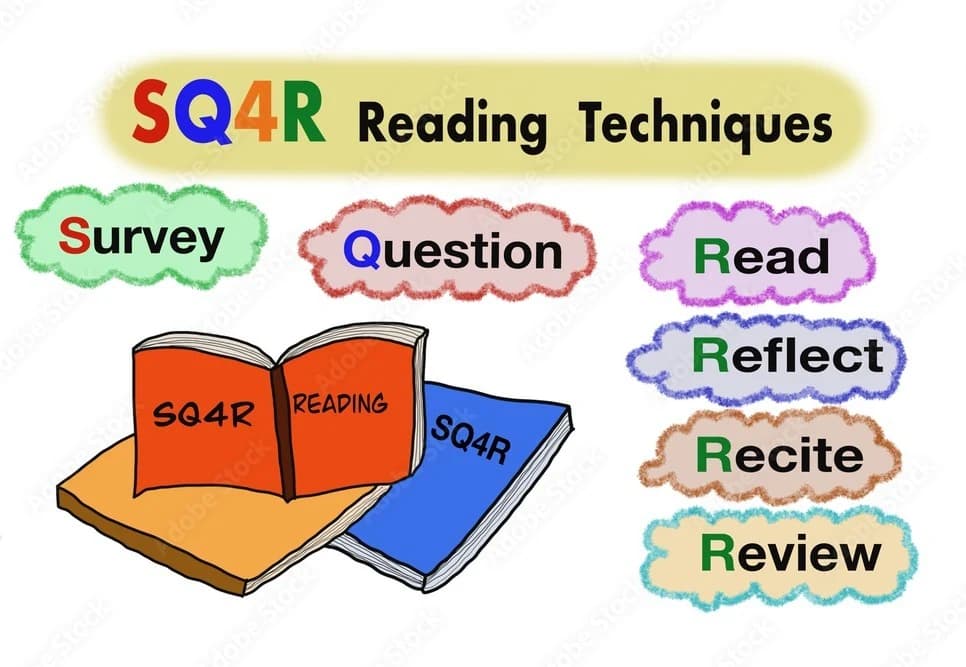
Surveying, questioning, reading, reflecting, reciting and reviewing (SQ4R) is a smart and systematic study strategy designed to improve understanding, concentration and memory. The provenance of the unique technique is attributed to Francis P. Robinson (1906-1983), an American educator and psychologist who spent several years teaching students how to get it right from textbooks. In 1946, he popularised this brilliant thought in a heroic book titled Effective Study. Therefore, learners can use SQ4R Study Strategy to pore over textbooks, revision books, reference books and set texts. How?
1. Surveying
Firstly, surveying means getting a general overview of the book before digging deep into it. What do you do? Spend a few minutes surveying the title and topic; strand or sub-strand. Survey headings and sub-headings. Survey introduction and conclusion. Survey words in bold, italics, or ones underlined. Survey diagrams, charts, tables and pictures. Survey summaries. Survey chapter objectives. Survey questions at the tail-end. Survey key words.
Advisedly, surveying helps learners to understand oeuvre of texts. Surveying activates previous knowledge. Surveying makes it easy to identify the theme – main idea. Surveying makes you to know what is expected while reading. Surveying creates a mental framework for new information. Surveying is reading actively, not passively. For instance, while reading about Photosynthesis in Biology, surveying reveals sections such as definition of photosynthesis, chloroplasts, light-dependent reactions, Calvin Cycle, factors affecting photosynthesis, et cetera.
2. Questioning
Secondly, after surveying, it’s imperative turning headings and subheadings into important points. How? You simply convert heading and subheadings into quality questions beginning with words such as what, why, how, when, where, who and which? For example, in Agriculture, a strand or sub-strand such as Soil Erosion, can lead to a question such as: What causes soil erosion? The purposes of questioning include: Giving readers real reasons for reading. They make reading become more active. They increase concentration and attention span. They point-out important information. They encourage critical thinking. They build massive powers of mastery and memory.
3. Reading
After careful questioning, it’s worth reading the text with military precision so as to ascertain answers to questions raised. How do you go about it? Read one section at a time. Search for the main idea. Identify supporting details. Find definitions and explanations. Look for relationships between ideas. Aptly, pay rapt attention to examples, evidences and diagrams. Try to answer your questions as you read avidly and actively.
More importantly, SQ4R Study Strategy does not mean simply reading the chapter for the umpteenth time. Instead, the focus should be on active and productive reading. Meaning, reading while interacting with the text. Reading while thinking, linking and looking for answers. This calls for wise use of reading skills such as text-marking or highlighting, text-annotation, note-making, colour-coding and use of reference materials. Reading this way, enhances deeper understanding of the subject and arrival on appropriate responses to questions. It’s also the best way of sieving information; separating maize from chaff. With that approach, the learner connects new knowledge with what is already known, prior knowledge.
4. Reflecting
Thirdly, reflecting is in the additional element that distinguishes SQ4R from the traditional SQ3R Study Strategy. Advisedly, after reading a certain text, the learner pauses to think deeply about the information. Therefore, reflection entails asking quality questions such as: What does this information mean? How does it relate to what I already know? Why is it important? Can I provide an example? How can I apply the information? How are the ideas related? What would happen in case the situation changed?
For example, in case the student learns in Agriculture or Geography that deforestation can increase soil erosion, instead of just memorising the information, the student ought to reflect: In case trees are cut, their roots no longer hold the soil together. Therefore, when it pours, the heavy rains can wash and sweep the exposed soil. In such a situation, the learner has connected the new information with a causal explanation. So, reflection is important because it promotes in-depth understanding, critical thinking, meaningful learning, connection with prior knowledge, application of knowledge, as well as long-term retention of information.
5. Reciting
Thirdly, reciting means recalling what you have learnt without referring to the source of knowledge – textbook. Somewhat, reciting is a self-testing technique used in building strong memories. Therefore, after reading, close the book or cover the notes. Then, ask yourself the questions you created. Rely on your memory to answer them. Explain the ideas by paraphrasing – explaining in your own words as you jot down important points.
Actually, recitation is important because of some real reasons. It helps in building strong memory. It assists in identification of glaring gaps in understanding. It prevents passive study, and enhances active and productive study. It’s useful in exam preparation. It encourages learners to explain concepts in their own words. For when you cannot explain it without looking at the book, then haply you have not understood it fully.
6. Reviewing
Consequently, reviewing means poring over the material again after studying. What is the best reviewing approach? After finishing the chapter, re-visit your questions. Try to answer the questions, again. Review your notes. Remember major concepts. Re-visit headings and summaries. Point-out portions that seem problematic. Test yourself instead of just re-reading.
Again, there is what is known as spaced review, which acknowledges: Reviewing should not happen only immediately after a particular study session. Instead, for its import and impact, review the material shortly after the study session. Then, do it the next day. Likewise, do it several days later. By the same token, do it after a week or more. Somehow, the exact schedule can vary depending on difficulty and importance of the material being studied. This is the best approach to dodge cramming, which is a bad study skill, method, habit or technique.
Victor Ochieng’ rolls out talks and training services in schools. He speaks to students about useful Study Strategies, Skills, Methods, Habits and Techniques. vochieng.90@gmail.com. 0704420232




Reader Discussion (0)
Sign in to comment