







The Kenya National Examinations Council (KNEC) has reminded candidates sitting the 2026 national examinations to observe examination regulations, warning that possession of prohibited materials could lead to serious consequences, including cancellation of results.
More than 3.6 million learners were registered for the Kenya Primary School Education Assessment (KPSEA), Kenya Junior School Education Assessment (KJSEA) and Kenya Certificate of Secondary Education (KCSE) examinations.
As the examination period continues, candidates have been urged to prepare adequately, follow examination procedures and carry only materials authorised for use in examination rooms.
Approved stationery and calculators
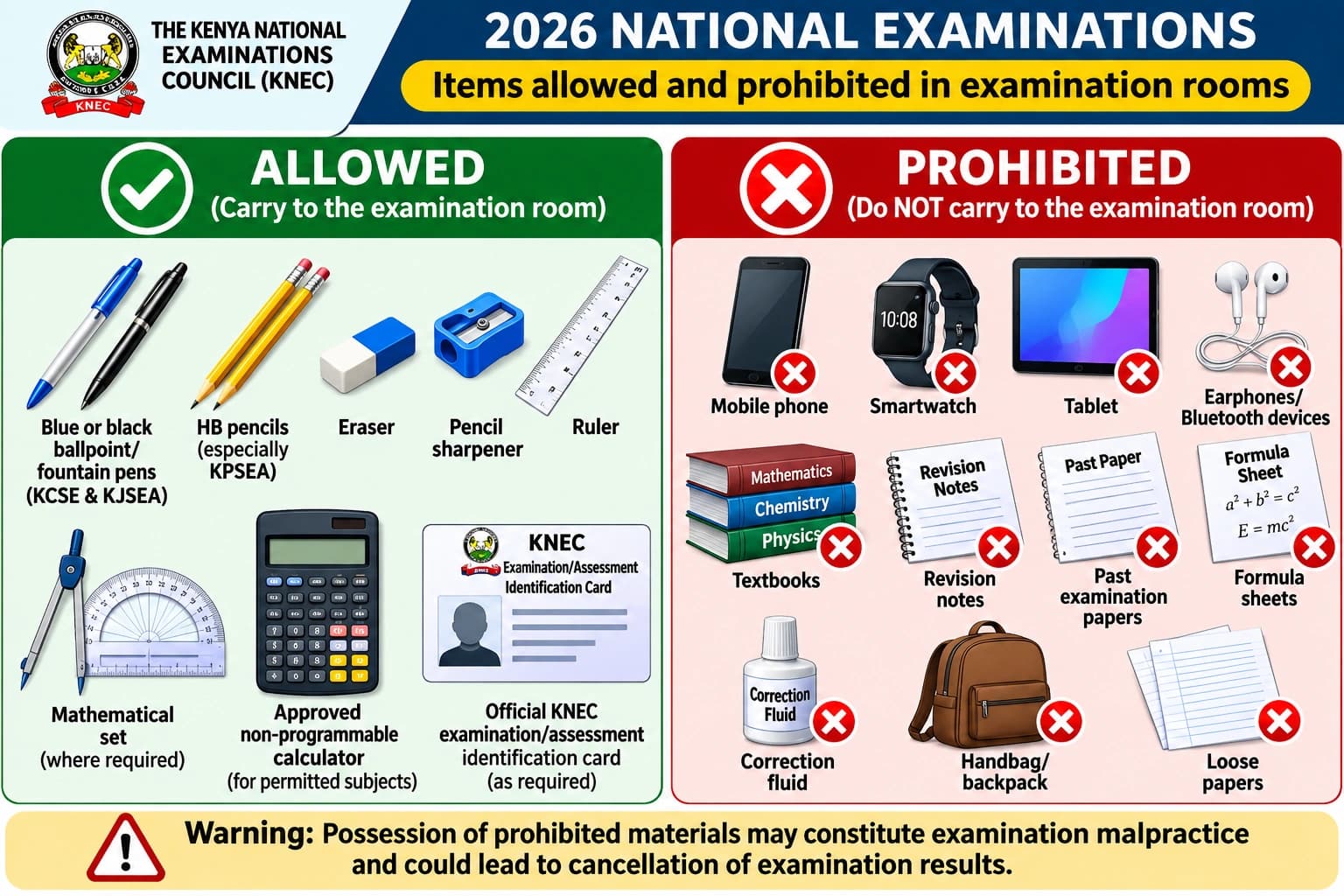
Grade 6 KPSEA candidates should use the writing materials specified in their assessment instructions, including HB pencils where required, alongside essential stationery such as erasers, pencil sharpeners and rulers.
For Grade 9 KJSEA and Form Four KCSE candidates, the appropriate writing materials should be determined by the instructions for each assessment or examination paper.
KCSE candidates are required to write their answers in blue or black ink, using ballpoint or fountain pens. Pencils should only be used for diagrams and other drawings where permitted.
Candidates should avoid erasable pens and unauthorised coloured inks, including red, green and purple, in their answer booklets.
They should also have the identification documents required for their respective examinations or assessments, as directed by their schools and examination officials.
Candidates sitting subjects that permit calculator use may bring approved non-programmable calculators.
For KCSE, calculator use is permitted in specified subjects, including Mathematics, Biology, Physics, Chemistry, Geography, Agriculture, Business Studies and selected technical subjects, unless the instructions on a particular paper prohibit their use.
Programmable calculators and devices capable of storing or communicating unauthorised information are prohibited.
Candidates should also avoid bringing calculator covers containing notes or other unauthorised information into examination rooms.
Sharing mathematical sets, calculators or other equipment during an examination is not permitted.
Prohibited materials and examination integrity
KNEC regulations prohibit candidates from possessing mobile phones and other unauthorised electronic communication devices in examination centres.
These include smartwatches, tablets, earphones, Bluetooth-enabled devices and other gadgets capable of facilitating unauthorised communication.
Candidates should leave handbags, backpacks and other personal belongings outside examination rooms in accordance with instructions issued by examination officials.
Textbooks, revision notes, past examination papers, unauthorised formula sheets, loose papers and correction fluid should not be taken into examination rooms.
Candidates must also ensure that their clothing, rulers, calculators and other belongings do not contain written information that could be used to gain an unfair advantage.
Possession of prohibited materials may constitute examination malpractice and result in penalties, including cancellation of results, depending on the nature of the irregularity and applicable regulations.
Candidates are therefore encouraged to organise their examination materials in advance to avoid last-minute confusion.
They should confirm that they have the required stationery and identification documents while leaving prohibited items at home or in designated areas outside examination rooms.
Reporting to examination centres early will allow sufficient time for security checks and other procedures before the start of each paper.
Candidates should also read the instructions on their question papers carefully and seek clarification from supervisors whenever they are uncertain about permitted materials.
As the 2026 national examination period continues, candidates, teachers and school administrators have a responsibility to safeguard the credibility of the assessment process.
Observing examination regulations is essential to ensuring fairness, transparency and equal treatment of all candidates.
Learners are encouraged to concentrate on answering their questions confidently while avoiding conduct that could compromise their examination results.



Reader Discussion (0)
Sign in to comment