




Every time someone opens a smartphone, enters a destination and follows directions to an unfamiliar location, they benefit from a scientific breakthrough shaped by a remarkable woman whose contribution went largely unrecognised for decades.
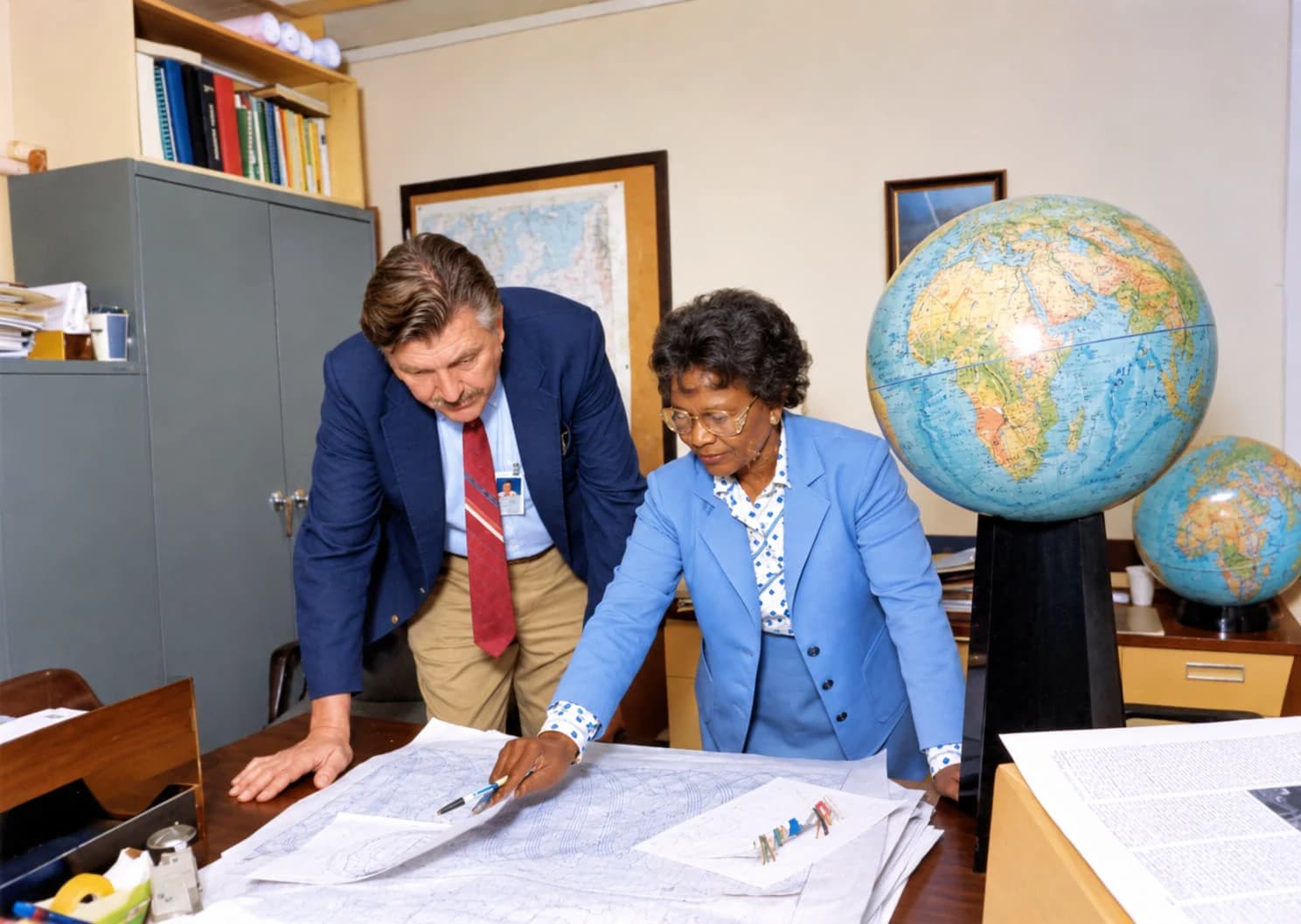
Dr Gladys West, the American mathematician whose groundbreaking calculations helped lay the mathematical foundations for modern Global Positioning System (GPS) technology, died on January 17, 2026, aged 95.
Her remarkable journey from a modest farming background in rural Virginia to becoming one of the most influential mathematicians in satellite navigation is a story of resilience, academic excellence and scientific achievement.
From tobacco fields to mathematical excellence
Born on October 27, 1930, in rural Virginia, West grew up in a farming family during an era when racial segregation severely restricted opportunities for Black Americans.
Her parents worked on a farm, and she understood the hardships of rural life from an early age.
As a young girl, she helped with farm work, including picking tobacco, but education offered her a possible escape from poverty and racial discrimination.
She developed an exceptional interest in mathematics and distinguished herself academically, eventually graduating as valedictorian of her high school class.
Her performance earned her a scholarship to Virginia State College, now Virginia State University, where she pursued mathematics and graduated in 1952.
She subsequently obtained a master's degree in mathematics in 1955.
In 1956, she joined the United States Naval Proving Ground in Dahlgren, Virginia, as a mathematician and computer programmer.
At a time when scientific institutions offered limited opportunities to Black women, West entered a highly technical environment where she would eventually make contributions with global consequences.
Her most significant contribution involved developing highly accurate mathematical models of Earth's shape.
Although Earth is commonly represented as a sphere, its actual shape is more complicated. It is slightly flattened at the poles and irregular because of variations in gravity, elevation and the distribution of mass across the planet.
Scientists require precise measurements of Earth's shape to calculate satellite positions and determine locations on its surface.
Working with complex mathematical equations, satellite observations and computer processing systems, West helped develop increasingly accurate models of the planet.
Her work contributed to the development of geodetic reference systems that underpin modern satellite navigation.
GPS depends on satellites transmitting signals that receivers use to calculate their positions. Accurate knowledge of Earth's shape and coordinate systems is essential in translating those calculations into reliable geographical locations.
The technology has since transformed transportation, aviation, shipping, agriculture, emergency response, military operations, telecommunications and everyday navigation.
From motorists finding unfamiliar streets to aircraft navigating across continents, satellite positioning has become an essential part of modern life.
West did not invent GPS itself, but her mathematical research helped establish the foundations for its accuracy.
Recognition after decades of scientific service
Despite the importance of her contribution, West remained largely unknown to the general public for much of her career.
Her work was conducted within a military research environment, where some projects and findings were classified.
For years, millions of people benefited from technological developments to which her calculations had contributed without knowing the mathematician behind them.
Her story eventually attracted wider public attention as her achievements became better documented.
In 2018, she was inducted into the United States Air Force Space and Missile Pioneers Hall of Fame in recognition of her contribution to satellite navigation.
In 2021, she received the Prince Philip Medal from the Royal Academy of Engineering, further cementing her place among influential figures in engineering and scientific history.
Her recognition represented more than an individual achievement. It also drew attention to women and minority scientists whose contributions had often been overlooked in traditionally male-dominated scientific institutions.
West spent 42 years working for the United States Navy before retiring in 1998.
However, retirement did not mark the end of her academic journey.
After experiencing two strokes, she continued pursuing education and earned a PhD in public administration and public affairs from Virginia Tech in 2000.
Her determination to continue studying despite serious health challenges demonstrated her lifelong commitment to learning and personal development.
At an age when many people would have considered their educational journey complete, West was still pursuing new academic milestones.
One of the most fascinating aspects of her life was her personal relationship with the technology she helped advance.
Despite contributing to the mathematical foundations of modern GPS navigation, she reportedly preferred traditional paper maps.
She appreciated being able to see the road, identify turns and understand the route herself rather than depending entirely on electronic directions.
It was an extraordinary contrast: the mathematician whose work helped millions navigate the world remained comfortable with traditional methods of finding her way.
A legacy that will continue guiding generations
West's death at the age of 95 brought to an end a remarkable life whose scientific contributions extend far beyond her lifetime.
Her journey carries a powerful message about the transformative role of education, particularly for children growing up in disadvantaged communities.
She was born into a farming family, worked in tobacco fields as a child and overcame racial and gender barriers to become a respected mathematician whose work helped shape technology used across the globe.
Her story also challenges the tendency to celebrate technological breakthroughs without recognising the scientists, researchers and mathematicians whose contributions make them possible.
For young learners, particularly girls pursuing science, technology, engineering and mathematics (STEM), her achievements demonstrate that talent, determination and access to education can overcome significant barriers.
Her life is also a reminder that academic excellence does not always lead to immediate public recognition.
Sometimes, the importance of scientific work becomes widely appreciated only decades after the research has been completed.
Today, GPS is woven into everyday life. It guides drivers, pilots, sailors, farmers, emergency responders and millions of smartphone users.
Behind that convenience lie decades of scientific research, mathematical precision and the dedication of people such as Dr Gladys West.
She may have preferred paper maps, but her calculations helped the modern world navigate with extraordinary precision.
Her name deserves to be remembered alongside the great minds whose work transformed human civilisation.
Rest in peace, Dr Gladys West. You helped the world find its way, and your legacy will continue guiding generations.

Reader Discussion (0)
Sign in to comment