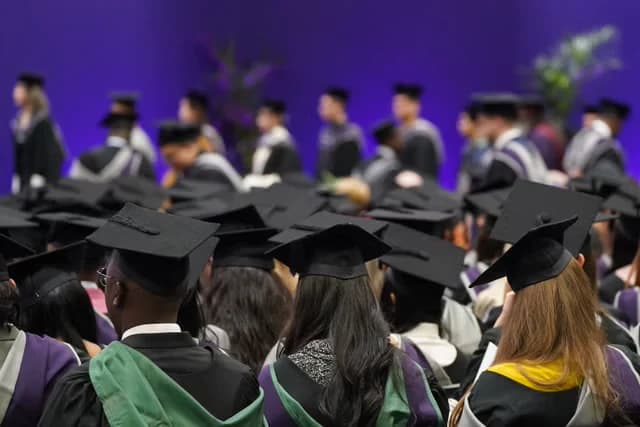








A new study in the United Kingdom has found that university courses relying heavily on coursework have recorded substantially higher increases in top grades than programmes assessed mainly through traditional examinations.
The research by the Higher Education Policy Institute (HEPI) examined changes in degree classifications between the 2014-2015 and 2024-2025 academic years, using data from the Higher Education Statistics Agency.
It found that about three-quarters of British university graduates received first-class or upper second-class honours in 2024-2025, compared with fewer than half three decades ago.
Combined and general studies recorded the largest increase in first-class honours, up 17 percentage points. The proportion of students obtaining either a first or an upper second rose by 33 percentage points.
In computing, first-class degrees rose by 12 percentage points and the combined share of firsts and upper seconds by 15 percentage points. Media, journalism and communications recorded increases of about 10 percentage points in both categories.
The picture was different in disciplines where examinations carry more weight. Medical sciences recorded an increase of just 0.2 percentage points in first-class awards, while the share receiving a first or an upper second fell by two percentage points. Mathematical sciences recorded increases of 1.6 percentage points in firsts and 1.4 percentage points in the combined category.
The study suggests that the type of assessment may be a significant contributor to grade inflation, rather than the traditional divide between science and arts disciplines.
The Office for Students, which regulates higher education in England, has expressed concern about the growing number of first-class degrees. It has warned that the increase cannot be fully explained by improvements in students' prior academic performance.


Reader Discussion (0)
Sign in to comment