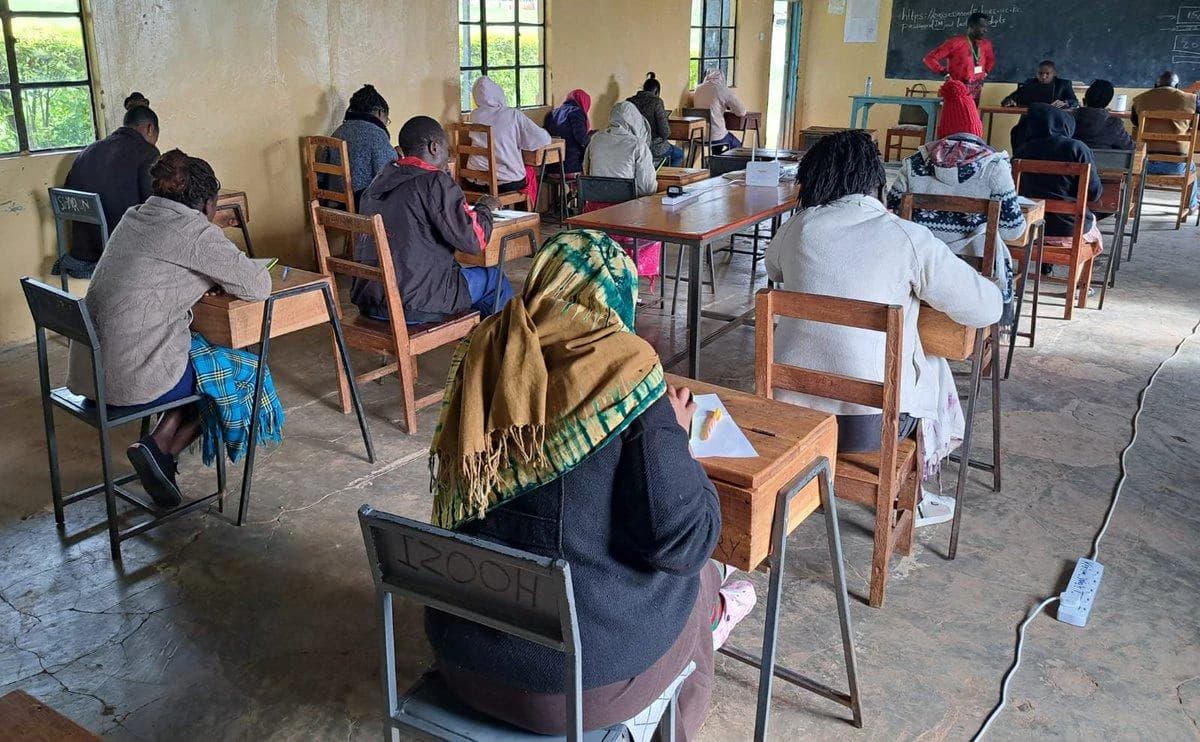









The release of teacher training examination results has exposed a striking performance gap among Kenya’s teacher training colleges, with hundreds of candidates referred for resits at several institutions and some colleges recording exceptionally high referral rates.
Results released by the Kenya National Examinations Council (KNEC) in October cover teacher education assessments and examinations undertaken by different cohorts in 2023 and 2025, including the Diploma in Primary Teacher Education (DPTE), Diploma in Secondary Teacher Education (DSTE), Diploma in Early Childhood Teacher Education (DECTE), Diploma in Teacher Education (DTE), Diploma in Special Needs Education (DSNE) Parts I and II, and Teacher Certificate in Adult Education (TCAE).
While the announcement offered relief to thousands of candidates who had waited for months, the figures emerging from individual colleges have raised fresh concerns about the quality of teacher preparation, the effectiveness of assessment systems and the support available to student teachers.
The results have also arrived at a critical moment, with the Teachers Service Commission (TSC) expected to undertake a major teacher recruitment exercise in November, creating urgency for successful candidates while leaving those referred to resit facing an uncertain path into employment.
Mosoriot, Kenyenya and other colleges record high referral rates
The performance figures reported by individual institutions reveal the extent of the challenge.
At Murang’a Teachers Training College, 782 candidates were assessed during the 2023/2024 academic year. Only six attained a Distinction, while 564 earned Credit and two obtained Pass. Another 210 were referred to resit one or more subjects.
Kenyenya TTC recorded no Distinctions among its candidates. Although 476 students attained Credit, 230 were referred, while approximately 18 received Course Requirement Not Met (CRNM), a classification whose implications depend on the applicable examination regulations.
The situation was particularly striking at Mosoriot TTC, where only 17 candidates were reported as being on course to graduate. Of the 944 candidates, 927 were referred for resits.
Asumbi TTC also recorded a substantial number of referrals. Of 750 registered candidates who sat the 2023 assessment, 12 attained Distinction, 88 scored Credit 1, 209 obtained Credit 2 and five earned Pass. A total of 422 were referred, while 14 candidates who were absent were graded Fail.
At St Mark’s Kigari TTC in Embu County, 11 candidates attained Distinction, 308 obtained Credit and 541 were referred.
Kitui TTC recorded one Distinction among 851 registered candidates. A further 567 obtained Credit and 11 scored Pass, while 263 were referred. Nine candidates received CRNM.
At Eregi TTC, no candidate attained Distinction. A total of 568 obtained Credit, while 256 were referred. Tambach TTC also reported 578 referrals, while Madonna TTC in Eldoret recorded 64 candidates referred in Mathematics alone.
These figures paint a troubling picture, although the reasons behind the outcomes cannot be established from the grades alone.
Some colleges post impressive results
The national picture is not uniformly bleak. Some institutions recorded strong performances, demonstrating that candidates can excel under the same broad assessment framework.
Mandera TTC reportedly had 610 candidates attain Distinction out of 639, with another 14 obtaining Credit. Bishop Mahon TTC recorded no referrals, while Moi TTC Baringo registered 252 Distinctions and 247 Credits, with only 14 candidates referred.
Neema Lutheran TTC also recorded encouraging results. Of its 132 candidates, 53 attained Distinction and 74 earned Credit. Three were referred, while two received CRNM.
The contrasting outcomes raise a fundamental question for KNEC and the Ministry of Education: why are some institutions producing overwhelmingly strong results while others have hundreds of candidates unable to complete the assessment successfully?
The answer requires more than assumptions about student discipline or the difficulty of national examinations. It calls for a systematic examination of teaching practices, institutional resources, candidate preparedness, assessment conditions and the consistency of implementation across colleges.
Assessment standards under scrutiny
One explanation advanced by some stakeholders is that KNEC's summative assessments are demanding, requiring candidates to demonstrate a deeper understanding of their subjects and professional competencies than they might be accustomed to in routine college examinations.
Unlike internal assessments, which are generally administered and marked within institutions, national examinations are externally controlled. Candidates therefore need broad subject mastery, consistent preparation and the ability to apply what they have learnt rather than rely on last-minute revision.
High standards are necessary in teacher education. Teachers are entrusted with developing learners' knowledge, skills, values and competencies, making rigorous professional preparation essential.
However, a demanding examination is only defensible when its standards are valid, transparent, consistently applied and aligned with the curriculum and competencies candidates are expected to acquire.
Mass referrals should not automatically be interpreted as evidence of improved quality. Equally, they should not be taken as proof that the examinations are unfair. The results must be examined alongside evidence about the assessment design, teaching conditions and candidates' performance throughout their training.
Student preparation also matters
The commitment of trainees is another factor that deserves attention.
Teacher education requires sustained engagement with coursework, practical teaching, assignments and revision. Candidates who miss classes, postpone preparation or underestimate the demands of external examinations risk entering the assessment without adequate mastery of the required competencies.
The strong results reported at Mandera TTC, Moi TTC Baringo and Bishop Mahon suggest that effective preparation can produce positive outcomes. However, their performance alone does not establish that candidates in poorly performing colleges were less committed.
Student responsibility must therefore be considered alongside the responsibility of tutors and institutions to provide effective instruction, timely feedback and appropriate academic support.
Teacher training colleges should identify struggling candidates early, provide remedial instruction and ensure that internal assessments accurately reflect the demands of national examinations. Waiting until the final assessment to discover widespread learning gaps is an expensive failure for both trainees and institutions.
E-assessment complaints require investigation
Concerns about the electronic assessment system have also emerged, with some candidates and stakeholders alleging that technical difficulties disrupted examinations.
If substantiated, such problems could raise serious questions about the fairness and reliability of the results.
An assessment system must provide stable access, clear instructions, adequate technical support and reliable recording of candidates' responses. Where technical interruptions occur, there should be a transparent process for documenting incidents, investigating complaints and determining whether affected candidates require corrective action.
KNEC should therefore establish whether reported technical problems occurred, how widespread they were and whether they materially affected candidates' ability to complete their examinations.
It would be premature to attribute the high referral rates to technical failures without evidence. Equally, dismissing complaints without investigation would undermine confidence in the assessment process.
What the grades mean for candidates
The results carry different consequences depending on the classification awarded.
A Distinction is the highest grade, followed by Credit, including Credit 1 and Credit 2, and Pass. Candidates referred to resit must clear the affected subjects or units before satisfying the qualification requirements.
CRNM, or Course Requirement Not Met, is a more serious outcome whose implications depend on the applicable examination and training regulations.
The implications are significant for trainees who have invested years in their education and expected to graduate alongside their classmates.
Candidates who have been referred should obtain an official breakdown of their results from their colleges, establish which units they need to repeat and seek clarification on the next assessment cycle.
Those who received CRNM should request written guidance on the specific requirements and procedures governing their cases.
Colleges should also provide academic counselling and emotional support. A disappointing result can be distressing, but affected candidates need clear information and a practical route to completing their training rather than stigma or discouragement.
November TSC recruitment adds urgency
The release of the results comes as TSC prepares for a major recruitment exercise expected in November, according to its chairperson, Dr Jamleck Muturi.
Successful candidates can now begin preparing their application documents, subject to the official recruitment requirements and deadlines. KNEC has advised candidates to obtain their results through their respective colleges, noting that results were issued to institutions that had fully cleared their examination-related payments.
Candidates should confirm with their colleges whether their results are available and obtain the relevant result slips. They should also monitor official TSC announcements to establish which qualifications and documents will be accepted for particular vacancies.
However, the timing presents a challenge for candidates referred to resit. Even where they are otherwise prepared for employment, outstanding examination requirements may prevent them from meeting the qualification criteria for recruitment.
The situation also affects teachers who sat Special Needs Education examinations in anticipation of career development or deployment to special schools and units. Their progression will depend on the qualifications they successfully complete and the applicable TSC requirements.
The Commission's recruitment plans should therefore be understood separately from examination outcomes: the release of results does not guarantee that every successful candidate will qualify for a vacancy or secure employment.
New teacher education structure signals a shift
The results have also emerged during a broader restructuring of teacher education following recommendations of the Presidential Working Party on Education Reforms.
A Ministry of Education circular dated January 19, 2026, attributed to Dr Julius Bitok, outlined changes affecting early childhood and primary teacher preparation.
The reforms replaced the separate Diploma in Early Childhood Teacher Education (DECTE) and its upgrading programme, UDECTE, with a unified Diploma in Teacher Education, Pre-Primary and Primary (DTE, PP & P) programme.
The new three-year course is designed to prepare teachers to handle learners from Pre-Primary 1 and Pre-Primary 2 through Grades 1 to 6, with a minimum KCSE mean grade of C (plain).
The directives included stopping new registrations under the standalone DECTE and UDECTE programmes, requiring full-time delivery of the new course and maintaining the suspension of school-based training modes. Education directors were also directed to ensure compliance by public and private institutions.
The unified qualification is intended to improve continuity between early childhood and primary education while widening graduates' potential employment options, subject to the requirements of county governments and TSC.
Candidates whose results have just been released largely belong to earlier training arrangements. Nevertheless, their experience highlights why reforms must address not only course structures but also instructional quality, assessment readiness and the capacity of colleges to prepare competent teachers.
KNEC and the Ministry must provide answers
The sharply contrasting results demand a coordinated response from KNEC, the Ministry of Education and teacher training institutions.
First, KNEC should explain the overall performance patterns, clarify the standards applied and publish a transparent analysis of referral rates across the affected programmes and colleges.
Second, any credible complaints about electronic assessment should be investigated, with findings communicated to affected candidates and institutions.
Third, colleges recording exceptionally high referral rates should undertake internal reviews covering tutor preparedness, curriculum coverage, practical training, access to digital resources and the effectiveness of continuous assessment.
Fourth, the Ministry should establish whether poorly performing institutions require targeted academic support, closer quality assurance or corrective measures to address persistent weaknesses.
Finally, candidates need clear information about resits, appeals where applicable, the treatment of technical incidents and the documentation required for graduation and employment.
The purpose of such a review should not be to lower examination standards to improve pass rates. It should be to establish whether the assessment accurately measures professional competence and whether every candidate has received a fair opportunity to acquire the knowledge and skills being tested.
The real test is the quality of teachers produced
The October results have delivered sharply different fortunes across Kenya's teacher training colleges. While some institutions have recorded impressive performances, the high referral figures at others raise questions that cannot be resolved by blaming students, defending examination standards or attributing everything to technology.
KNEC must protect the credibility of national assessment, colleges must take responsibility for the quality of instruction they provide, and trainees must approach their preparation with the seriousness their future profession demands.
As TSC prepares for recruitment and the Ministry implements a new teacher education structure, the central issue is not simply how many candidates pass or fail. It is whether the system consistently produces teachers who are competent, professionally prepared and ready to support learners under the Competency-Based Education framework.
A strong teacher education system must do more than produce impressive grades; it must guarantee credible assessments, effective preparation and competent teachers for every classroom.


Reader Discussion (0)
Sign in to comment