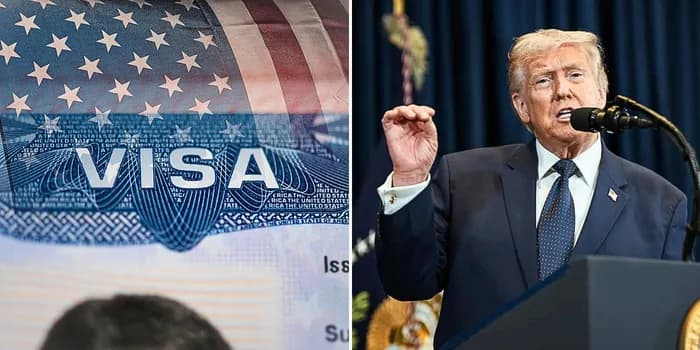






Kenyan students pursuing higher education in the United States have received a major reprieve after a federal judge struck down controversial visa restrictions proposed by President Donald Trump’s administration.
The ruling, delivered on Monday by US District Judge Dennis Saylor, blocked a policy that sought to impose stricter limits on how long international students and foreign journalists could remain in the country.
The decision offers relief to thousands of Kenyan students who could have faced uncertainty over their academic programmes and ability to complete their studies had the proposed regulations taken effect.
According to data from the Institute of International Education, 5,337 Kenyan students were enrolled in US colleges and universities during the 2024/25 academic year, making Kenya one of Africa’s leading sources of international students in the United States.
In his ruling, Judge Saylor described the proposed visa restrictions as "arbitrary, capricious, an abuse of discretion, and otherwise not in accordance with law".
He argued that the Department of Homeland Security (DHS) was seeking to discourage educational opportunities that Congress had intended to promote by allowing foreign students to study in the United States.
"Put bluntly, DHS is seeking to prevent or discourage the very activity providing educational opportunities for foreign students in the United States that Congress sought to permit and encourage," Saylor said.
Under the proposed regulations, foreign students would have been allowed to remain in the United States for a maximum of four years, after which they would have been required to apply for extensions.
Previously, international students could stay in the country for the duration of their academic programmes.
The restrictions would particularly have affected Kenyan students undertaking lengthy postgraduate courses, including PhD programmes, as well as those pursuing joint degrees or seeking to change their academic specialisations.
Judge Saylor warned that the proposed rules would interfere with students' ability to pursue extended academic programmes and make changes to their studies.
The ruling followed a lawsuit filed against the Department of Homeland Security by a coalition of organisations representing universities, teachers and journalists, challenging the legality of the proposed restrictions.
The Trump administration had initially planned to introduce the regulations in September but their implementation was temporarily halted by the court. The administration had already appealed the earlier decision.
The proposed policy also targeted foreign journalists, limiting their stays in the United States to 240 days, while Chinese journalists would have been restricted to 90 days. Both categories would have been required to seek extensions to remain longer.
The court ruling comes at a time when the United States and Britain are facing declining interest from international students amid tightening immigration and visa regulations.
The United States welcomed more than 1.1 million international students during the 2023/24 academic year, making it one of the world's leading destinations for higher education.
However, an increasing number of prospective international students are now considering universities in Asia and continental Europe as stricter visa policies reshape global education choices.
A global university survey released on Thursday showed that the United States and Britain recorded the sharpest declines in international undergraduate enrolments between October and August compared with the same period a year earlier.
The survey, conducted by Studyportals, NAFSA and Oxford Test of English across 437 universities in 63 countries, found that international undergraduate numbers fell by 13 per cent in the United States and 19 per cent in Britain.
Canada and Australia also experienced weaker demand, while universities in Asia and continental Europe reported stronger growth in international enrolments.
The findings point to shifting preferences among international students, with visa restrictions increasingly influencing decisions on where to pursue higher education.
International students are an important source of revenue for universities because they typically pay significantly higher tuition fees than domestic students. Their contributions help institutions finance teaching, research and other academic programmes.

Reader Discussion (0)
Sign in to comment