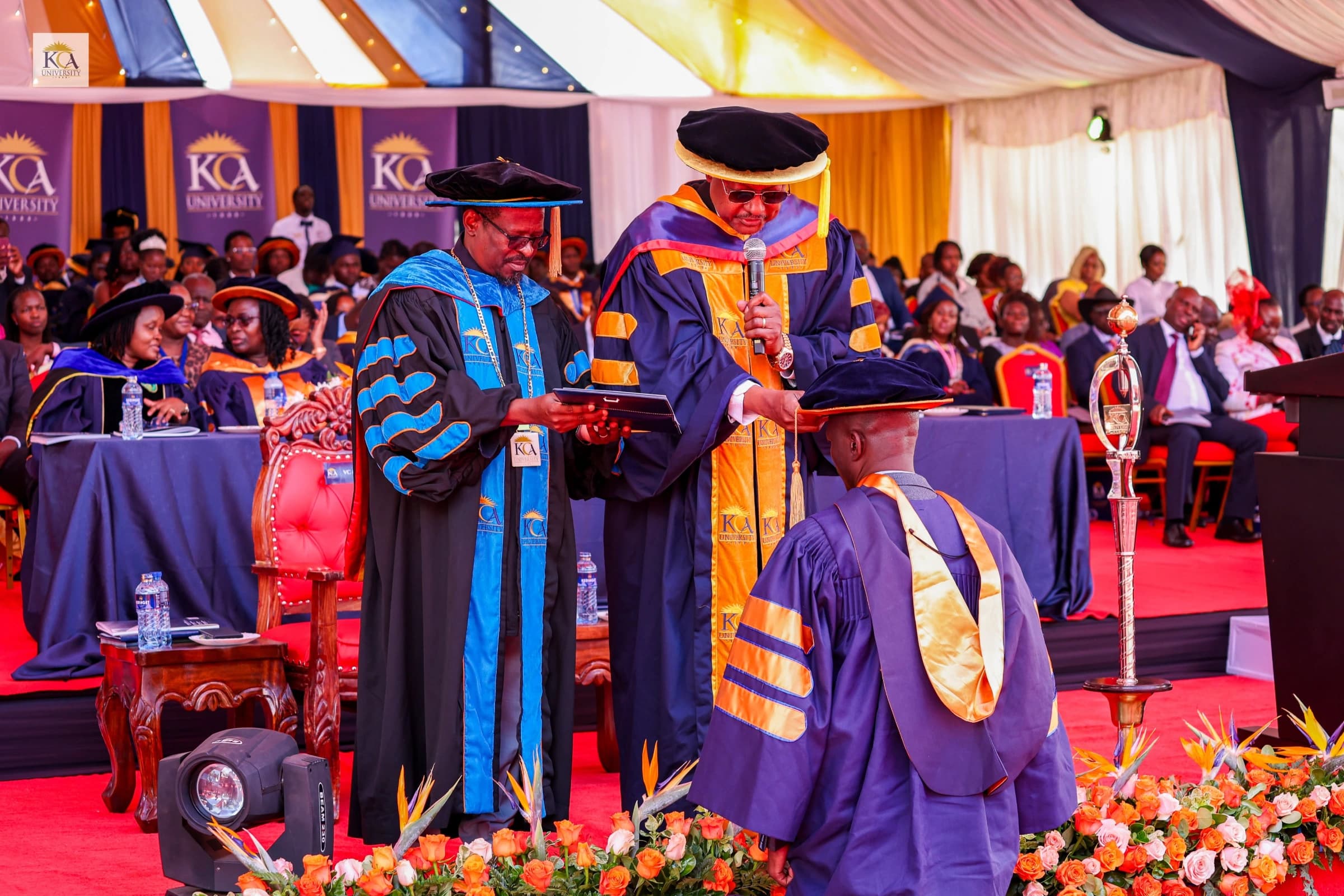



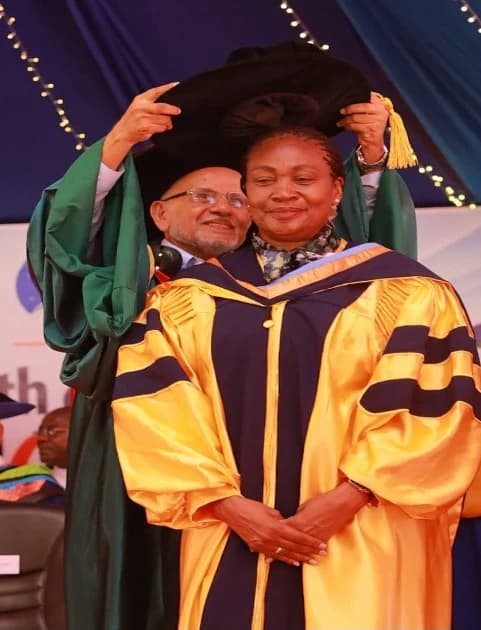




The ceremony, held on November 27, 2026, brought together university leaders, graduands, families, academics and other stakeholders to celebrate the achievements of students who successfully completed various academic programmes.
Beyond the impressive number of graduates, the occasion provided an opportunity to reflect on the university’s transformation, expanding academic mandate and growing contribution to Kenya’s human capital development.
It also demonstrated the institution’s determination to position itself within an increasingly competitive higher education environment where academic excellence must be accompanied by research, innovation, technological competence and practical problem-solving abilities.
One of the most outstanding highlights was the award of four Doctor of Philosophy (PhD) degrees in Finance, representing a notable achievement for the university’s postgraduate research agenda.
The doctoral research addressed emerging questions in Islamic banking, financial development, green finance, environmental sustainability and the relationship between capital investment and economic transformation in sub-Saharan Africa.
The achievement underscored the importance of universities moving beyond the conventional transmission of knowledge to become centres of intellectual inquiry, original research and solutions to contemporary development challenges.
Graduates challenged to develop homegrown solutions
The Chancellor, FCPA Dr Martin Oduor-Otieno, challenged graduates to recognise that their qualifications carried responsibilities extending beyond personal advancement.
He emphasised the need for African institutions and scholars to develop homegrown solutions to the continent’s challenges through research, innovation and informed leadership.
His message was particularly relevant at a time when technological disruption, artificial intelligence (AI) and changing employment patterns are redefining the skills required in the modern economy.
Graduates were encouraged to appreciate that academic qualifications alone would not guarantee professional success. The ability to exercise sound judgement, demonstrate integrity, think critically and adapt to emerging technologies would increasingly distinguish individuals in the workplace.
Vice-Chancellor and Chief Executive Officer (CEO) Prof Isaiah I.C. Wakindiki reinforced this message, urging graduates to concentrate on practical competencies and the capacity to translate academic knowledge into meaningful outcomes.
His remarks reflected a fundamental shift in the expectations placed on universities. Higher education institutions are increasingly being judged not merely by the number of students they enrol or graduate, but by the quality of professionals they produce, the research they undertake and the contribution they make to society.
The university’s growing engagement with professional institutions and international academic networks also featured prominently during the ceremony.
KCA University received recognition from the Kenya Accountants and Secretaries National Examinations Board (KASNEB) as a Centre of Excellence in September 2026, following strong performance by its students in professional examinations.
Prof Wakindiki also attained international recognition through his election to the Administrative Board of the International Association of Universities (IAU) for the 2026–2030 term, an achievement that strengthens the university’s visibility within global higher education leadership.
Another significant development is the institution’s pursuit of a PhD programme in Data Science through a partnership with the University of Calgary in Canada.
The proposed programme reflects the growing importance of data-driven decision-making, AI and advanced technological research in contemporary society.
Student innovation was equally celebrated, with Stephen Kamau Macharia receiving recognition after his AI-powered risk assessment innovation, Fortify AI, emerged second runner-up in the ISACA Kenya Digital Innovator of the Year 2026 competition.
His achievement demonstrated the potential of university education to nurture innovators capable of developing practical technological solutions to emerging industry challenges.
The university also highlighted its commitment to widening access to higher education through scholarship initiatives. Its annual cycling initiative has raised more than Sh24.8 million, supporting 42 scholarships.
Eleven members of the November 2026 graduating cohort benefited from donor-supported scholarships.
Such initiatives demonstrate the importance of partnerships, philanthropy and institutional responsibility in ensuring that financial limitations do not unnecessarily prevent deserving students from pursuing higher education.
From a professional accountancy college to a growing university
KCA University’s present achievements are rooted in a history that began in 1989, when the Institute of Certified Public Accountants of Kenya (ICPAK) established the Kenya College of Accountancy to strengthen professional training and address the country’s shortage of qualified accountants.
Starting with approximately 170 students, the institution gradually expanded its academic programmes, professional training opportunities and partnerships.
Its transformation into a university marked a significant departure from its original specialist mandate. In 2007, it received a Letter of Interim Authority and began operating as KCA University. It subsequently received its university charter on March 1, 2013.
The transition opened a new chapter in its development, enabling it to broaden its academic offerings beyond accountancy and financial management into business, technology, education, arts and social sciences, alongside postgraduate studies and research.
The institution’s journey illustrates how a specialised professional training institution can progressively develop into a university with a wider responsibility for knowledge creation, professional development and national transformation.
The bigger question: What does Kenya expect from its graduates?
The graduation of 3,994 students comes at a time when Kenya’s higher education sector is under increasing pressure to demonstrate its relevance to the country’s economic and social development priorities.
The traditional assumption that a university certificate automatically guarantees employment is increasingly being challenged by changing labour market demands, technological advancement and the growing importance of entrepreneurship.
Universities must, therefore, prepare students to become more than job seekers. They must nurture innovators, researchers, ethical professionals, employers and problem-solvers capable of creating opportunities within their communities and beyond.
The growing prominence of AI makes this responsibility even more urgent. While technology is transforming professional practice, graduates must develop the human capabilities that give knowledge meaning: creativity, critical thinking, ethical judgement, communication, leadership and the ability to respond intelligently to unfamiliar challenges.
Equally important is the need to strengthen the relationship between university research and the country’s development priorities.
Academic research must increasingly find expression in industries, public institutions, businesses and communities where its impact can be experienced.
KCA University’s 21st graduation ceremony, consequently, represents more than the awarding of academic qualifications. It is a celebration of institutional evolution, individual achievement and the continuing responsibility of higher education to prepare society for the future.
As the 3,994 graduates embark on different professional and entrepreneurial journeys, their success will ultimately be measured not only by the certificates they carry, but also by the ideas they generate, the problems they solve, the institutions they strengthen and the lives they transform.
For KCA University, the milestone offers both an opportunity to celebrate its progress and a renewed obligation to pursue academic distinction, research excellence and innovation.
The next chapter will be defined by how effectively the institution converts its growing academic capacity into knowledge, opportunities and solutions that advance Kenya and the wider African continent.
Reader Discussion (0)
Sign in to comment