- The closure of three Kitui schools should prompt deeper questions about why learners are disappearing from classrooms.
- Hillary Muhalya argues that authorities must investigate hunger, poverty, attendance and demographic pressures before closing schools.
- He says Kenya must move beyond expanding access and place greater emphasis on learner retention and completion.
The closure of three schools in Kitui County because of critically low learner enrolment should not be viewed merely as an administrative decision. It is a warning signal about a deeper challenge confronting Kenya’s education system: what happens when children gradually disappear from classrooms?
County Director of Education Khalif Hassan Isaack, speaking to the media in his Kitui office, confirmed that education authorities had closed Munyange Secondary School and withdrawn its principal and teachers. He also confirmed the closure of Manooni and Soma primary schools in Katulani because of inadequate learner numbers.
It is important, however, to distinguish between confirming the closures and personally ordering them. The available report establishes that Isaack announced and explained the closures as County Director of Education; it does not establish that he personally issued the formal closure orders.
Isaack further warned that other schools across the county could face a similar fate if declining enrolment and poor attendance persist. Mbusyani Secondary School, for instance, was identified as one of the institutions facing possible closure because it reportedly had no learners, with plans to withdraw its principal and transfer teachers elsewhere.
The developments raise fundamental questions about learner retention, school attendance, poverty, hunger, demographic changes, education financing and the efficient utilisation of public resources.
A school cannot remain indefinitely viable when its classrooms are virtually empty. Teachers have to be deployed where they are needed, public funds must be used responsibly and educational infrastructure must serve learners. But closing schools should not become the first response to declining enrolment.
It should be the last stage of a deeper investigation into why children are no longer enrolling, attending or remaining in school.
In some communities, declining enrolment may be linked to population movements and demographic changes. In others, poverty, hunger, child labour, household responsibilities, teenage pregnancy, insecurity, long distances to school and other social pressures may be pushing children out of education.
There is also a crucial distinction between low enrolment and poor attendance. A school may have children registered on its books but still have largely empty classrooms because learners attend irregularly. Kenya therefore needs to look beyond enrolment statistics and establish whether children are actually participating consistently in education.
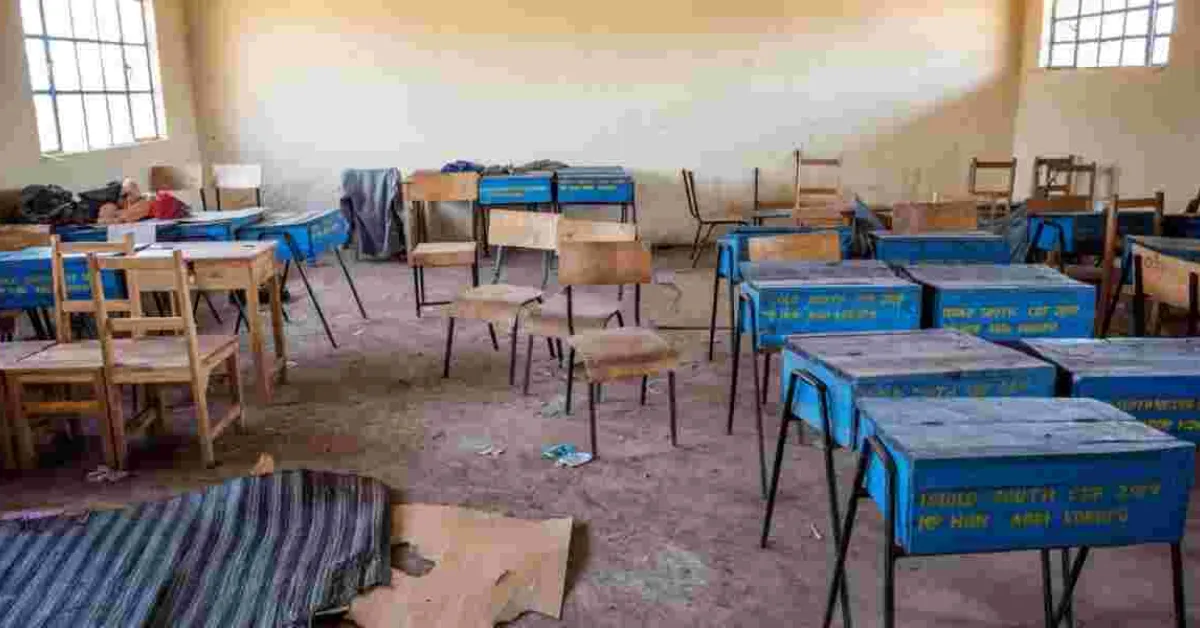
The empty classroom is a national warning
When a classroom falls silent, the consequences extend far beyond the school compound.
Teachers may be transferred, school leadership positions withdrawn and government resources redirected. Infrastructure such as classrooms, laboratories, sanitation facilities, libraries and other facilities can become underutilised despite having been constructed with public money.
That represents a potential wastage of investment.
Kenya has invested heavily in expanding education infrastructure, recruiting teachers and increasing access to schooling. But infrastructure alone cannot guarantee educational participation.
The next frontier must be retention.
Parents and communities have a critical role to play. Education cannot be left entirely to teachers and government officials. Parents must ensure that children attend school consistently, while community leaders, Boards of Management and teachers should identify learners who have dropped out and develop mechanisms for bringing them back.
A child who begins missing classes repeatedly should not simply disappear from the school’s radar.
Early intervention can prevent eventual dropout.
Hunger can empty a classroom
Isaack’s call for schools to introduce feeding programmes for day scholars deserves serious attention.
For vulnerable learners, hunger can directly affect attendance, concentration and retention. A child who leaves home without food may find it difficult to remain attentive throughout the school day. In households facing severe economic hardship, school attendance can even compete with the immediate need for food.
Providing a meal at school should therefore not be dismissed as merely a welfare intervention.
It can be an education-retention strategy.
Schools, government, communities and development partners should explore sustainable feeding mechanisms, particularly in areas where hunger is a major contributor to absenteeism.
Even targeted interventions can make a difference when directed towards schools and communities facing the greatest vulnerability.
Education funding must recognise real school costs
Declining enrolment also exposes an important issue concerning education financing.
As Isaack observed, low enrolment can affect government capitation because allocations are largely linked to the number of learners enrolled. This creates a difficult situation for small and vulnerable schools.
A school with 50 learners still needs functioning classrooms, sanitation, administration, electricity, maintenance and other basic services. Many of these are fixed costs that do not disappear simply because enrolment has fallen.
Kenya should therefore examine whether its education financing model sufficiently protects schools serving sparsely populated or economically disadvantaged communities.
A funding formula that recognises both learner numbers and minimum institutional operating costs could help prevent vulnerable schools from entering a downward spiral in which declining enrolment produces reduced funding, reduced services and eventually even lower enrolment.
School closure must be strategic
Where closure becomes unavoidable, the process must be carefully managed.
Authorities should establish why enrolment has declined, whether learners can be brought back, whether neighbouring schools have sufficient capacity, how far children would have to travel and whether the proposed transfer arrangements will protect their right to education.
School closures should never leave children stranded.
Where appropriate, merging nearby institutions could provide an opportunity to consolidate teachers and resources while creating better-equipped learning environments. But such decisions must be based on reliable data and meaningful consultation rather than simply the number of learners appearing on a register.
The voices of parents and communities must also be heard.
School quality can help keep children in class
The learning environment itself matters.
The implementation of the learning-hours guidelines reiterated by Education Cabinet Secretary Julius Ogamba should be seen within the broader objective of improving learner retention. Schools need sufficient instructional time while also giving learners opportunities for co-curricular activities, recreation and holistic development.
A school must be more than a building where children sit for lessons.
It must be an environment where learners feel safe, valued, nourished and motivated to attend.
That requires effective school leadership, committed teachers, clean and healthy facilities, adequate learning materials, child protection, meaningful co-curricular activities and strong relationships between schools and communities.
From school access to school retention
Kenya’s education conversation has traditionally focused heavily on access—constructing classrooms, recruiting teachers and increasing opportunities for children to enrol.
The Kitui experience demonstrates that the next frontier must be retention.
Getting a child into school is only the beginning. The real success of the education system lies in ensuring that the child remains there, participates meaningfully, completes the education cycle and acquires the competencies needed for adult life.
The closure of a school should therefore never be treated simply as an administrative statistic.
It should be a national warning bell.
Before another school closes its gates, Kenya should ask: Where have the children gone? Why did they leave? What can be done to bring them back?
The answers may reveal that the problem is not the school itself, but the economic, social and environmental conditions surrounding it.
Kenya must therefore shift from simply counting schools and enrolments to measuring attendance, retention, completion and learning outcomes.
READ ALSO:
Because an empty classroom is not just an empty room.
It is a warning that somewhere, a child may be losing a pathway to a better future.
By Hillary Muhalya
Get more stories from our website: Education News
To write to us or offer feedback, you can reach us at: editor@educationnews.co.ke
You can also follow our social media pages on Twitter: Education News KE and Facebook: Education News Newspaper for timely updates.
>>> Click here to stay up-to-date with trending regional stories