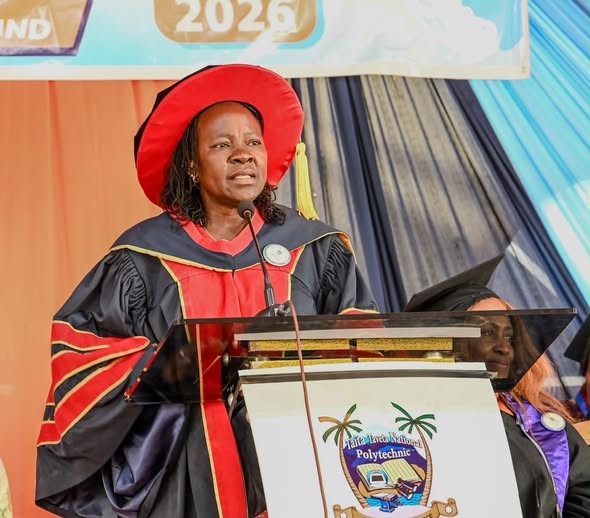
- Muoria said the future of technical education lies in hands-on practical training rather than theory-based classroom learning.
- Muoria called on TVET institutions to tie their programs more closely to industry needs through the dual training mode
The government has signalled a major shift in technical and vocational education, with Principal Secretary (PS) for Technical and Vocational Education and Training Dr. Esther Thaara Muoria declaring that TVET institutions should stop investing in conventional classrooms and instead convert them into workshops and laboratories.
Speaking during the second graduation ceremony of Taita Taveta National Polytechnic (TTNP) on Friday, Dr. Muoria said the future of technical education lies in hands-on practical training rather than theory-based classroom learning.
“We don’t need classrooms in TVET anymore. Any young person walking through the gates should go to a workshop or a laboratory. All those classrooms should become laboratories and workshops to train these young people practically,” PS Muoria said.
Her remarks came after the Polytechnic’s management appealed for support to address inadequate workshops and laboratories, a shortage of trainers, and limited student accommodation.
Turning to the broader question of educational outcomes, the PS said Kenya could no longer afford to churn out graduates without evaluating what their training actually achieves.
“We cannot continue doing things the same way and expect different results. We cannot continue training young people and graduating them without asking ourselves what the outcome of that training is,” she said.
She called on TVET institutions to tie their programs more closely to industry needs through the dual training model, under which students split their time between classroom instruction and workplace attachment. In her view, the country’s ability to attract investment hinges directly on the strength of its skilled workforce. “If education is the key to development, then TVET is the master key. Investors will only come when we demonstrate that Kenya has enough skilled manpower to run their industries,” she said.
ALSO READ:
Government enlists NGAO officers to drive grassroots campaigns toward 2 million TVET enrollment
Taita Taveta National Polytechnic, she noted, has emerged as the country’s best-performing institution in dual training, a distinction she said underscores the value of industry-led skills development. She further disclosed that international recruiters who recently visited the Polytechnic selected 74 graduates for overseas employment, describing such recruitment drives as a useful gauge of whether TVET institutions are producing graduates who can compete globally.
Dr. Muoria also pushed institutions to go beyond producing workers for outside industries and instead build income-generating enterprises within their own campuses that double as training grounds for students. “We not only want industries outside our institutions; we must also create industries within TVETs so that students learn by producing,” she said, commending TTNP for operations that include a water bottling plant, a bakery, a driving school and catering services, as well as plans to register its automotive workshop as a government vehicle service garage.
On infrastructure, the PS pledged to support the Polytechnic’s request for additional student hostels by engaging her counterpart at the State Department for Housing to have the institution included in upcoming affordable housing projects. She also addressed concerns over student funding, saying the government was actively reviewing ways to ease the burden following discussions chaired by President William Ruto. “It pains us when students are unable to remain in training because of funding challenges. We are actively looking at practical solutions to improve the situation,” she said.
On staffing shortages raised by the institution, Dr. Muoria directed the Polytechnic’s management to submit details of trainer gaps in specific disciplines for consideration by her ministry.
Speaking earlier at the same event, TTNP Governing Council Chairperson Esther Kalunda Ndile said the institution continues to grapple with shortages of trainers, workshops and laboratories despite its strong national standing. She noted that the Polytechnic was ranked ninth nationally in the latest performance contracting evaluation and has remained among Kenya’s top ten TVET institutions for the second consecutive year.
ALSO READ:
Parliament seeks to cap Senior School admissions ahead of 2027 Grade 9 transition
Principal Show F. Kalama said the institution has distinguished itself in dual training, gemology, green energy and competency-based education, but said additional investment in practical learning facilities is needed to keep pace with growing enrolment.
A total of 1,780 graduands received certificates and diplomas in various technical disciplines at the ceremony, held under the theme, Global Sustainable Development Through Skilled and Innovative Graduates.
By Michael Oduor
You can also follow our social media pages on Twitter: Education News KE and Facebook: Education News Newspaper for timely updates.
>>> Click here to stay up-to-date with trending regional stories
>>> Click here to read more informed opinions on the country’s education landscape