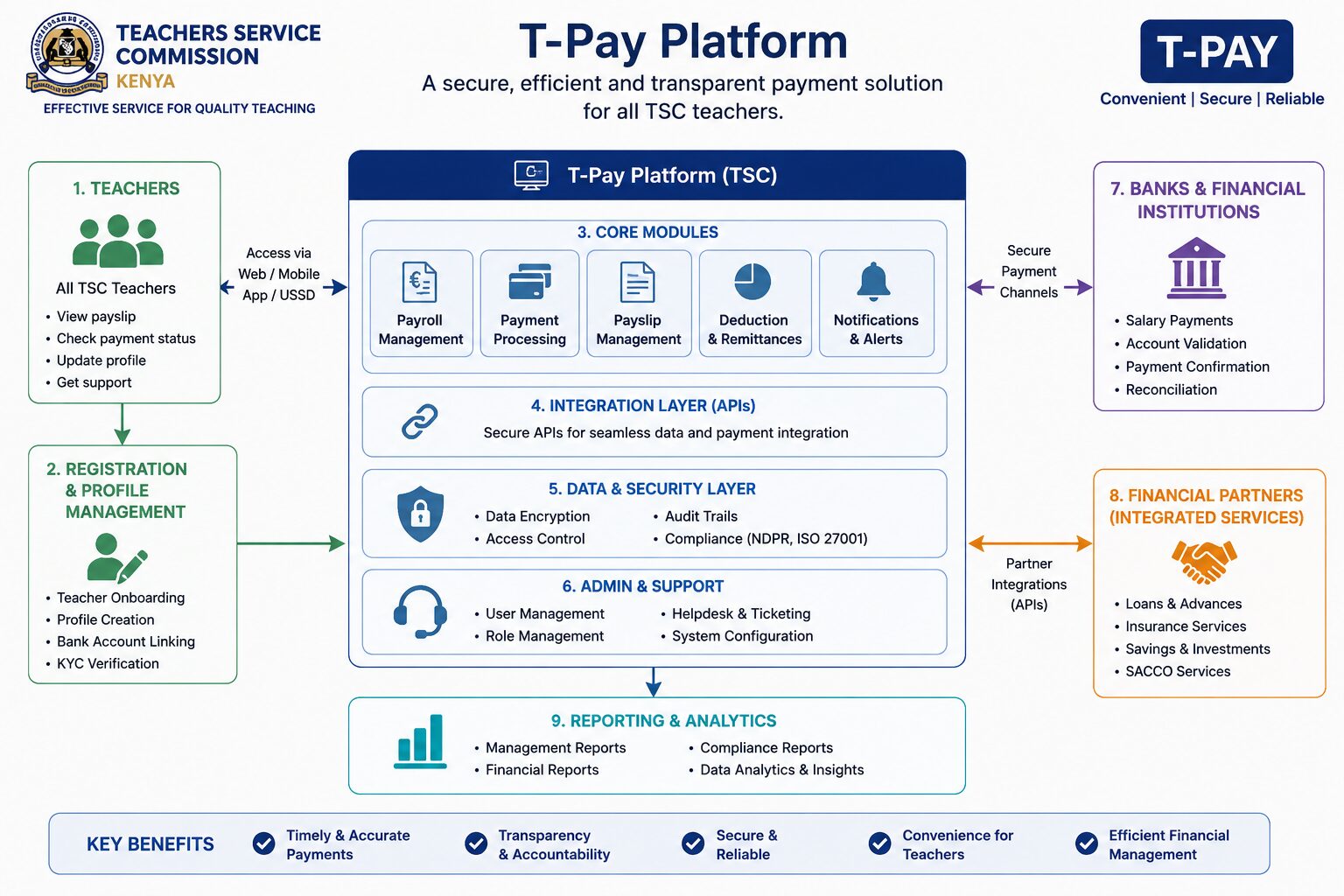
- The Teachers Service Commission has introduced a digital Control Sheet that makes school heads the first point of payroll verification.
- Heads of Institution will now be required to verify every teacher’s employment status before salaries are processed.
- The reforms are expected to improve payroll accuracy, strengthen accountability and reduce salary errors.
The Teachers Service Commission (TSC) is implementing one of the most significant reforms to teachers’ payroll management in recent years by introducing a digital Control Sheet within the T-Pay platform that shifts the first stage of payroll verification from the Commission’s headquarters to individual schools.
The new system places Heads of Institution (HOIs) at the centre of payroll accountability, making them responsible for verifying the employment status of every teacher before salary information is processed.
The reforms are designed to strengthen payroll integrity, improve data accuracy, eliminate salary anomalies and curb fraudulent payments by ensuring that employment records are verified where teachers actually work.
If successfully implemented, the initiative is expected to reduce cases of overpayments, underpayments, delayed salaries and payroll errors that have occasionally affected teachers across the country.
Under the enhanced T-Pay system, every Head of Institution is required to access the digital Control Sheet dashboard and verify every teacher attached to the institution.
Each member of staff must be declared under the appropriate category, including Correct, Incorrect, Passing or Not Declared.
Where a teacher is missing from the school register, the Head of Institution must search for the teacher using the TSC number and indicate the reason for the omission, such as Transfer In, Transfer Out, return from leave or any other recognised administrative circumstance.
New accountability measures
Unlike previous payroll procedures, the declaration process carries significant administrative responsibility.
Before the Control Sheet can be submitted, the Head of Institution must formally certify that all information entered is accurate and truthful.
This declaration makes school heads directly accountable for the accuracy of payroll information originating from their institutions.
The Commission has also introduced mandatory nationwide training for Heads of Institution to familiarise them with the new procedures.
The training covers use of the Control Sheet dashboard, staff declaration requirements, handling of missing staff records, payroll verification procedures and the responsibilities attached to certifying payroll information.
Benefits for teachers
The reforms mark a major shift in the way TSC manages teachers’ payroll.
Rather than depending almost entirely on centralised verification, the Commission is adopting a decentralised approach in which schools become the first point of payroll validation.
The expectation is that employment records maintained at the institution will provide a more accurate reflection of the actual staffing situation than records updated later through administrative channels.
For teachers, the changes are expected to reduce payroll discrepancies arising from outdated records, delayed transfers or administrative omissions.
Salary processing is also expected to become more efficient because discrepancies can be identified and corrected before payroll is finalised.
Teachers are advised to log into their T-Pay accounts regularly and verify that their TSC number, identification details, names, bank details and current duty station are correctly reflected.
Any discrepancies should be reported promptly through the appropriate administrative channels before payroll processing begins.
Teachers who have recently been transferred, promoted, deployed to new institutions or resumed duty after leave are particularly encouraged to communicate with their Heads of Institution to ensure their records are updated without delay.
Strengthening payroll integrity
One of the most discussed features of the reforms is the handling of teachers who appear as “Missing” within the Control Sheet.
Such cases may occur where transfer records have not yet been finalised or employment details are still being updated.
Under the new framework, the receiving or releasing institution is expected to indicate the appropriate status, enabling TSC to reconcile payroll records with the teacher’s actual deployment.
Although some educators have expressed concern about the additional administrative responsibility placed on schools, the reforms operate within established TSC procedures supported by digital audit trails, official employment records and existing complaint mechanisms.
The new system is intended to strengthen accountability rather than create unchecked authority.
Every declaration submitted electronically can be traced to the responsible officer, reinforcing the need for accuracy, professionalism and compliance with TSC regulations.
The reforms also encourage stronger record management within schools.
Heads of Institution are expected to maintain up-to-date staff registers, verify reporting dates, retain copies of transfer and deployment letters and ensure new teachers are promptly captured in institutional records.
Likewise, teachers are encouraged to retain appointment letters, promotion documents, deployment letters and leave approvals to support future administrative reviews.
Ultimately, the success of the Control Sheet will depend on collaboration between TSC, Heads of Institution and teachers.
School administrators must verify records carefully and submit accurate declarations, while teachers must remain actively engaged in confirming that their employment information is current and complete.
If implemented effectively, the enhanced T-Pay Control Sheet has the potential to modernise payroll management across Kenya’s education sector by improving transparency, strengthening accountability and ensuring salaries are processed using verified information from individual schools.
READ ALSO: Shock as Govt names only universities cleared to train Kenya’s future lawyers
The reforms represent a significant step in TSC’s broader digital transformation agenda and reinforce the importance of accurate records, prompt communication and professional administration in ensuring timely salary payments.
By Hillary Muhalya
You can also follow our social media pages on Twitter: Education News KE and Facebook: Education News Newspaper for timely updates.
>>> Click here to stay up-to-date with trending regional stories
>>> Click here to read more informed opinions on the country’s education landscape