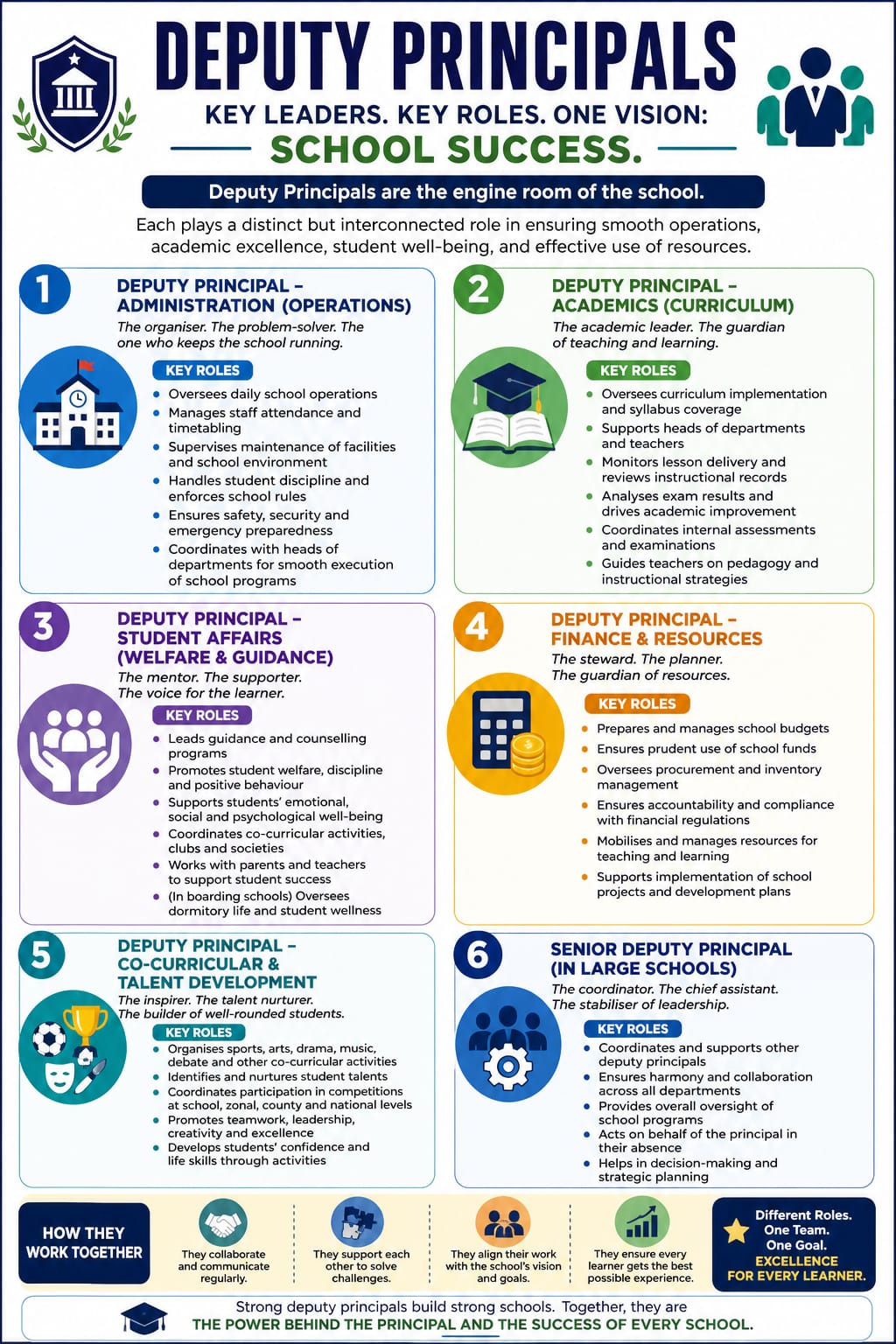
In the complex and ever-evolving environment of modern schools, leadership cannot be left to a single individual. The principal may be the head, the symbol, and the ultimate authority, but deputy principals often sustain the day-to-day heartbeat of a school. These individuals are not mere assistants; they are strategic leaders entrusted with specific domains that collectively determine an institution’s success or failure. It is within this “engine room” of leadership that the real work of translating vision into reality takes place, making deputy principals the unseen force powering school success.
At the core of school administration lies the Deputy Principal in charge of operations, often referred to as the administrative deputy. This is the individual who ensures that the school runs like a well-oiled machine. From the moment the gates open in the morning to the last bell in the evening, this deputy is deeply involved in coordinating activities that keep the institution functional. They oversee staff attendance, ensuring that teachers report on time and fulfill their duties. They handle timetabling, which is no small task, especially in schools with large student populations and limited teaching staff. Every lesson must fit into a structured schedule, and any disruption—such as a teacher’s absence—must be swiftly managed.
Beyond that, they supervise the maintenance of school facilities, ensuring classrooms, laboratories, and sanitation areas remain usable and safe. Discipline, a cornerstone of any learning environment, often falls squarely under this deputy’s jurisdiction. They are tasked with enforcing school rules, addressing cases of indiscipline, and maintaining order within the institution. This role demands firmness, fairness, and a deep understanding of adolescent behaviour. It is not simply about punishment but about creating a structured environment where students understand boundaries and expectations. In many schools, this deputy becomes the immediate problem-solver when crises arise—be it student unrest, logistical breakdowns, or emergencies requiring swift intervention.
ALSO READ:
Govt plans to double teacher promotions from July, says PS Bitok
Parallel to the administrative function is the Deputy Principal in charge of academics, a role that directly influences the intellectual output of the school. If the administrative deputy ensures that the school runs, the academic deputy ensures that it achieves its primary mission: teaching and learning. This individual is the guardian of curriculum implementation, working closely with heads of departments to ensure that subjects are taught effectively and syllabi are completed on time. In Kenya, curriculum guidelines are shaped by the Kenya Institute of Curriculum Development, and it is the responsibility of the academic deputy to ensure that these guidelines are faithfully executed within the school.
The academic deputy monitors lesson delivery, often reviewing professional records such as schemes of work, lesson plans, and students’ exercise books. They analyze examination results, identifying strengths and weaknesses across subjects and classes. When performance dips, they initiate interventions—be it remedial teaching, teacher mentorship, or adjustments in instructional strategies. Their role is deeply analytical, requiring not only an understanding of pedagogy but also the ability to interpret data and translate it into actionable strategies. They are, in many ways, the academic compass of the school, constantly steering it toward excellence.
Equally critical is the Deputy Principal in charge of student affairs, whose focus extends beyond books and classrooms to the holistic development of learners. Education is not merely about passing examinations; it is about shaping character, nurturing talents, and supporting emotional well-being. This deputy oversees guidance and counselling programs, addressing issues such as peer pressure, mental health, and career choices. They work closely with teachers, parents, and sometimes external professionals to ensure that students receive the support they need to thrive.
In boarding schools, the responsibilities of this deputy become even more extensive. They may oversee dormitory life, ensuring that students are safe, comfortable, and adhering to routines that promote discipline and well-being. They also coordinate co-curricular activities, recognizing that sports, music, drama, and clubs play a vital role in developing well-rounded individuals. Through these programs, students learn teamwork, leadership, and resilience—skills that cannot be fully cultivated within the confines of a classroom.
In larger schools, financial management becomes too significant a responsibility to be handled solely by the principal, leading to the emergence of a Deputy Principal in charge of finance and resources. This role demands a high level of integrity and accountability, as it involves managing school funds, overseeing procurement processes, and ensuring that resources are utilized effectively. The deputy works within established regulations, often guided by frameworks set by institutions such as the Teachers Service Commission and the Ministry of Education.
ALSO READ:
Budgeting is a central function of this role. The deputy must allocate funds to various departments, balancing competing needs while ensuring that the school’s priorities are met. They oversee procurement, ensuring that goods and services are acquired transparently and cost-effectively. They also manage inventories, keeping track of textbooks, laboratory equipment, and other resources essential for teaching and learning. In many ways, this deputy acts as the financial steward of the school, ensuring sustainability and preventing mismanagement.
Another emerging category, particularly in institutions that emphasize holistic education, is the Deputy Principal in charge of co-curricular activities and talent development. This role recognizes that academic success alone is not sufficient in preparing students for the demands of the modern world. The deputy organizes sports programs, coordinates clubs and societies, and facilitates participation in competitions at various levels. They identify and nurture talents, providing students with opportunities to excel in areas such as athletics, music, drama, and debate.
This role requires energy, creativity, and a passion for youth development. It involves liaising with external bodies, organizing events, and ensuring that students are exposed to platforms where they can showcase their abilities. In doing so, the deputy contributes to building confidence and self-esteem among learners, qualities that are essential for success beyond school.
In very large or complex institutions, the structure may include a Senior Deputy Principal, a role that sits just below the principal and above other deputies. This individual acts as the chief coordinator, ensuring that all departments function in harmony. They provide oversight, mediate conflicts, and step in fully when the principal is absent. Their role requires a broad understanding of all aspects of school management, as well as strong leadership and decision-making skills.
ALSO READ:
Bomet KUPPET official slams TSC internship policy, demands confirmation of 44,000 teachers
What makes the system of deputy principals effective is not merely the existence of these roles but the deliberate structuring and operationalization of these offices. Putting these offices in place is what makes administration effective in large institutions. Without clearly defined and functional deputy principal roles, leadership becomes centralized, strained, and often ineffective. Large schools, by their very nature, require distributed leadership where responsibilities are shared, specialized, and executed with precision.
However, a hard truth is emerging across many institutions: even where schools have four or more deputy principals, some principals have failed to utilize them effectively. The problem is not structural—it is perceptual. Some principals, unfortunately, view their deputies not as partners in leadership, but as potential competitors. This mindset quietly cripples the very system designed to support them.
When deputies are seen through the lens of suspicion rather than collaboration, trust breaks down. Responsibilities are withheld, decisions are centralized, and initiative is stifled. Deputies become spectators instead of drivers of progress. A school may have a full complement of highly qualified deputy principals, yet still struggle with inefficiency, poor performance, and internal tension simply because leadership is not being shared.
This fear of “competition” is often misplaced. Leadership in schools is not a zero-sum game where one person’s influence diminishes another’s. On the contrary, effective principals understand that empowering their deputies strengthens the entire institution and, ultimately, reinforces their own leadership. A confident principal builds leaders; an insecure one suppresses them—and pays the price through burnout and declining results.
When deputies are underutilized, several consequences quickly surface. Decision-making slows down because everything must pass through one office. Staff morale drops because capable leaders are not trusted with responsibility. Innovation declines because deputies are not given space to think, propose, and implement new ideas. Most critically, students suffer because the school is not operating at its full leadership capacity.
On the other hand, when principals shift perspective and begin to see deputies as allies rather than rivals, transformation is often immediate. The administrative deputy streamlines operations, the academic deputy drives performance, the student affairs deputy strengthens discipline and welfare, and the finance deputy ensures resources are effectively managed. The principal is then freed to focus on strategic direction, external relations, and long-term planning rather than being trapped in daily operational overload.
This is where effective delegation becomes not just a management tool, but a leadership philosophy. Delegation is not about offloading work; it is about distributing leadership. It requires clarity of roles, mutual respect, and accountability. When done well, it creates a system where every leader operates at their highest level of competence.
A school is an ecosystem where different elements influence one another. Discipline affects academic performance; student welfare impacts behaviour and concentration; resource management determines the availability of teaching materials. No single leader, regardless of experience or competence, can efficiently manage all these aspects alone. It is the establishment of these deputy principal offices—and the trust placed in them—that ensures balance, efficiency, and sustained progress.
In conclusion, deputy principals are not just support staff to the principal; they are the operational backbone of the institution. Each type—whether focused on administration, academics, student affairs, finance, or co-curricular activities—plays a distinct yet interconnected role in ensuring that the institution operates effectively. Together, they form a leadership team that balances structure with flexibility, discipline with support, and academic rigour with holistic development.
The modern school demands leadership that is distributed, specialized, and collaborative. Having multiple deputy principals is not enough—the real difference lies in how they are perceived and utilized. A principal who sees deputies as competitors builds walls; one who sees them as partners builds systems. And in education, it is systems—not individuals—that sustain excellence.
By Hillary Muhalya
You can also follow our social media pages on Twitter: Education News KE and Facebook: Education News Newspaper for timely updates.
>>> Click here to stay up-to-date with trending regional stories
>>> Click here to read more informed opinions on the country’s education landscape