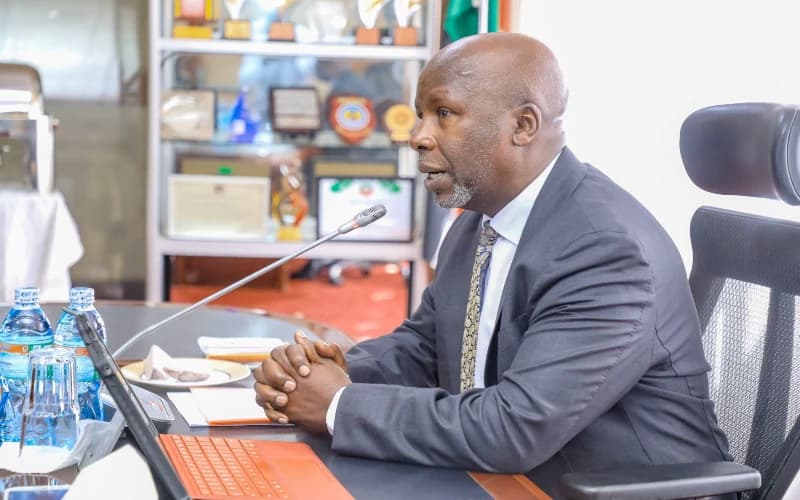
Outgoing Public Service Commission (PSC) chairman Anthony Muchiri has reignited debate over the quality of higher education in Kenya after claiming that some holders of doctoral degrees struggle to demonstrate the knowledge and reasoning expected of highly qualified professionals.
Muchiri, who is leaving office after serving as PSC chairman, made the remarks while reflecting on his experience interviewing candidates for public service positions. He said he had encountered individuals whose academic documents appeared authentic but whose responses raised questions about their understanding of the subjects they had studied.
"We, unfortunately, have a lot of PhD holders in Kenya with empty heads," Muchiri said, according to remarks circulated in a report attributed to Opera News. He questioned whether some candidates were genuinely knowledgeable or had merely passed examinations without developing the depth of understanding expected of doctoral graduates.
His comments have drawn mixed reactions. While some Kenyans agree that the pursuit of academic certificates can overshadow practical competence, others argue that his language unfairly generalises about scholars and risks undermining confidence in universities without sufficient evidence.
Is Muchiri's Criticism Justified?
Muchiri's remarks place universities under scrutiny, but his reported interview experiences alone cannot establish that doctoral graduates generally lack knowledge or that the institutions awarding their degrees are failing. A candidate's poor performance in an interview may reflect limited preparation, communication difficulties or gaps in particular areas of knowledge, and does not automatically prove that the candidate holds a fraudulent qualification or that the awarding university has compromised its standards. Universities should, however, not be shielded from scrutiny where credible evidence points to weaknesses in research supervision, examination procedures or academic quality assurance. Determining whether a wider problem exists requires evidence from academic audits, accreditation assessments, research evaluations, investigations into examination malpractice and graduate performance, since questioning individual competence is not the same as proving institutional failure.
At the heart of the controversy is whether academic qualifications are being given greater weight than the ability to apply knowledge. A PhD ordinarily requires advanced study, independent research, rigorous examination and an original contribution to knowledge, with its credibility depending on the quality of the research, the integrity of the examination process and the standards maintained by the awarding institution. However, academic achievement does not automatically guarantee leadership ability, sound judgement or effectiveness in every professional role, just as practical experience cannot always replace the specialised knowledge required in fields such as medicine, engineering, research and education. In public service, where recruitment decisions affect institutional performance and service delivery, employers must assess candidates against the actual demands of their positions rather than relying solely on certificates or the prestige of academic titles, using structured interviews, practical assessments, professional portfolios and evidence of previous performance to establish whether candidates can translate their training into results.
Are Universities Protecting the Value of Degrees?
The debate also raises questions about the expansion of postgraduate education and the responsibility of universities to maintain rigorous academic standards. Concerns about plagiarism, examination malpractice, inadequate research supervision and the commercialisation of postgraduate programmes deserve investigation wherever credible evidence exists, as compromised standards could affect the value of qualifications and public confidence in universities. Universities must ensure that postgraduate students demonstrate mastery of their disciplines, use sound research methods, produce credible work and defend their findings under independent academic scrutiny, while regulators must enforce accreditation requirements and investigate substantiated complaints.
The debate extends beyond doctoral degrees to Kenya's education system, from early childhood education to postgraduate studies. An excessive emphasis on examination scores can encourage learners to memorise information and pursue grades without developing sufficient understanding, curiosity or problem-solving abilities.
The Competency-Based Education (CBE) framework seeks to promote the application of knowledge, practical skills, values and competencies, with its success depending on effective implementation, adequate learning resources, teacher preparation and assessments that reward understanding rather than memorisation alone. Universities must build on these foundations by nurturing critical thinking, independent inquiry, research integrity and the ability to apply knowledge to real-world challenges.
Muchiri's observations have opened an important conversation, but their broader implications remain a question for evidence-based investigation. His reported experiences may point to shortcomings in how some candidates demonstrate their knowledge, but they do not independently establish the prevalence of weak doctoral scholarship, fraudulent qualifications or declining university standards in Kenya. A meaningful assessment would require systematic evidence on postgraduate programme quality, research supervision, academic integrity and professional outcomes, combined with recruitment systems that evaluate both academic attainment and demonstrable competence, while genuine scholars and reputable institutions should not be unfairly discredited by sweeping allegations.




Reader Discussion (0)
Sign in to comment