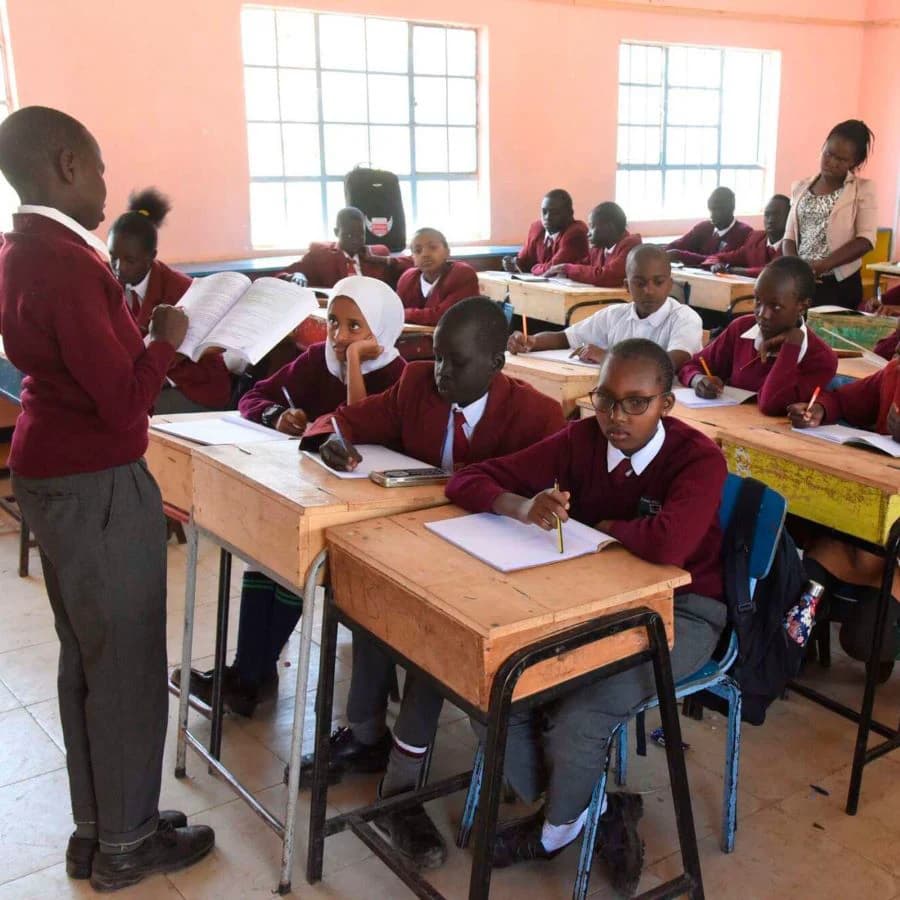
The biggest mistake in treating Junior Secondary School (JSS) as an extension of primary education is failing to recognise the learner standing at the centre of it. A JSS learner is not simply an older primary pupil who has moved to a new classroom; the learner is entering adolescence—a fundamentally different stage of physical, emotional, social and intellectual development.
If the learner has changed, the teacher must change too.
JSS has therefore created a challenge that goes beyond curriculum, classrooms, textbooks and examinations. It has raised a more fundamental question: Does Kenya have teachers adequately prepared to teach adolescents?
The answer will determine whether JSS becomes a successful bridge between childhood and adulthood or simply another stage where teachers struggle to understand learners and learners struggle to understand themselves.
Primary learners are generally still within childhood. They depend considerably on adults for direction and benefit from structured routines, close supervision, concrete examples, repetition and frequent encouragement.
The JSS learner is different.
Entering adolescence brings rapid physical, emotional, social and cognitive changes. Learners begin seeking greater independence. They question instructions, develop stronger opinions and become increasingly conscious of how their peers perceive them.
Their capacity for abstract and critical thinking also grows. They want to know not only what they are expected to learn but why they should learn it.
A primary learner may ask, “What am I supposed to do?”
The JSS learner increasingly asks, “Why should I do it?”
That question should not automatically be interpreted as disrespect. It can be evidence of developing intellectual independence.
Why JSS classrooms can become difficult
Adolescence can make the JSS classroom particularly demanding.
Some learners become outspoken, impulsive, emotionally sensitive or resistant to authority. Others become withdrawn. Peer pressure can influence behaviour, friendships and attitudes towards school.
Social media and mobile phones can compete for attention. Emerging romantic relationships may become distractions. Bullying, body-image concerns and fear of rejection can undermine confidence.
At the same time, learners are adjusting to new subjects, different teachers and increased academic expectations.
Some carry challenges from home into school. Poverty, family conflict, neglect or inadequate parental support can manifest themselves through absenteeism, aggression, withdrawal, poor concentration or declining academic performance.
The result is that a behaviour problem may sometimes be mistaken for a character problem when it is actually a developmental, emotional, social or academic challenge.
Discipline remains essential.
JSS learners need clear rules, boundaries and accountability. But punishment cannot be the universal response to adolescent behaviour.
A learner repeatedly disrupting lessons may be struggling academically. Another may be seeking peer recognition. A withdrawn learner may be experiencing bullying.
The crucial question should therefore move beyond “How do we punish this learner?”
It should become:
“What is behind this behaviour, and what intervention will help the learner develop?”
This does not mean excusing indiscipline. It means responding intelligently.
JSS teacher must be different
The distinction between primary and JSS education must be reflected in teacher preparation.
A primary teacher plays a critical role in building foundational knowledge and skills while providing substantial guidance and supervision.
The JSS teacher has an expanded role as teacher, facilitator, mentor and role model, with sufficient understanding of adolescent development to respond appropriately to changing learner behaviour.
Primary teaching tends to require more structured instruction and close guidance.
JSS teaching increasingly requires inquiry, discussion, problem-solving, collaboration, critical thinking and guided independence.
The teacher must know when to instruct, when to facilitate, when to listen and when to intervene.
Adolescents want independence. Schools should not attempt to eliminate that desire.
They should channel it.
Student leadership, clubs, debates, projects, peer mentorship and community activities can give learners opportunities to exercise responsibility.
The goal should be a gradual movement from external discipline to self-discipline.
Firm boundaries remain necessary, but adolescents also need to understand the reasons behind rules and the consequences of their choices.
CBE makes the transition even more important
Competency-Based Education (CBE) makes this distinction especially significant.
The objective is not simply for learners to memorise information. They must demonstrate the ability to apply knowledge, communicate, collaborate, create, solve problems and make responsible decisions.
That requires a classroom in which adolescents can ask questions, investigate, debate, experiment and apply knowledge to real-life situations.
The JSS teacher therefore cannot be merely a transmitter of information.
The teacher must become a facilitator of learning and developer of competencies.
Subject knowledge alone is not enough.
JSS teachers need professional development in adolescent psychology, classroom management, guidance and counselling, conflict resolution, child protection, inclusive education, social-emotional learning and digital literacy.
This is particularly important when teachers move from primary education into JSS.
A teacher who is highly effective with a 10-year-old learner may not automatically use the most effective methods with a 14-year-old adolescent.
The difference is not about one teacher being better than another. It is about developmental fit.
Different learners require different approaches.
Strengthen guidance and counselling
Guidance and counselling should become an integral part of JSS rather than an emergency service activated only after serious misconduct.
Learners need support in dealing with identity, peer pressure, relationships, emotional regulation, academic stress, bullying, digital behaviour and career choices.
Teachers should also be able to recognise warning signs such as sudden withdrawal, persistent aggression, absenteeism and unexplained academic decline.
Early intervention can prevent small difficulties from developing into serious disciplinary and educational problems.
JSS learners should have structured opportunities to participate in school life.
Learner councils, clubs, debates, peer mentorship and community projects can help adolescents develop leadership and responsibility.
Giving learners a voice does not mean surrendering authority.
It means teaching them that voice must be accompanied by responsibility.
This is precisely the kind of transition JSS should facilitate.
Make learning relevant
Adolescents increasingly want to understand how education connects to their lives and future.
Teachers should therefore use practical activities, projects, investigations, discussions and real-world problems.
A learner who sees the purpose of learning is more likely to engage with it.
The JSS classroom should become a place where learners do not merely memorise what the teacher says but learn to think, question, create, collaborate and solve problems.
The school cannot manage adolescence alone.
Parents need regular communication with teachers about academic progress, behaviour, attendance and emerging challenges.
They also need to recognise that adolescence requires boundaries and supervision, but equally demands communication, patience and emotional support.
The home and school must work together to provide consistent expectations.
The real test of JSS
The success of JSS should not be measured simply by how quiet classrooms are or how few disciplinary cases are recorded.
A quiet learner may not necessarily be learning, just as a questioning learner is not necessarily an undisciplined learner.
The real question is whether JSS is producing young people who can think critically, communicate effectively, collaborate, solve problems, regulate themselves and take responsibility for their decisions.
Primary education lays much of the foundation for learning.
JSS must build upon that foundation while responding to a learner who is changing physically, emotionally, socially and intellectually.
That requires a corresponding transformation in the teacher.
Primary learners need teachers who guide children. JSS learners need teachers who can guide adolescents towards responsible independence.
The future of JSS will ultimately be determined not by how successfully schools silence adolescents, but by how effectively they help them grow.
Kenya cannot expect adolescent learners to thrive under methods designed primarily for younger children, nor can it expect teachers to manage adolescence effectively without the right preparation and professional support.
JSS is therefore not upper primary with different subjects.
It is a distinct stage of education requiring a distinct understanding of the learner—and a teacher equipped for that reality.
If JSS is the bridge between childhood and adulthood, then the teacher is the architect of that bridge. Its strength will determine whether learners cross into adulthood confused and alienated—or equipped to think, choose, create, collaborate and take responsibility.


Reader Discussion (0)
Sign in to comment