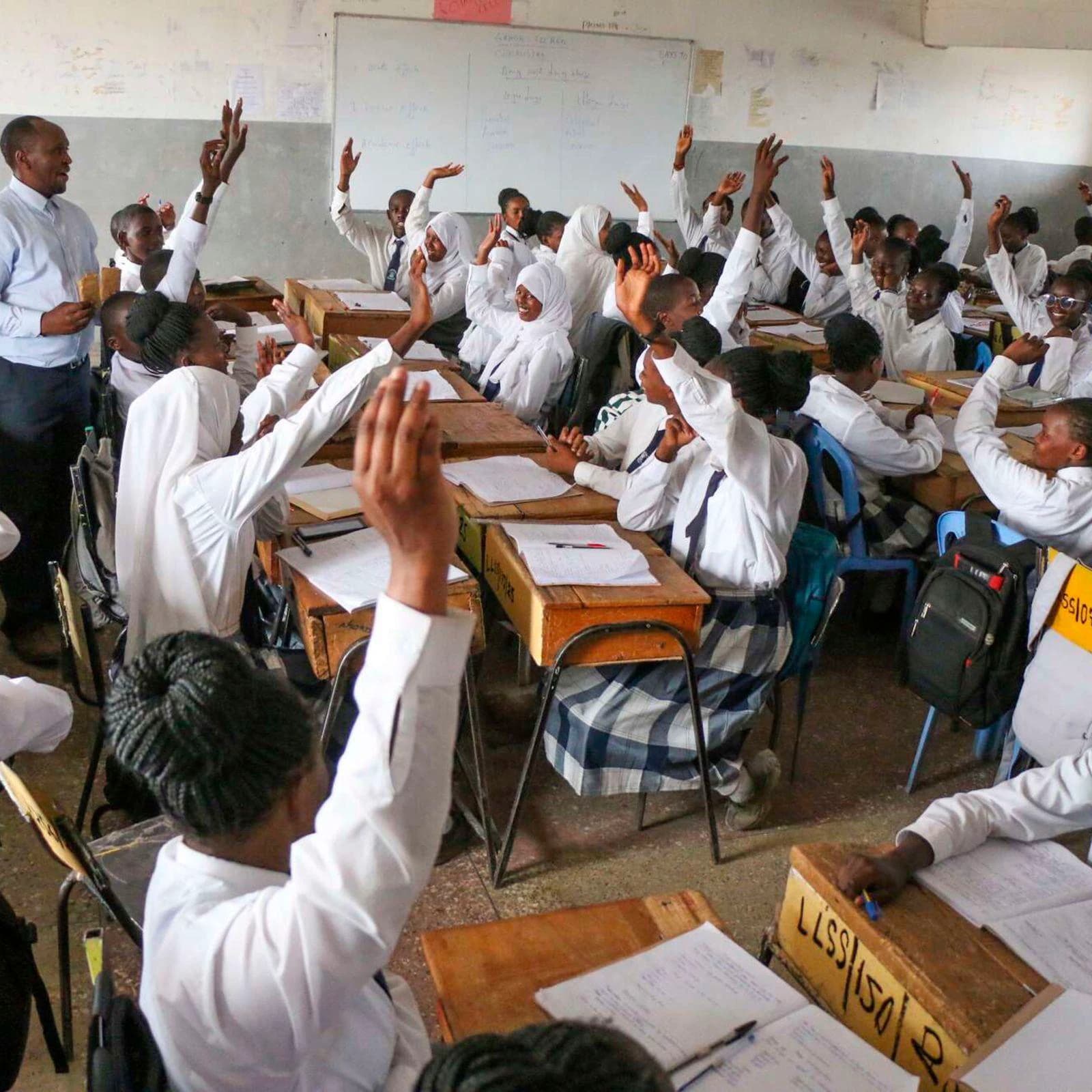
I sometimes wonder whether the Grade 10 learners who are the pioneers of the Competency-Based Curriculum (CBC) are living the values that the curriculum was designed to nurture. Of particular concern is self-efficacy, the belief that one can accomplish a task, overcome a challenge and make progress through effort. If there is a cohort of learners experiencing disillusionment with the education system, this pioneering generation deserves our attention.
These are not ordinary learners. They are the first cohort to navigate the full CBC journey into senior school. They have spent years learning under a curriculum that promised to recognise individual talents, nurture competencies, promote creativity and prepare learners for the realities of life. They were told that education would no longer be about examinations alone, that every learner had a strength worth developing and that success could take different pathways.
Now that they have arrived at Grade 10, are they beginning to believe in these promises, or are some of them questioning whether the system has kept its word?
Self-efficacy is not simply the ability to recite motivational statements in a classroom. It is the conviction that, despite difficulties, one can learn, improve and succeed. A learner with self-efficacy does not necessarily believe that everything is easy. Rather, the learner believes that difficulties can be overcome with the right effort, support and strategy.
Unfortunately, this belief does not grow in a vacuum. It is shaped by experience. When learners repeatedly encounter encouragement, meaningful opportunities and visible progress, their confidence grows. When they experience rejection, uncertainty, comparison and repeated disappointment, that confidence can weaken.
This is where we must examine the experiences of our Grade 10 pioneers.
For years, CBC has encouraged learners to explore their interests and abilities. The curriculum has emphasised that children are different, that competencies matter and that education should help learners discover their potential. Yet the transition to senior school has placed the system under an intense public spotlight, particularly over placement, school choices, pathways and the expectations surrounding senior school.
For learners and parents who feel that their preferred choices have not materialised, the experience can be emotionally difficult. A learner who had imagined pursuing a particular pathway may suddenly have to reconsider that ambition. A parent who invested time, money and hope in a particular school may feel disappointed. In such circumstances, the question is not merely where a learner has been placed. It is what that experience communicates about the learner's worth and future.
Does the learner conclude, "My plans have changed, but I can still succeed"? Or does the learner begin to think, "Perhaps I am not good enough"?
The distinction is important. The first response reflects resilience and a developing sense of self-efficacy. The second may signal that confidence is being eroded. We should not assume that every Grade 10 learner feels disillusioned, but neither should we dismiss the possibility that some are struggling to reconcile the promises of CBC with their lived experiences.
There is also a danger in confusing self-efficacy with academic performance. A learner who scores below expectations is not necessarily incapable. A learner who has not secured a preferred placement is not necessarily less talented. A learner who takes a different pathway from the one initially imagined has not forfeited the right to a meaningful future.
Unfortunately, our society can be quick to attach labels to children. We celebrate those who appear to have succeeded and quietly marginalise those whose journeys seem less impressive. Social media can intensify this culture through comparisons, school-placement discussions and public displays of achievement. Parents, too, may unintentionally communicate disappointment in ways that make children feel that their worth depends on a school name, a pathway or an examination result.
Teachers and parents must nurture self-efficacy
If CBC is to nurture self-efficacy, we must change this conversation.
Teachers have a critical role to play. The classroom must be a place where learners can make mistakes without being humiliated, ask questions without being ridiculed and attempt difficult tasks without being branded failures. Feedback should help learners understand what they can improve, not merely remind them of what they have failed to achieve.
A learner who struggles with Mathematics today should be helped to identify the gaps and work towards improvement. A learner with a talent for performing arts, agriculture, sports or practical problem-solving should be shown how that talent can develop into competence and opportunity. Encouragement must be accompanied by deliberate teaching, access to resources and opportunities to practise.
Parents must also recognise that a child's educational journey is not a competition in which the family must defeat its neighbours. Children need honest conversations about their strengths, limitations and ambitions. They need guidance to make informed decisions, but they also need reassurance that a setback is not a final verdict on their lives.
The Ministry of Education and other stakeholders, meanwhile, must listen to learners themselves. Policy success cannot be measured only through placement statistics, the number of schools opened or the pathways advertised. We must also ask learners whether they understand their options, whether they feel supported, whether they can see a future for themselves and whether they believe their efforts can make a difference.
These questions should inform the implementation of CBC at senior school. A curriculum that promises learner-centred education must be willing to hear learners' frustrations without interpreting every complaint as resistance to change.
The true test of CBC lies in learners' experiences
We must also remember that self-efficacy is built through small, repeated experiences of success. It grows when a learner who once struggled can solve a problem independently, when a practical project works after several attempts, when a teacher notices improvement and when an alternative route leads to a meaningful achievement. Schools must deliberately create these experiences rather than simply tell learners to believe in themselves.
READ ALSO:
The pioneers of CBC should not become a generation that learns to distrust the very system that raised its expectations. They should become a generation that understands that talent can be developed, challenges can be managed and different pathways can lead to fulfilling lives.
Their disillusionment, where it exists, should not be met with lectures about patience or accusations of entitlement. It should prompt us to listen, examine our practices and correct what is not working.
Ultimately, the test of CBC is not whether its pioneers can recite the values printed in curriculum documents. It is whether they experience those values in their classrooms, their schools and their communities.
Self-efficacy cannot be demanded from learners while the adults responsible for their education leave them feeling powerless. We must give them reasons to believe: opportunities to participate, room to improve, guidance when they struggle and assurance that their futures remain open.
The question facing us is therefore bigger than whether Grade 10 learners understand the meaning of self-efficacy. It is whether we have created an education system in which they can genuinely practise it.
We owe these pioneers more than the title of the first CBC cohort to enter senior school. We owe them an experience of education that gives them the confidence to face uncertainty without surrendering hope.
Ashford teaches English and Literature and writes on education, literacy and youth development.



Reader Discussion (0)
Sign in to comment