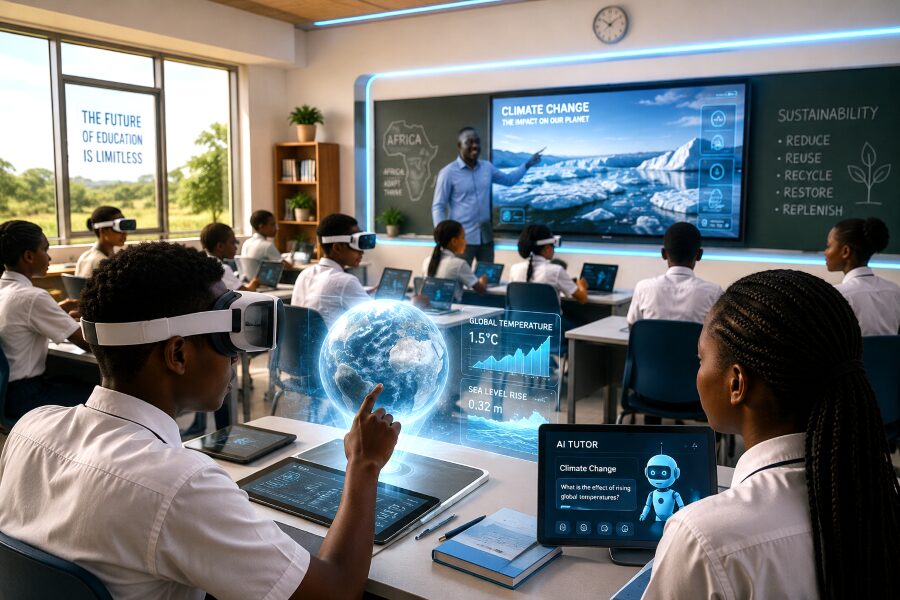
The year is 2050. A learner in a remote village in West Pokot puts on lightweight smart glasses and enters a virtual classroom attended by students from Nairobi, Tokyo, London, and New York.
The lesson is on climate change. Instead of reading about melting glaciers in a textbook, learners virtually walk across Antarctica, observe ice sheets breaking apart, and interact with scientists in real time.
This may sound like science fiction today, but many of the technologies needed to make such learning possible already exist. By 2050, education is likely to be transformed more dramatically than at any other time in human history.
The classroom beyond walls
The traditional classroom, characterized by rows of desks facing a teacher, may become increasingly rare.
Learning will no longer be confined to a specific building, timetable, or geographical location. Instead, education will occur anytime and anywhere through digital platforms, immersive technologies, and artificial intelligence.
The evolving role of teachers
One of the most significant changes will be the role of the teacher.
Contrary to fears that technology will replace educators, teachers will become more important than ever. However, their role will shift from being transmitters of information to facilitators of learning, mentors, coaches, and guides.
For centuries, teachers have been the primary source of knowledge. By 2050, knowledge will be instantly available through artificial intelligence systems capable of answering questions, explaining concepts, and adapting content to individual learners.
The challenge will no longer be accessing information but interpreting, evaluating, and applying it wisely. Teachers will therefore focus on nurturing critical thinking, creativity, ethics, collaboration, and emotional intelligence.
Artificial intelligence and personalized learning
Artificial intelligence will personalize education on an unprecedented scale.
Every learner will have a digital learning assistant capable of identifying strengths, weaknesses, interests, and preferred learning styles. Lessons will be customized to individual needs, ensuring that learners progress at their own pace rather than according to rigid class schedules.
This personalized approach could finally address one of the greatest weaknesses of traditional education—the assumption that all learners should learn the same content in the same way at the same time.
In 2050, education systems may recognize more fully that every learner follows a unique learning journey.
The future of assessment
Assessment will also undergo a fundamental transformation.
The examination culture that dominates many education systems today may become less relevant. Instead of relying heavily on end-of-course tests, learners will be continuously assessed through projects, simulations, portfolios, and practical demonstrations of competence.
Employers are increasingly valuing skills alongside certificates. By 2050, educational credentials may be based more on demonstrated abilities than on time spent in school.
Learners could earn digital credentials for specific competencies, building personalized portfolios that reflect what they can actually do rather than merely what they have studied.
A changing curriculum
The curriculum itself will evolve significantly.
While literacy and numeracy will remain essential, new competencies will gain prominence. Digital literacy, artificial intelligence literacy, environmental sustainability, entrepreneurship, global citizenship, and emotional intelligence are likely to become core learning areas.
Climate change will also influence education. Schools of 2050 will prepare learners not only to understand environmental challenges but also to develop solutions.
Sustainability is likely to be integrated into every aspect of learning, from curriculum design to school infrastructure and community engagement.
Preparing for a new world of work
The workplace of 2050 will be vastly different from today’s labour market.
Many current occupations may disappear due to automation, while entirely new professions emerge. Education systems will therefore place greater emphasis on adaptability, lifelong learning, and transferable skills.
Charles Darwin’s observation that survival belongs not to the strongest or most intelligent but to those most responsive to change will become increasingly relevant.
In a rapidly changing world, adaptability may become one of the most valuable educational outcomes.
Lifelong learning becomes the norm
The concept of lifelong learning will no longer be optional.
Learning will extend beyond childhood and adolescence into adulthood and old age. Individuals may repeatedly return to education throughout their lives to acquire new skills, update knowledge, and respond to changing career demands.
Universities will also undergo profound transformation. Traditional degree programmes may become more flexible, modular, and competency-based.
Learners could assemble personalized qualifications by combining courses from multiple institutions across the world.
The distinction between formal education and workplace learning may gradually become less pronounced.
The future of schools
Physical school buildings will still exist, but their purpose will evolve.
Schools will become centres for collaboration, innovation, mentorship, creativity, and social interaction rather than mere locations for information delivery.
Human connection will remain indispensable even in highly technological learning environments.
The future classroom may also become more inclusive. Advanced assistive technologies could help learners with disabilities participate more fully in education.
Language translation systems may break down barriers between learners from different cultures and linguistic backgrounds.
Challenges on the horizon
Yet the future will not be without challenges.
The digital divide could create new forms of educational inequality if access to technology remains uneven. Ethical concerns surrounding artificial intelligence, data privacy, and algorithmic bias will require careful regulation and oversight.
There is also the risk that excessive reliance on technology could weaken interpersonal relationships, empathy, and social skills.
Education leaders will need to strike a balance between technological innovation and human development.
Kenya’s journey toward 2050
For Kenya, the journey toward 2050 presents both opportunities and responsibilities.
Investments in digital infrastructure, teacher training, connectivity, and innovation will be critical. The Competency-Based Education framework has already signalled a shift toward skills development, but future reforms will need to go even further in preparing learners for a world characterized by uncertainty and rapid change.
Redefining education
Perhaps the most profound change will be a shift in how society defines education itself.
Education will no longer be viewed merely as preparation for life; it will increasingly become a continuous process woven into life itself. Learning will not end with graduation but will accompany individuals throughout their personal, professional, and civic journeys.
The classroom of 2050 may look very different from today’s classroom. The technologies will change. The curriculum will evolve. The methods of assessment will be transformed.
Yet one truth is likely to remain constant: education will continue to be humanity’s most powerful tool for unlocking potential, advancing progress, and shaping a better future.
READ ALSO: Why pride, not lack of ability, may be holding some students back from success
The future of education is not merely about smarter machines. It is about creating wiser human beings capable of navigating an increasingly complex world with knowledge, creativity, compassion, and purpose.
By Hillary Muhalya
You can also follow our social media pages on Twitter: Education News KE and Facebook: Education News Newspaper for timely updates.
>>> Click here to stay up-to-date with trending regional stories
>>> Click here to read more informed opinions on the country’s education landscape