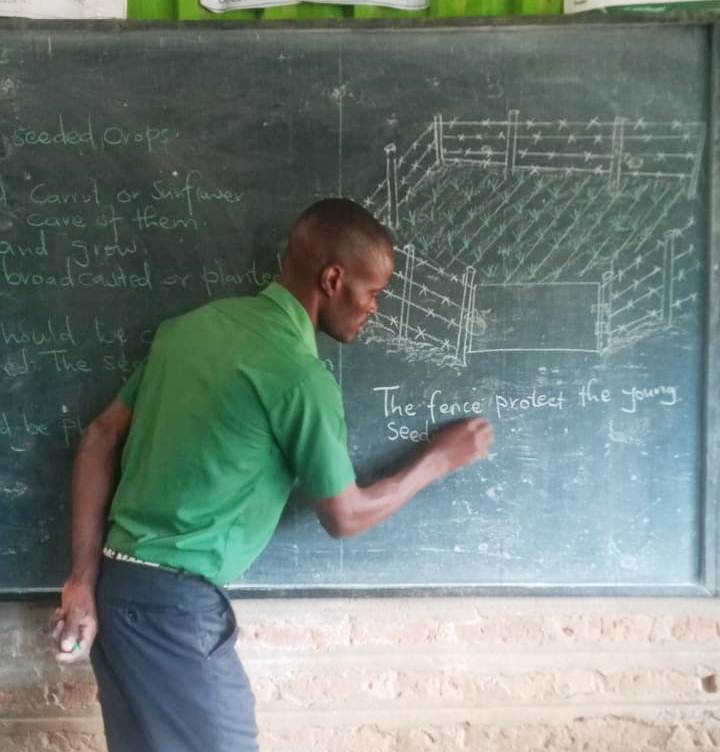
The enduring Chinese proverb, “Teachers can open the door, but you must enter it yourself,” captures a truth that remains profoundly relevant in today’s education systems and personal development journeys.
In an era where information is abundant, access to schooling has expanded, and teachers are increasingly equipped with modern pedagogical tools, one stubborn reality persists: learning is ultimately an individual responsibility. No matter how skilled, passionate, or committed a teacher may be, the decisive factor in success lies within the learner.
At its core, the proverb draws a clear boundary between instruction and transformation. Teachers introduce ideas, explain concepts, and create pathways for intellectual exploration. They illuminate possibilities. However, illumination is not the same as movement.
A well-lit path still requires someone willing to walk it. Too often, learners confuse exposure with mastery. Sitting in a classroom, listening to a lesson, or even taking notes can create the illusion of learning. Yet, without active engagement—questioning, practicing, applying, and reflecting—knowledge remains superficial and fleeting.
This insight has deep implications for how we understand failure and success in education. In many contexts, including Kenya’s schooling system, there is a tendency to attribute poor performance primarily to teachers or institutions.
While systemic challenges are real and cannot be dismissed, the proverb redirects part of that conversation toward the learner. It asks uncomfortable but necessary questions: Did the student revise? Did they attempt to apply what was taught? Did they seek clarification when confused? Did they cultivate discipline?
Such questions are not meant to absolve educators of responsibility but to restore balance. Education is not a one-sided transaction where teachers deposit knowledge into passive recipients. It is an interactive process that demands agency from the learner.
ALSO READ:
Classroom On the Edge: Why schools need technology – and why they don’t
A teacher may explain poetic devices with clarity and enthusiasm, but unless the student reads widely, analyzes texts independently, and experiments with writing, the lesson remains incomplete. The door has been opened, but the student has chosen to stand at the threshold.
The proverb also highlights the critical role of self-discipline. Talent, intelligence, and even quality teaching pale in comparison to consistent effort. Two learners may sit in the same classroom, taught by the same teacher, using the same materials. One excels while the other struggles.
The difference often lies not in ability but in attitude and habits. The successful learner takes ownership—reviews notes after class, practices beyond assigned work, and remains curious. The struggling learner, on the other hand, may rely solely on classroom exposure, expecting understanding to happen automatically.
In this sense, the proverb challenges a culture of dependency that can quietly take root in education systems. When learners expect to be “carried” by teachers, they undermine their own potential. Real growth begins when a student shifts from asking, “What did the teacher give me?” to “What did I do with what I was given?” That shift marks the transition from passive learning to active mastery.
Beyond the classroom, the proverb resonates powerfully in professional and personal development. In the workplace, training sessions, mentorship programs, and capacity-building workshops are common. Yet, not all participants benefit equally.
Some leave inspired but unchanged, while others translate learning into tangible improvement. The difference, again, is personal initiative. The trainer opens the door; the employee must step through it by applying new skills, seeking feedback, and refining their craft.
In personal growth, the same principle applies. Books, seminars, podcasts, and advice from mentors provide valuable guidance. However, consumption without action leads to stagnation. One may read extensively about discipline, leadership, or financial management, but without deliberate implementation, such knowledge remains theoretical. Growth is not measured by what one knows, but by what one does consistently.
ALSO READ:
Ruto launches Soma Play digital platform to showcase student creativity nationwide
For educators, this proverb serves as both a reminder and a challenge. It affirms that their role is vital—they are door-openers, catalysts, and guides. But it also underscores the limits of their influence. Teachers cannot force curiosity, manufacture motivation, or internalize knowledge on behalf of students.
What they can do is create environments that encourage participation, design tasks that require active engagement, and model the very discipline they wish to see.
For learners, the message is even more direct. Opportunity is not enough. Access to education, however valuable, does not guarantee success. The decisive variable is effort. Walking through the door requires courage—the courage to try, to fail, to ask questions, and to persist.
It demands discipline—the willingness to work even when motivation wanes. It requires ownership—the recognition that one’s future is shaped not just by what is taught, but by what is done with that teaching.
Ultimately, the proverb dismantles the comforting illusion that success can be outsourced. It insists that while others may guide, support, and inspire us, they cannot substitute our effort. The door to knowledge, growth, and achievement may be wide open, but it remains merely an entrance until someone chooses to step through.
By Ashford Kimani
Ashford teaches English and Literature in Gatundu North Sub-county and serves as Dean of Studies.
You can also follow our social media pages on Twitter: Education News KE and Facebook: Education News Newspaper for timely updates.
>>> Click here to stay up-to-date with trending regional stories
>>> Click here to read more informed opinions on the country’s education landscape