








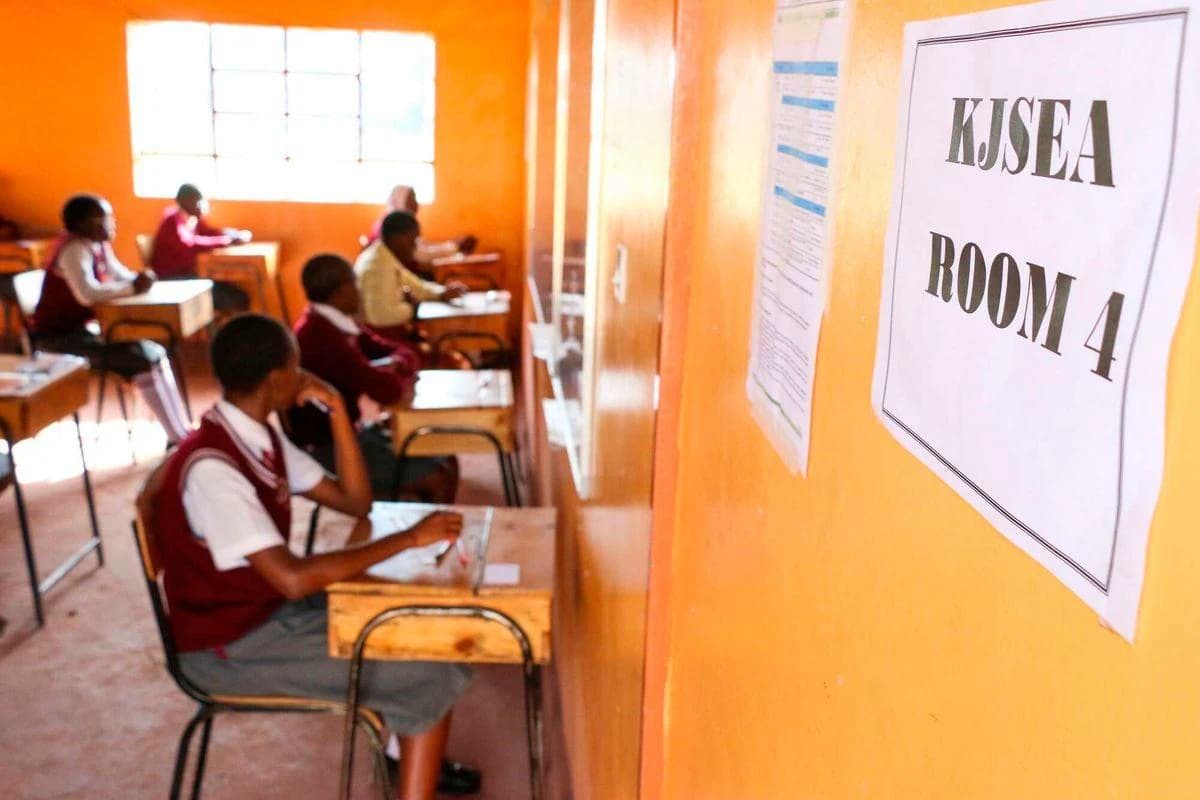
The welfare of Grade 9 learners has come under scrutiny following concerns raised by teachers and candidates over the demanding schedule of the 2026 Kenya Junior School Education Assessment (KJSEA), particularly the decision to schedule three papers on each of the final two examination days.
As the national assessment enters its final stretch, the central question is whether the timetable sufficiently considers the physical comfort, mental alertness and emotional wellbeing of the learners expected to demonstrate their knowledge under examination conditions.
Teachers and learners have questioned the concentration of three papers on Thursday, October 29, and Friday, October 30, arguing that the cumulative demands of sitting several examinations in one day may leave candidates exhausted and struggling to maintain the concentration required for subsequent papers.
Their concerns deserve serious consideration. National examinations are intended to measure learning, not a candidate's ability to withstand prolonged periods of mental strain.
Learners are not examination machines
The KJSEA marks an important transition in the educational journey of Grade 9 learners. The results contribute to decisions about their progression to senior school and the pathways they will pursue under the Competency-Based Education (CBE) system.
For many candidates, therefore, the assessment carries considerable academic and emotional significance.
However, the importance of the examinations should not overshadow the welfare of the children sitting them.
Learners have different levels of stamina, concentration and emotional resilience. While some may manage several papers in a day without apparent difficulty, others may experience fatigue, anxiety or reduced concentration as the hours pass.
A demanding schedule can become particularly difficult when candidates must switch repeatedly between subjects requiring different forms of thinking, interpretation, calculation and written expression.
The question is not whether learners should be prepared to sit examinations. It is whether examination arrangements should be designed with a realistic understanding of their needs.
Children should not be expected to function like examination machines whose concentration remains constant regardless of how many papers they sit or how long they remain at assessment centres.
Under the published timetable, Thursday, October 29, features Integrated Science, Social Studies and Creative Arts and Sports. Friday, October 30, includes Pre-Technical Studies, Religious Education and Integrated Science Paper 2.
For candidates sitting the standard papers, the final session ends at 3:40 pm on Thursday and 3:00 pm on Friday. Candidates using Braille have extended examination durations, with the final sessions ending at 4:10 pm and 3:30 pm, respectively.
Although the schedule enables the assessment to be completed within five days, the concentration of papers towards the end of the examination period has prompted questions about whether administrative efficiency has been adequately balanced against learner welfare.
Three examinations in a single day mean that candidates must sustain attention across multiple sessions, manage examination pressure and repeatedly prepare themselves for different assessment tasks.
Even when breaks are provided, they may not be sufficient for every learner to recover fully from the demands of an earlier paper.
The concern becomes more significant when candidates must return the following morning and repeat the process.
This does not automatically mean that three papers in one day will undermine every learner's performance. However, the possibility of cumulative fatigue warrants careful consideration by examination planners.
Fatigue should not become an unintended test
An examination should assess a learner's understanding, knowledge and competencies in the subject being tested.
It should not inadvertently reward those who can endure prolonged examination schedules while disadvantaging those whose concentration declines under sustained pressure.
When learners become mentally exhausted, they may find it more difficult to read questions carefully, organise their thoughts, interpret instructions and express their answers accurately.
Such difficulties do not necessarily reflect a lack of preparation or understanding. In some cases, the conditions under which a paper is administered may affect how effectively a candidate demonstrates what they know.
This is why the design of a national assessment must consider more than the number of papers and the dates on which they are administered.
Fairness also involves creating reasonable conditions in which candidates can demonstrate their abilities.
KNEC should therefore consider feedback from teachers, learners and assessment-centre personnel when evaluating whether the current arrangement provides an appropriate balance between examination demands and children's wellbeing.
The KJSEA is taking place within a broader education reform that seeks to identify learners' competencies, interests and strengths as they prepare to enter senior school.
That objective places a responsibility on all education stakeholders to ensure that assessment practices remain consistent with the learner-centred principles underpinning CBE.
A system that emphasises the abilities, interests and individual development of learners should also pay attention to their physical and emotional needs during assessment.
Learners cannot be treated as active participants in their education during classroom instruction and then regarded merely as candidates to be processed during national examinations.
Their welfare should remain central throughout the learning and assessment process.
This is especially important for candidates who require additional support because of disabilities, health needs or other circumstances that may affect their examination experience.
Reasonable accommodation should be an integral part of assessment planning, rather than an afterthought.
KNEC should review examination scheduling and learner welfare
The concerns raised over the timetable provide KNEC with an opportunity to review the experience of candidates during the current assessment.
The council should examine whether the number of papers scheduled per day, the duration of individual sessions and the intervals between examinations adequately support concentration and learner comfort.
Teachers who work directly with learners can provide useful insights into how candidates respond to prolonged examination sessions. Learners themselves can also describe their experiences, including fatigue, anxiety, meal arrangements and the pressure of preparing for successive papers.
Such feedback should be considered alongside examination-administration requirements, including security, staffing, costs and the need to complete assessments within a reasonable period.
If the current timetable cannot be changed without disrupting the ongoing examinations, the feedback should inform future examination cycles.
Any adjustment to the current schedule must, however, come through an official KNEC communication to ensure consistency and protect examination integrity.
The completion of national examinations within a prescribed period is an important administrative achievement. But efficiency alone should not be the ultimate measure of a successful assessment.
The welfare of candidates, the fairness of examination conditions and the ability of learners to demonstrate their competencies should carry equal weight in timetable planning.
Teachers raising concerns about the KJSEA schedule should not automatically be dismissed as resisting examination demands. Their observations provide an opportunity to examine whether the assessment arrangements adequately reflect the needs of the children involved.
Equally, the debate should be guided by evidence rather than the assumption that every learner will necessarily perform poorly after sitting three papers in one day.
The appropriate response is to listen, investigate and make adjustments where necessary.
As the 2026 KJSEA examinations conclude on Friday, October 30, KNEC should consider a structured review that incorporates the experiences of learners, teachers, parents and examination personnel.
The guiding principle should be straightforward: national examinations must measure what learners have learned without imposing avoidable burdens on their wellbeing.
The purpose of education is to develop children, not simply to move them through an assessment timetable. Their welfare must remain central to every decision made in the name of educational progress.



Reader Discussion (0)
Sign in to comment