
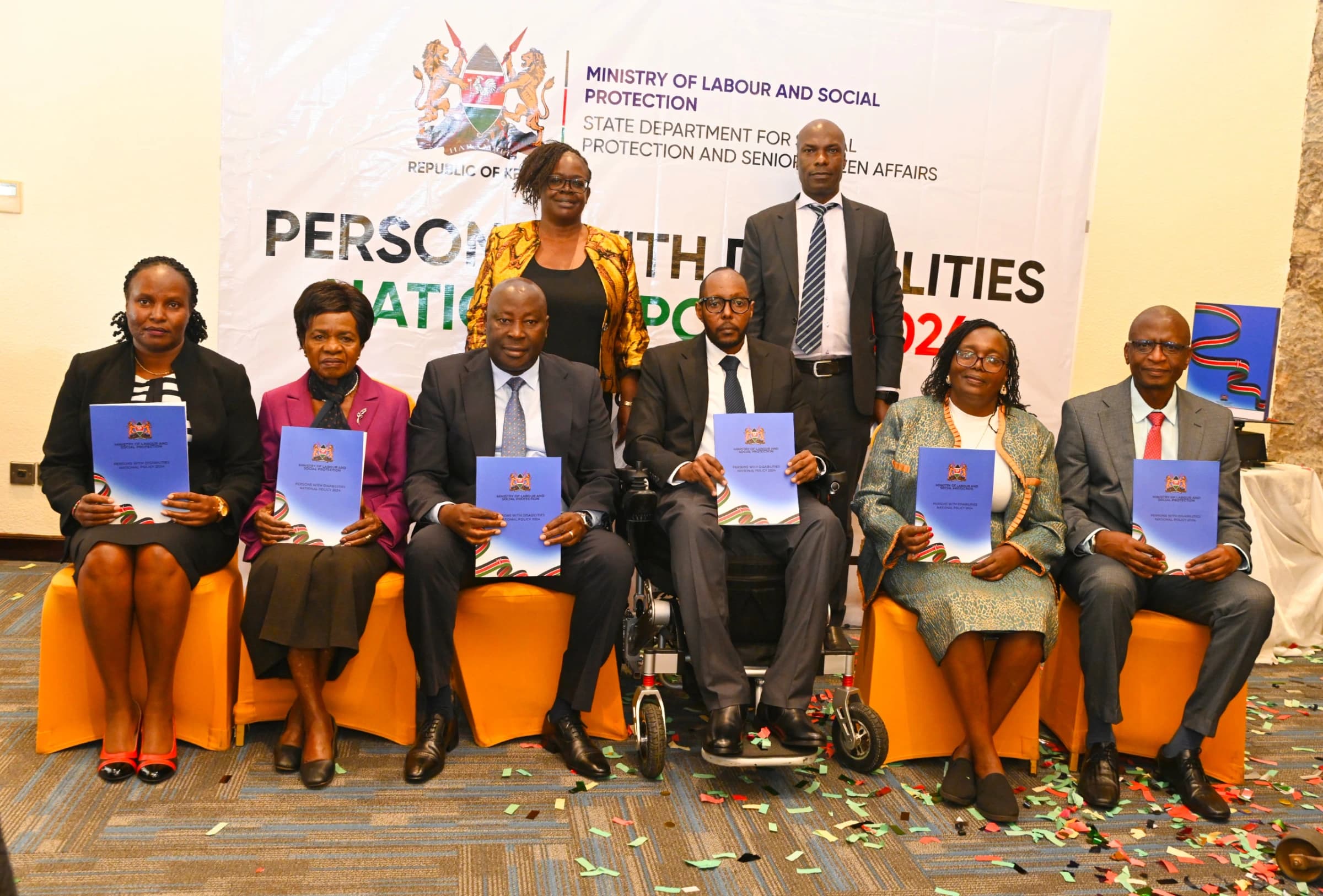








The real test of an inclusive public service is not how eloquently government institutions pronounce their commitment to persons with disabilities, but whether that commitment translates into tangible financial support, workplace accommodation and equal professional opportunities.
This is the central question raised by the Salaries and Remuneration Commission (SRC) circular dated March 7, 2024, Reference No. SRC/ADM/11(190), which provides for a monthly Personal Guide Allowance of Sh20,000 for specified categories of public officers with disabilities.
The circular represents an important recognition that disability can create additional practical and financial demands in the workplace. However, it also highlights a wider institutional challenge: government cannot claim to have achieved workplace inclusion merely by issuing policy directives.
Inclusion must be demonstrated through actual payments, institutional compliance and the removal of barriers that prevent employees with disabilities from performing their duties on equal terms.
Recognising the additional cost of participation
The SRC circular provides for a flat-rate Personal Guide Allowance of Sh20,000 per month, payable as part of the beneficiary’s monthly remuneration.
The specified beneficiaries include deaf and blind public officers, officers with qualifying severe visual impairment, and officers with physical disabilities who use wheelchairs, a pair of crutches, walking aids requiring both hands or walking frames.
For the specified low-vision category, eligibility requires an ophthalmologist’s report confirming visual acuity of 6/60 or below.
The underlying principle is significant. Employees with disabilities may require additional assistance to navigate workplaces, access information and undertake ordinary professional responsibilities. These requirements should not become a financial penalty for choosing to participate in public service.
The allowance therefore represents more than an additional payment. It recognises that equitable employment sometimes requires differentiated financial support.
One persistent misconception about workplace equality is that every employee must receive precisely the same treatment regardless of individual circumstances.
That approach overlooks the realities of disability.
A visually impaired officer may require specialised assistance to access printed information. An employee with a physical disability may need support with mobility and workplace navigation. A deaf officer may encounter communication barriers that require appropriate accommodation.
Treating these employees identically to colleagues without such requirements does not automatically produce equality.
True equity means recognising different needs and providing reasonable support that enables every employee to contribute meaningfully.
This is the philosophical foundation upon which the SRC allowance should be understood.
Implementation requires institutional accountability
The most important question is no longer simply whether SRC has recognised the need for this allowance. It is whether the institutions covered by the provision have translated it into actual benefits for eligible employees.
The public-service institutions concerned include ministries, constitutional commissions, public universities, state corporations and county public service institutions.
These institutions have a responsibility to ensure that eligible employees are informed about the provision and that the necessary administrative processes are handled efficiently.
A policy that exists in government files but remains inaccessible to its intended beneficiaries achieves little.
There must be clarity on beneficiary identification, medical documentation, payroll processing and the actual payment of the allowance.
Equally important, institutions should establish transparent mechanisms through which eligible officers can raise concerns where their entitlements are delayed or overlooked.
The Teachers Service Commission (TSC) and other education-sector institutions must pay particular attention to the implications of this provision for eligible employees.
Teachers are public officers, and those who satisfy the stipulated conditions should be able to access the relevant benefits through the appropriate administrative procedures.
TSC communicated the revised eligibility categories to teachers and secretariat staff through its June 2024 circular. The important questions therefore concern awareness, eligibility verification, processing of applications and consistency in payment.
TSC should ensure that eligible teachers understand the requirements and that disability-related entitlements are not lost in routine payroll bureaucracy.
The same responsibility extends to public universities, education agencies and other institutions employing public officers with disabilities.
However, the SRC circular should not be interpreted as automatically granting the allowance to every employee with a disability. Eligibility must be assessed against the specific categories and conditions stipulated in the provision.
Inclusion must extend beyond an allowance
Perhaps the strongest argument for effective implementation is that public officers with disabilities should not have to repeatedly struggle with administrative systems to obtain support recognised by government.
An employee should not be forced to endure unnecessary bureaucracy, repeated documentation demands or prolonged uncertainty over an established entitlement.
Institutional responsibility means making the process accessible, predictable and accountable.
The government must also recognise that a monthly allowance alone cannot resolve every workplace barrier. Accessible buildings, appropriate communication systems, assistive technologies, reasonable accommodation and fair promotion opportunities remain essential components of meaningful inclusion.
The Sh20,000 provision is therefore one part of a much broader responsibility.
SRC has established a specific remuneration provision. The next measure of institutional performance should be the extent to which eligible public officers actually benefit from it.
How many eligible officers have been identified? How many are receiving the allowance? Which institutions have fully implemented the provision? Are there administrative bottlenecks preventing qualified employees from accessing it?
These are the questions that should now command attention.
Ultimately, the measure of an inclusive public service is not the number of disability policies it produces, but the number of employees whose working conditions, dignity and professional participation are genuinely improved.
The central argument is straightforward: disability inclusion must move from institutional declarations to effective administrative action. A government that recognises the additional costs of disability but fails to deliver the support it has prescribed undermines the very principle of equality it claims to defend.
The Sh20,000 Personal Guide Allowance should therefore be judged not by its announcement, but by its implementation.



Reader Discussion (0)
Sign in to comment