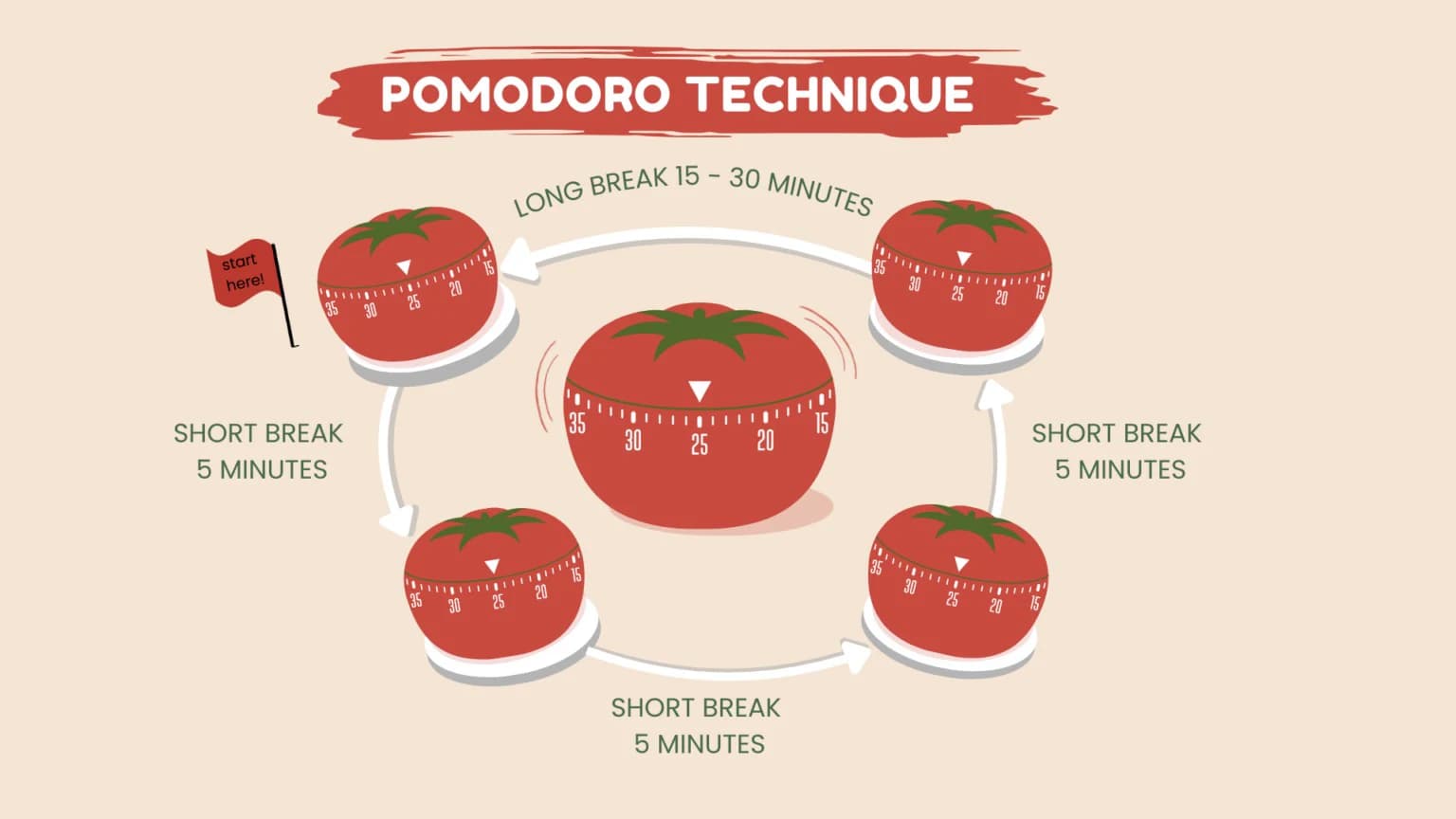
Indeed, through wise use of the Pomodoro Technique, students can address the problem of procrastination, confront challenges of concentration, avoid wanton wastage of time, mitigate mental fatigue, dodge frequent distractions, or whittle down large tasks into smaller units. For it is sagely said, by a yard, it is hard. But inch by inch, everything is a cinch. Meaning, the Pomodoro Technique is a true time-management tool designed to improve attention and concentration.
In its nuts and bolts, Pomodoro Technique basically breaks down study time into brief breaks. The traditional Pomodoro Cycle is 25 minutes of sedulous study with 5-minute breaks: Happening in 4 complete cycles followed by a longer break. Eureka! Through Pomodoro Technique, a serious student can study for 100 minutes or 1 hour 40 minutes with 20 minutes of productive breaks.
Origin of Pomodoro Technique
Digging deeper, with sharp shafts of great intellect, Pomodoro Technique was developed in the late 1980s by an Italian university comrade, Francesco Cirillo. Somewhat, Cirillo found it difficult to maintain attention and concentration while studying. So, he decided to ascertain a study strategy. What did he do? He used a tomato-shaped kitchen timer to divide his work into short stints. This led to “pomodoro” – the Italian appellation for tomato.
Principles of Pomodoro Technique
In fact, this unique technique is useful for students at all levels of learning because it encourages active concentration and attention for a fixed period, followed by time for rest. For when you rest, you don’t rust. Therefore, instead of studying continuously for several hours without rest, a learner that embracing Pomodoro Technique organises study session into manageable blocks. So, Pomodoro Technique abuts on the following principles: Firstly, choosing a task you yearn to learn or complete. Secondly, setting a timer for a fixed period. Thirdly, working without interruption until the timer rings. Then, taking a brief break. Progressively, repeating the process for the umpteenth time. More importantly, after approximately 4 intervals, it is wise taking a longer health break to re-charge mental batteries.
Application of Pomodoro Technique
Meaning, in its apt application in reading, instead of a student poring over a textbook chapter continuously, there is the division of tasks into several simple sections. For example, in Pomodoro 1, reading pages 1-10. In Pomodoro 2, reading pages 11-20. In Pomodoro 3, striving to summarise core-concepts. In Pomodoro 4, focusing on reviewing problematic portions. Therefore, a long chapter becomes simple like a dimple. The chapter becomes captivating in nature.
Basically, a self-driven student can apply Pomodoro Technique in note-making as recommended in riveting reading skills. How? By using 25 minutes to convert lecture materials into concise notes. Taking a brief break of 5 minutes. In the next 25 minutes, reviewing and correcting the notes. It is how serious students make note-making appear strong and structured.
Likewise, there is wise use of Pomodoro Technique in revision, or re-visiting. A student can wend this way by allotting different Pomodoros to topics. For example: First Pomodoro to Algebra in Mathematics. The second Pomodoro to Genetics in Biology. The third Pomodoro to World War in History. The fourth Pomodoro to Essay Writing in English. Broadly, this assists a student to shun spending too much time on one subject while dodging others. So, failing flat to balance subjects; leading to poor performance.
Additionally, students can make wise use of Pomodoro Technique in problem-solving process. More so, while studying concept-bent subjects requiring painstaking practice such as Mathematics, Physics, Chemistry, Accounting, Computer Programming, et cetera. Meaning, a diligent student can spend 25 minutes in solving problems without getting distracted for no apparent reason.
Advisedly, students can apply Pomodoro Technique in writing assignments. More so, breaking down mountain of academic work into molehills. For example, breaking down complex tasks into: Research, planning, creating an outline, writing the preamble, writing main sections, editing, proof-reading, et cetera. So, every small task can be assigned one or more Pomodoros. In turn, this makes a great assignment to be more achievable.
Again, Pomodoro Technique can aid students in mastery and memory process. More so, when merged with active-recall technique. For while here and there, doing this and that, we oft advise students to shun passive study, and focus more on active study. With this smart strategy, the diligent student spends 25 minutes reviewing flashcards. Afterwards, taking a brief break of 5 minutes. Then, the diligent student spends 25 minutes in testing oneself without notes, followed by a brief break of 5 minutes. Then, 25 minutes in correcting mistakes made. This is generally more productive than simply reading material repeatedly.
Benefits of Pomodoro Technique
Actually, Pomodoro Techniques has bountiful benefits. Firstly, it improves attention and concentration span. Knowing that the study period has a definite end-point, augments attention and concentration span. Secondly, Pomodoro Technique kills procrastination. Thirdly, Pomodoro Technique mitigates mental fatigue. Fourthly, Pomodoro Technique makes large tasks to become manageable. Withal, Pomodoro Technique assist students to become steadfast stewards of time. Through it all, they also value rest as part of therapy and productive work. They become motivated after completing simple tasks. They also become consistent.
Rules of the Pomodoro Technique
Finally, as students employ Pomodoro Technique, they should adhere to some raft of rules. Firstly, choose one specific task before starting to study. Secondly, remove all forms of destruction. Thirdly, pay meticulous attention to academic work. Pomodoro period should be treated as protected study time. Meaning, in case unrelated thought assails the mind, it should not divert your rapt attention. Then, take the brief breaks seriously. Ideally, you should make wise use of breaks to re-charge batteries of your mortal mind. How do you do it? Engage in useful activities such as stretching, walking, drinking water, breathing deeply, or chatting with someone briefly. In addition, take longer breaks after several cycles of Pomodoro. After approximately 4 Pomodoros, take a longer break of around 15-30 minutes.
Victor Ochieng’ rolls out talks and training services in schools. He speaks to students about useful Study Skills, Methods, Habits and Techniques.
Email:vochieng.90@gmail.com
Telephone: 0704420232




Reader Discussion (0)
Sign in to comment