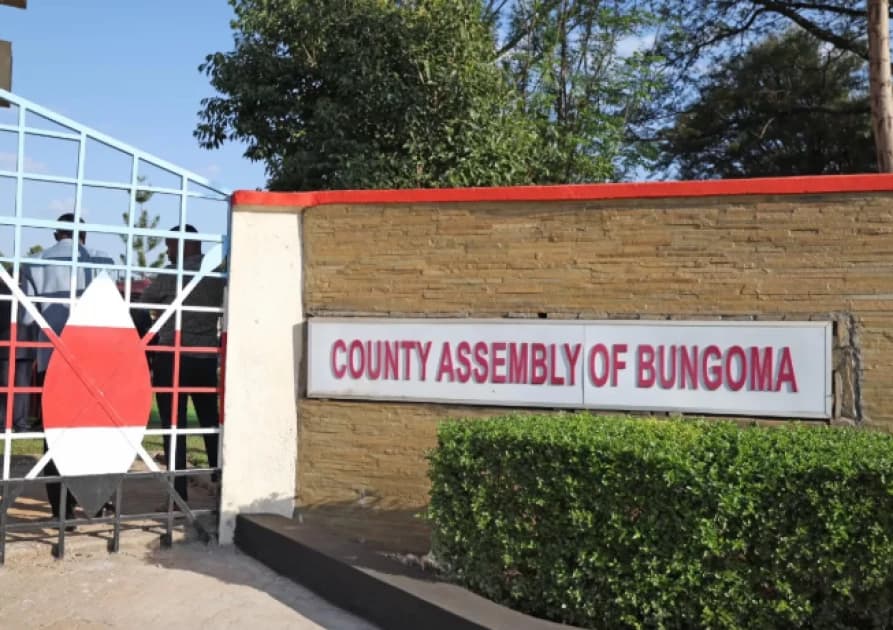



The Bungoma County Assembly has raised concerns over gaps in the implementation of the EIDU Digital Learning Programme, citing incomplete coverage of Early Childhood Development Education (ECDE) centres, discrepancies in gadget distribution records and inconsistencies in teacher training figures.
The concerns emerged after the House adopted a report by the Sectoral Committee on Education and Vocational Training, which examined the programme's implementation across the county.
The report was presented through a motion moved by Angeline Rugut and seconded by Jack Wambulwa. It called for urgent measures to address the gaps and to strengthen accountability in managing resources allocated to the initiative.
Presenting the report, Rugut told the House that the programme was launched after a Memorandum of Understanding signed on February 5, 2025, between the Bungoma County Government and EIDU Educational Limited to integrate digital technology into ECDE learning.
The committee established that of the 818 ECDE centres in the county, only 544, or 66.5 per cent, had been enrolled in the programme, leaving 274 centres, or 33.5 per cent, uncovered.
Sirisia recorded the lowest proportional coverage at 59.3 per cent, while Mt Elgon had the highest number of uncovered centres at 65.
The committee's findings showed disparities across the county's nine sub-counties. Mt Elgon, which has 169 ECDE centres, had enrolled 104, leaving 65 uncovered. Bumula had 74 of its 107 centres covered, while Tongaren had enrolled 71 of 105. Kanduyi had 70 of its 94 centres enrolled, while Sirisia had 54 of 91. In Kabuchai, 52 of 80 centres had benefited. Kimilili had enrolled 40 of 57 centres, while Webuye East had covered 40 of its 56.
The committee also questioned discrepancies in the distribution of digital learning gadgets, after establishing that only 1,992 devices could be verified against the 2,493 reported by the Department of Education. The variance of 501 gadgets raised concerns about the accuracy of departmental records and the management of public assets.
Rugut called for a comprehensive reconciliation of the distribution records to establish the actual number of devices supplied and where they are.
On distribution, Mt Elgon received the highest number with 334 devices, followed by Tongaren with 294, Kanduyi with 258 and Kabuchai with 231. Bumula received 224 gadgets, Kimilili 176, Sirisia 168, Webuye East 159 and Webuye West 148.
The committee noted that allocation was organised along sub-county lines, guided by learner population at an approximate ratio of one device for every 23 learners.
It also established that implementation was carried out in three phases over two financial years. The first two phases involved procurement during the 2024/2025 financial year, and an additional purchase was made in 2025/2026 to support the rollout.
The inquiry also found inconsistencies in teacher training records. The committee confirmed that 1,083 teachers had been trained, against the department's report of more than 1,500, leaving a discrepancy of at least 417 teachers whose training could not be independently verified.
"The committee verified that 1,083 teachers had been trained to support the programme. However, the department submitted that over 1,500 teachers had been trained, creating a difference of 417 teachers whom the committee could not ascertain," Rugut told the House.
The committee warned that the inconsistencies undermined the reliability of departmental records and called for improved documentation and accountability.
On financing, the report established that the programme was supported through donor funding alongside contributions from the county government, which had incurred Sh3.7 million in software renewal costs. The committee stressed the need for sustainable financing to protect the programme from disruption if donor support changes.
Seconding the motion, Wambulwa urged the County Assembly to allocate adequate funds to the initiative, arguing that its sustainability should not depend largely on external donors. He welcomed EIDU's support for the digitalisation of education but maintained that the county government should take greater financial responsibility for the programme.
"Mr Speaker and honourable members, I plead with this House that this programme should not primarily rely on donor funding but should be budgeted for by this House for its efficiency in reaching out to our children and our people," he said.
The committee called on the Department of Education to accelerate the expansion of the programme to all 274 uncovered ECDE centres to ensure equitable access to digital learning. It directed the department to reconcile the gadget distribution records and account for the 501-device discrepancy while strengthening asset tracking and management systems.
It also recommended that all teachers serving in participating ECDE centres undergo relevant training to improve the use of the digital learning equipment.
To ensure the recommendations are implemented, the department was directed to submit a progress report to the County Assembly within 90 days. The report is expected to detail measures taken to address the coverage gaps, reconcile gadget records and improve teacher capacity-building.


Reader Discussion (0)
Sign in to comment