







Correction of learners in the school setting is a central part of the teaching and learning process because it helps student improve academically, develop discipline, and build responsible behaviour.
In every classroom, mistakes are expected because learning is a gradual process. However, the way a teacher responds to those mistakes determines whether correction becomes a tool for growth or a source of fear and damage. For this reason, correction must always be done in a manner that is effective, respectful, and consistent with the law.
In Kenya and many other countries, correction in schools is guided by legal and policy frameworks such as the Constitution of Kenya (2010), the Children Act (2012, revised 2022), and Ministry of Education regulations. These laws emphasize child protection, dignity, and positive discipline.
They clearly prohibit corporal punishment and any form of cruel, degrading, or inhuman treatment in schools. This means that teachers are required not only to teach academic content but also to correct learners in ways that respect their rights and promote a safe learning environment.
The main purpose of correction is not to punish learners but to guide them, help them understand their mistakes, and support their growth. When correction is done well, it strengthens understanding, builds confidence, and encourages learners to participate actively in class. When it is done poorly, it can lead to fear, anxiety, low self-esteem, and even long-term resistance to learning. In extreme cases, improper correction can also lead to legal consequences for the teacher involved.
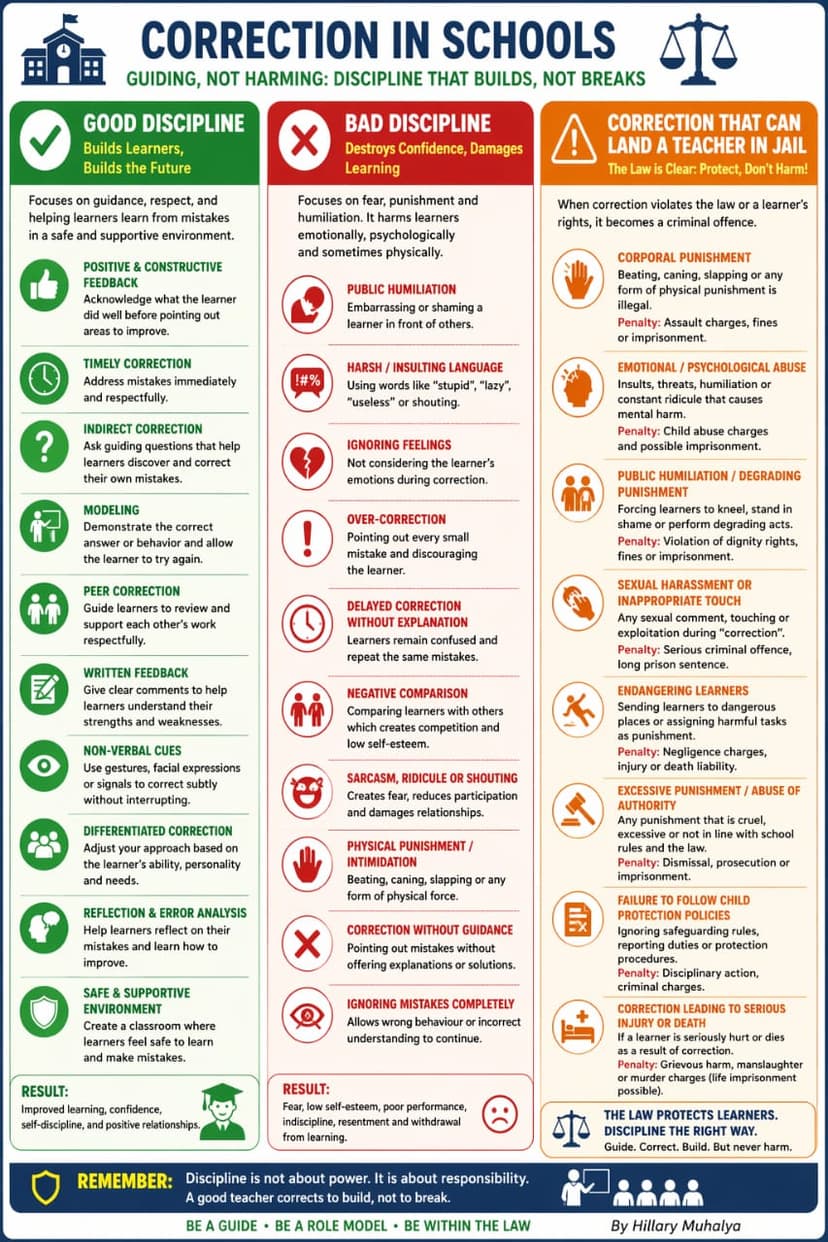
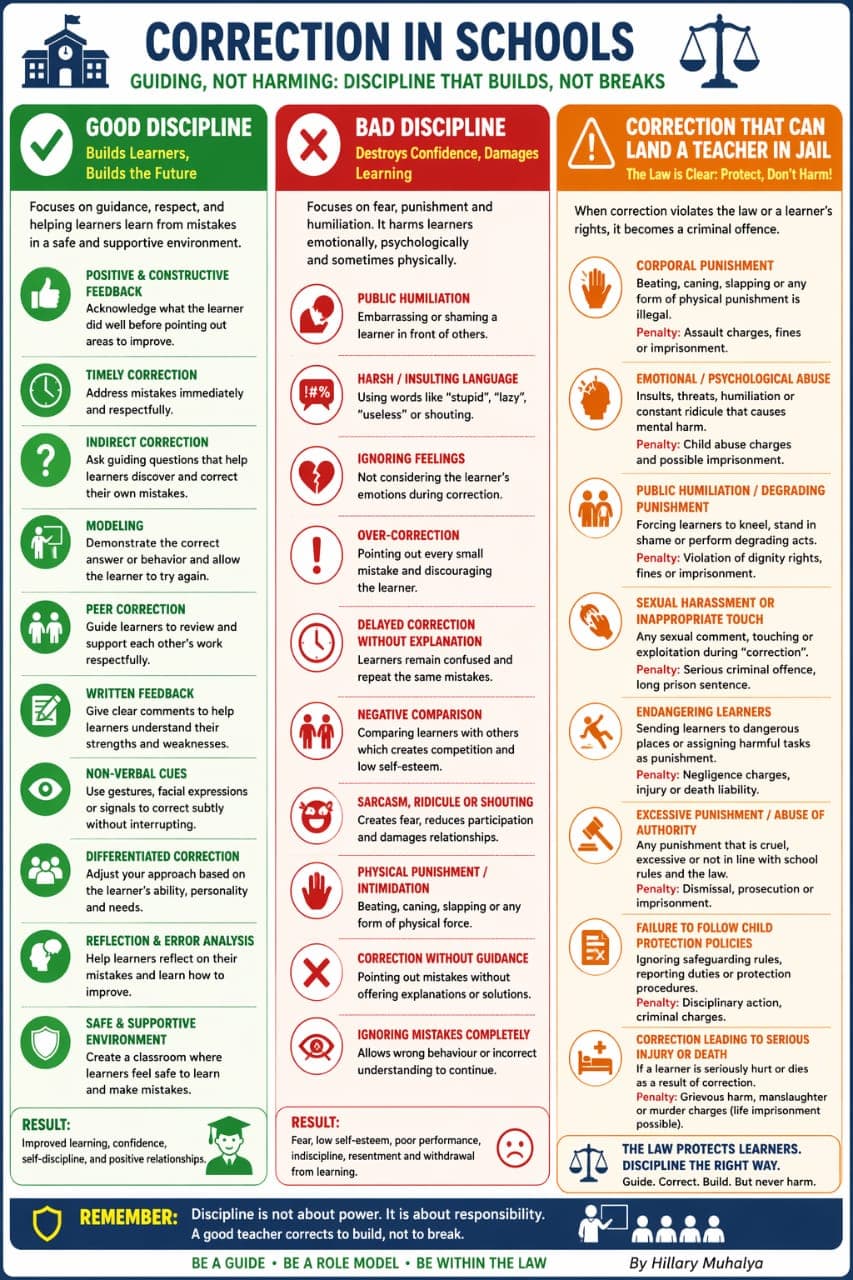
Infographic showing how teachers can address student indiscipline in school. Photo Courtesy
Effective correction begins with positive and constructive feedback. This means that a teacher should first acknowledge what the learner has done correctly before pointing out areas that need improvement. For example, a teacher may appreciate a learner’s effort in structuring an essay before guiding them on how to improve grammar or organization. This approach helps learners feel valued and reduces the fear of being corrected, making them more open to learning.
Timely correction is another important strategy. Mistakes should be addressed as soon as they occur, especially during oral activities such as reading, speaking, or classroom discussions. Immediate correction helps prevent learners from repeating errors and reinforces correct understanding. However, timing alone is not enough; correction must always be delivered respectfully to avoid embarrassing or discouraging the learner.
ALSO READ:
https://educationnews.co.ke/jss-teachers-threaten-strike-from-april-27-over-delayed-confirmations-health-cover/
Indirect correction is also widely used in effective teaching. Instead of directly giving the correct answer, the teacher guides the learner through questions that help them identify and correct their own mistake. This method encourages critical thinking, reflection, and independence. It helps learners become active participants in their learning rather than passive recipients of information.
Another effective method is modelling. In this approach, the teacher demonstrates the correct response or behaviour after a mistake is made. The learner is then given an opportunity to repeat or practise the correct version. This is especially useful in subjects such as languages, mathematics procedures, science experiments, and practical skills, where demonstration strengthens understanding.
Peer correction, when properly supervised, can also be an effective learning strategy. Learners are allowed to review and correct each other’s work, which promotes collaboration, teamwork, and analytical thinking. However, it must be guided carefully by the teacher to ensure that feedback remains respectful and constructive rather than mocking or harmful.
Written feedback is another important tool in correction. Instead of simply awarding marks, teachers should provide comments that explain what was done well and what needs improvement. This helps learners understand their mistakes more clearly and gives them direction on how to improve in future tasks.
Non-verbal communication is also part of effective correction. Teachers may use gestures, facial expressions, or pauses to signal that something is incorrect without interrupting the flow of the lesson. This method is subtle and helps maintain a positive classroom atmosphere while still guiding learners.
Differentiated correction is equally important because learners are not the same. Some are more confident, others are sensitive; some learn quickly, others need more time. Teachers must therefore adjust their correction methods depending on the individual learner. For example, some learners may benefit from private correction, while others may respond well to group feedback.
Encouraging reflection and error analysis is another powerful approach. Instead of only pointing out mistakes, teachers should help learners understand why the mistake occurred and how to avoid it in the future. This deepens understanding and promotes long-term retention of knowledge. A supportive classroom environment is essential in this process because learners must feel safe to make and correct mistakes without fear.
ALSO READ:
https://educationnews.co.ke/how-to-bounce-back-to-school-after-holidays-a-guide-for-students/
Despite these effective strategies, there are also many harmful and ineffective ways of correcting learners that should be avoided. One of the most damaging is public humiliation or embarrassment. Correcting a learner harshly in front of classmates can destroy confidence and make the learner afraid to participate in future lessons.
Harsh or insulting language is another poor method. Calling learners names such as “stupid,” “lazy,” or “useless” is emotionally harmful and unprofessional. Such language does not correct behaviour; instead, it damages the learner’s self-esteem and creates resentment toward the teacher and the learning process.
Ignoring learners’ feelings during correction is also harmful. Learners are human beings with emotions, and when their feelings are dismissed, they may withdraw from learning or develop negative attitudes toward school. Similarly, over-correction, where every small mistake is highlighted, can overwhelm learners and discourage creativity and participation.
Delayed correction without explanation is another ineffective practice. When learners are simply told they are wrong without understanding why, they remain confused and are likely to repeat the same mistakes. Negative comparison between learners is also harmful because it creates unhealthy competition and discourages weaker learners.
Sarcasm, ridicule, frustration, and impatience are also inappropriate correction methods. These behaviours create fear in the classroom and reduce learner participation. Learners who fear being laughed at or shouted at are less likely to answer questions or engage in learning activities. Physical punishment or intimidation is strictly prohibited in modern education systems because it violates learners’ rights and causes physical and psychological harm.
From a legal and professional perspective, correction in schools must always respect the learner’s dignity, safety, and right to education. Generally accepted legal methods of correction include positive discipline, respectful verbal correction, guidance and counselling, and restorative practices. Restorative approaches focus on helping learners understand the impact of their actions and encouraging them to make amends.
Other legally accepted methods include non-physical sanctions such as warnings or corrective assignments, time-out or reflection periods, written warnings for repeated misconduct, parental or guardian involvement, and peer mediation under teacher supervision. Teachers are also expected to model good behaviour and reinforce positive conduct through praise and recognition. These methods are lawful because they focus on development rather than harm.
When correction is done improperly and violates the law, it can lead to serious consequences, including imprisonment. In Kenya, there have been cases where teachers were convicted and jailed after administering corporal punishment that resulted in serious injury or death of learners. Such cases are prosecuted under offences like assault causing grievous harm or manslaughter under the Penal Code and child protection laws. Courts have imposed significant prison sentences depending on the severity of the harm caused.
Similarly, in the United Kingdom, teachers have also been prosecuted and jailed for excessive use of force or assault on pupils. Even when discipline was claimed as justification, courts ruled that the force used was excessive and criminal. These cases show a clear legal principle: once correction becomes abuse, excessive force, or humiliation, it becomes a criminal offence regardless of the intention behind it.
In conclusion, correction in schools must balance discipline, learning, and legal responsibility. Effective correction builds learners through guidance, patience, and constructive feedback, while ineffective or harmful methods can damage learners and lead to serious consequences. Teachers are expected to act as mentors and protectors of learners’ dignity, ensuring that every correction promotes growth rather than fear. Ultimately, correction should educate, not punish; build, not destroy; and always remain within the law.
By Hillary Muhalya
You can also follow our social media pages on Twitter: Education News KE and Facebook: Education News Newspaper for timely updates.
>>> Click here to stay up-to-date with trending regional stories
>>> Click here to read more informed opinions on the country’s education landscape




Reader Discussion (0)
Sign in to comment