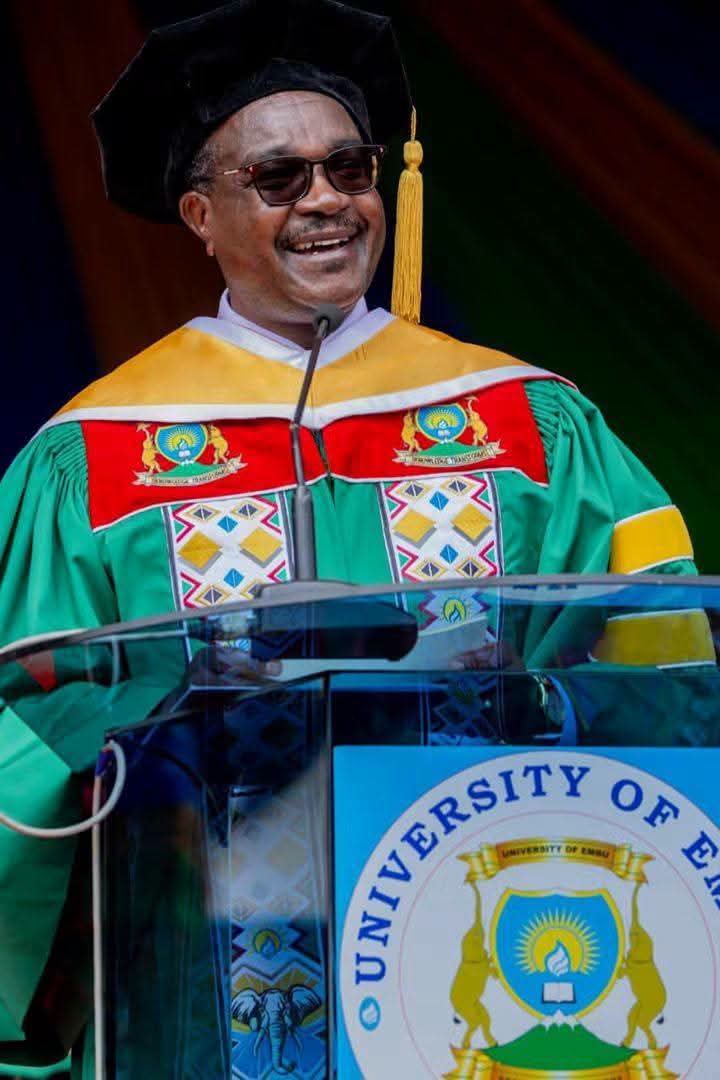
- The University of Embu has conferred various qualifications on 2,367 graduands during its 11th graduation.
- Ogamba urged graduates to apply their skills, innovation and knowledge to Kenya’s development.
- The Class of 2026 enters a labour market increasingly transformed by technology and entrepreneurship.
Education Cabinet Secretary Julius Migos Ogamba has challenged the University of Embu Class of 2026 to move beyond academic achievement and use their knowledge, skills and innovation to make a meaningful contribution to Kenya’s development.
Ogamba delivered the message on Friday, August 21, 2026, when he presided over the University of Embu’s 11th Graduation Ceremony, where 2,367 graduands were awarded various qualifications. The university described the occasion as a major celebration of academic achievement, resilience and the transition of its students into the next phase of their lives.
The CS’s presence at the ceremony comes at a time when the Government is placing greater emphasis on transforming higher education from a system focused mainly on awarding qualifications into one that produces graduates capable of solving real-world problems.
Ogamba has repeatedly stressed that Kenya’s universities must strengthen the connection between education, research, innovation, industry and employment. His message to graduates therefore comes against a wider national conversation on how institutions of higher learning can prepare young people for an economy increasingly shaped by technology, entrepreneurship and rapidly changing skills requirements.
For the graduates, the ceremony marks the end of years of lectures, examinations, research and practical training. But Ogamba’s message carries a broader implication: graduation should not be regarded as the final destination of education, but as the beginning of a responsibility to apply knowledge.
Beyond academic qualifications
The challenge is particularly significant in a country where thousands of young people enter the labour market every year. A university certificate, while valuable, cannot by itself guarantee employment. Graduates increasingly need to demonstrate creativity, adaptability, digital competence, communication skills and the ability to identify opportunities where others see challenges.
Ogamba has also been advocating for stronger links between universities and the private sector so that research and innovations generated within institutions can translate into enterprises, jobs and practical solutions. That approach places universities at the centre of Kenya’s economic transformation rather than treating them simply as institutions that produce graduates.
The Government has simultaneously been implementing reforms in higher education financing aimed at widening access and ensuring that students from financially disadvantaged backgrounds are not excluded from university because of their inability to meet fees.
The student-centred funding model has been presented as part of this broader effort to make higher education more accessible, with government support targeted according to students’ levels of financial need. The Government has also continued expanding university and tertiary placement opportunities as demand for post-secondary education grows. In 2026, KUCCPS placed 293,869 students in universities, TVET institutions and other tertiary colleges, illustrating the expanding scale of Kenya’s higher education system.
The graduation in Embu therefore comes at an important moment in the transformation of Kenya’s education sector.
Changing labour market
The Class of 2026 is also entering a labour market that is being reshaped by artificial intelligence, automation, digital platforms and new forms of entrepreneurship. Traditional career paths are changing, and graduates are increasingly expected to continue learning long after leaving university.
Ogamba’s message can consequently be read as a call for graduates to remain curious and adaptable. Their degrees should provide a foundation, but their willingness to acquire new competencies, innovate and respond to emerging opportunities will determine how effectively they navigate the future.
The CS’s address also fits into the Government’s wider preparations for the arrival of the first CBE cohort into universities. Education authorities have been working with universities, regulators and other stakeholders to prepare institutions for learners whose education will have placed greater emphasis on competencies, practical skills and application of knowledge.
The transition will require universities to rethink not only what they teach, but also how they teach, assess and prepare learners for the workplace.
Education for national development
For the University of Embu graduates, this means leaving the institution with more than academic certificates. They are expected to become professionals, entrepreneurs, researchers, innovators and responsible citizens capable of contributing to their communities and the country at large.
The university’s 11th graduation thus represents more than a ceremonial procession of gowns, certificates and photographs. It is another stage in Kenya’s continuing effort to expand access to higher education while ensuring that university education produces tangible social and economic value.
As the 2,367 graduands step into the world beyond the university gates, Ogamba’s message places a responsibility on them: the true value of their education will ultimately be measured not only by the certificates they receive, but by the problems they solve, the opportunities they create and the lives they transform.
The Government’s own higher-education reforms are moving in the same direction—towards widening access, strengthening university capacity, promoting research and innovation, and ensuring that education contributes directly to national development.
READ ALSO: Kiambu couple arrested over death of 7-year-old son after alleged beating
For the Class of 2026, therefore, graduation is not simply an ending.
It is a beginning—and the real examination starts outside the university gates.
By Hillary Muhalya
You can also follow our social media pages on Twitter: Education News KE and Facebook: Education News Newspaper for timely updates.
>>> Click here to stay up-to-date with trending regional stories
>>> Click here to read more informed opinions on the country’s education landscape
>>> Click here to stay ahead with the latest national news.