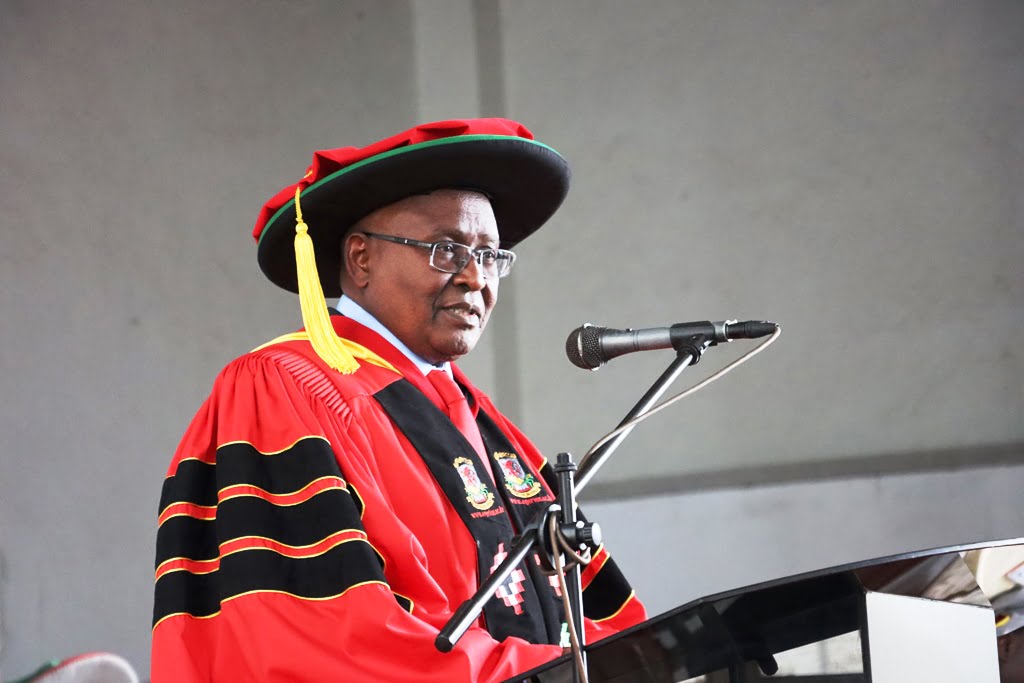
- A debate is emerging at Egerton University over the future of Vice Chancellor Prof. Isaac Kibwage.
UASU and student leadership reportedly hold differing positions as Kibwage’s current term approaches its expiry. - Hillary Muhalya examines whether continuity or leadership change would best serve the university’s future.
A potentially consequential governance debate is unfolding at Egerton University, with the University Academic Staff Union (UASU) and student leadership reportedly disagreeing over a proposed extension of Vice Chancellor Prof. Isaac Kibwage’s tenure.
Kibwage assumed office on October 5, 2021, and his current five-year term is expected to expire on October 4, 2026. As that date approaches, the question of who should lead Egerton into its next chapter is attracting growing attention within the university community.
The debate comes at a particularly delicate moment for the institution.
Egerton, one of Kenya’s oldest and most prominent public universities, is grappling with financial pressures, operational challenges and difficult institutional decisions. The university has been exploring measures aimed at improving its financial sustainability, including restructuring, reviewing programmes and addressing staffing costs.
It is against this challenging backdrop that the question of Kibwage’s tenure becomes much bigger than the future of one individual.
The case for continuity
For those who favour continuity, retaining the Vice Chancellor could provide stability at a time when Egerton is attempting to navigate complex financial and administrative challenges. A continuation of the current leadership could allow ongoing reforms, partnerships and restructuring initiatives to proceed without disruption.
Supporters of continuity may also argue that leadership transitions can create uncertainty, particularly when an institution is already under considerable financial pressure.
But those opposed to an extension are likely to view the matter through a different lens.
For them, the central issues are institutional accountability, transparent governance, stakeholder participation and the need for fresh leadership when a contractual term comes to an end.
The position of academic staff is particularly important. UASU represents a significant constituency within the university and has previously been involved in disputes concerning staff welfare, remuneration, promotions, working conditions and institutional decision-making.
Students, too, have a major stake in the outcome.
University leadership ultimately affects the quality of learning, availability of facilities, academic programmes, student welfare, research opportunities and the overall stability of the institution. Students therefore cannot be treated as passive observers in a debate that could shape the direction of their university.
Continuity or a new chapter?
The emerging disagreement consequently raises a fundamental question:
Should Egerton prioritise leadership continuity during a period of institutional turbulence, or should the expiry of the current tenure open the way for a new leadership chapter?
Whatever position different stakeholders take, the process must be guided by the university’s governing framework and the principles of fairness, transparency and institutional integrity.
Egerton’s immediate challenge is bigger than the fate of its Vice Chancellor. The university needs a sustainable financial model, motivated academic and non-academic staff, reliable student services, strong academic programmes, productive research and a leadership structure capable of restoring confidence.
The debate over Kibwage’s future therefore provides an opportunity for the university community to confront the deeper questions facing the institution.
Egerton’s interests must come first
As October 4 approaches, attention will inevitably intensify.
The ultimate test should not be whether one individual remains in office or leaves. It should be whether the decision strengthens Egerton University as an institution.
READ ALSO: Fifty years of seeing the world together through the art of friendship between Tom Carment and Robert Gray
Its students, staff, academic mission, financial sustainability and national reputation must remain at the centre of the conversation.
By Hillary Muhalya
You can also follow our social media pages on Twitter: Education News KE and Facebook: Education News Newspaper for timely updates.
>>> Click here to stay up-to-date with trending regional stories
>>> Click here to read more informed opinions on the country’s education landscape
>>> Click here to stay ahead with the latest national news.