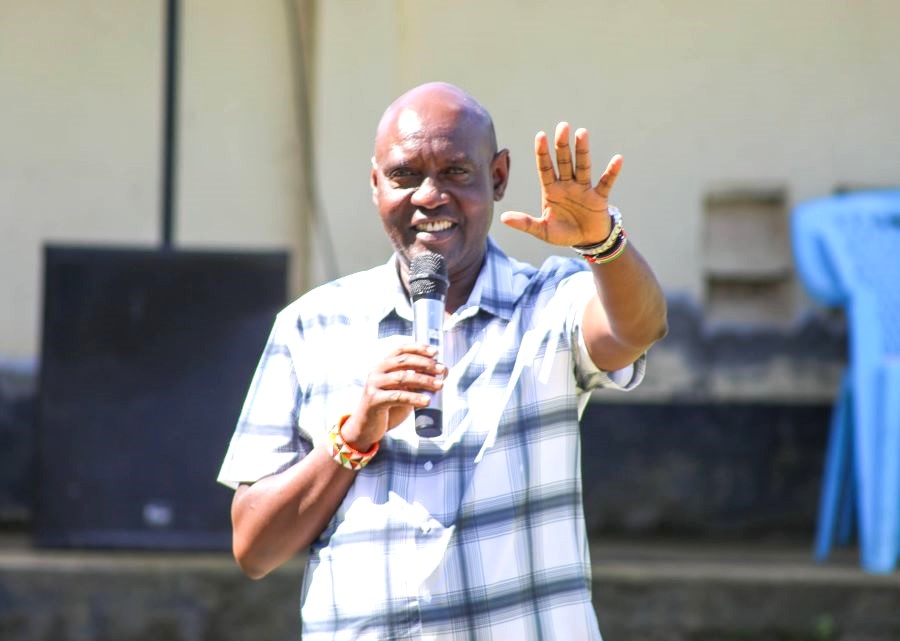
President William Ruto has appointed John Lekakeny Ololtuaa, as the Basic Education Principal Secretary in the Ministry of Education, marking a significant return of a senior administrator whose entire professional life has been shaped inside the education system.
He is now mandated to oversee at national level. Unlike typical appointments that draw heavily from academic, policy, or political backgrounds, Ololtuaa’s leadership identity has been formed through direct immersion in classrooms, school administration, county education offices, and regional coordination structures over several decades.
His journey began at the most basic level of education delivery, working as an untrained secondary school teacher at Olalui Secondary School before moving to Marani Secondary School in Kisii and Kilgoris Secondary School.
In these early years, he experienced firsthand the realities of Kenyan schooling systems—overcrowded classrooms, limited learning materials, teacher shortages, and learners whose performance was shaped as much by socioeconomic conditions as by curriculum demands. These formative experiences grounded his understanding of education as a lived system rather than a theoretical framework.
He later transitioned into school leadership as Principal of Ennosaen Secondary School, a position he held for approximately seven years. In this role, he carried full institutional responsibility for academic performance, teacher supervision, student discipline, school finances, infrastructure management, and community engagement.
ALSO READ:
PS Bitok: We will stick to the school calendar, no early half-term break despite unrest
The principalship exposed him to the operational pressure points of secondary education, where success depends on balancing policy expectations with on-the-ground realities that often conflict with resource limitations.
From school administration, he moved into government education bureaucracy as District Education Officer (DEO), serving in Suba, Mbita, and Bomet. This marked a shift from managing a single institution to supervising multiple schools across sub-counties. His role included implementing national education policies, monitoring compliance, coordinating teacher deployment, and supporting school leadership structures across diverse environments. This position deepened his understanding of how education policy translates—or fails to translate—into practice.
He was later promoted to County Director of Education in Bomet and Kajiado counties, where he oversaw entire county education systems. His responsibilities expanded to include examination coordination, quality assurance supervision, institutional performance monitoring, and management of education officers under his jurisdiction. At this level, he operated as a key link between national policy formulation and local execution, ensuring that government directives were implemented consistently across hundreds of schools.
His career advanced further when he became Regional Director of Education, serving in Eastern, Nairobi, Rift Valley, and Central regions. In this senior field role, he supervised thousands of schools and millions of learners, coordinated county directors, managed system-wide education performance, and responded to regional-level challenges affecting academic continuity and administrative stability. This position placed him among the highest-ranking field administrators in the Ministry of Education before his exit in 2022.
By the time he left the education sector, Ololtuaa had accumulated nearly three decades of continuous service across every major operational tier of the system: teacher, assistant teacher, principal, district officer, county director, and regional director. This rare vertical progression gave him an unusually complete understanding of how Kenya’s education system functions from classroom delivery to national coordination.
After his long service in education, he transitioned into national government and served as Principal Secretary in the Ministry of Tourism. This role expanded his exposure to inter-ministerial coordination, national planning systems, and executive-level governance structures beyond education. It also added a cross-sector dimension to his administrative experience, strengthening his capacity to operate within broader government frameworks.
His return to the Ministry of Education as Principal Secretary now places him at the apex of a system he has experienced from every level beneath him. This positions him differently from many senior officials who enter ministries primarily at policy level without extensive field exposure. In Ololtuaa’s case, his leadership is built on institutional memory accumulated over decades of direct involvement in education delivery and administration.
One of his strongest advantages lies in his deep institutional knowledge of how the education system actually functions beyond policy documents. Having worked across classrooms, schools, counties, and regional offices, he understands how decisions made at the national level affect implementation at the lowest levels. This provides him with a practical lens for evaluating policy effectiveness and identifying structural inefficiencies within the system.
ALSO READ:
Inside Kenya’s boarding schools’ crisis: Are we pushing learners too far?
He also carries strong credibility among education stakeholders, particularly teachers and principals, due to his lived experience in similar roles. This shared professional background enhances trust and communication between the ministry and field officers, which is often a challenge in policy implementation environments. His familiarity with school-level realities enables him to anticipate operational challenges before they escalate into systemic failures.
Another key strength is his extensive administrative experience across multiple governance layers. Having managed schools, districts, counties, and regions, he possesses a rare understanding of how education systems operate at scale. This equips him with the ability to coordinate complex administrative structures involving thousands of institutions and multiple levels of government oversight.
His career also reflects strong crisis management capabilities developed during his tenure as Regional Director of Education, where he handled large-scale operational challenges affecting entire regions. This includes managing system disruptions, coordinating responses to institutional challenges, and ensuring continuity of learning across diverse environments under pressure.
Despite these strengths, his leadership also faces structural challenges inherent in the role. One key concern is the risk that long-term immersion in the same system may encourage incremental rather than transformative reform approaches. Leaders with deep institutional backgrounds sometimes prioritise stability over disruption, which may limit the pace of structural change required in a rapidly evolving education landscape.
He also faces the demanding transition from field-based administration to national policy strategy, where responsibilities extend beyond implementation into budgeting, long-term planning, inter-governmental coordination, and political engagement. This requires a shift in focus from operational supervision to high-level strategic design.
Additionally, expectations from education stakeholders are extremely high. Teachers, principals, and administrators are likely to expect immediate improvements in staffing, workload management, infrastructure development, and system stability. These expectations exist within a context of limited resources and competing national priorities, making delivery complex.
The education docket itself remains highly sensitive and politically charged, particularly around curriculum reforms, examination systems, and funding structures. This means that policy decisions often attract public scrutiny and require careful balancing between technical necessity and political acceptability.
Despite these challenges, Ololtuaa’s appointment is widely viewed as strategically significant because it reduces one of the most persistent gaps in education governance: the disconnect between policy formulation and classroom implementation. His lived experience across all levels of the system provides him with a unique advantage in understanding not only what should be done, but what is realistically possible within existing structures.
This alignment between experience and responsibility is why many observers believe he stands a better chance of stabilising and potentially strengthening the education sector compared to leaders without extensive field exposure. He does not require orientation into the system; he requires activation of institutional memory already built over decades.
Ultimately, his appointment represents a rare form of leadership continuity in Kenya’s public service system—one where authority is shaped not by external interpretation of the system, but by internal experience within it. Whether this advantage translates into meaningful reform will depend on his ability to convert deep institutional knowledge into decisive national leadership at a time when the education sector is under sustained pressure to evolve.
For now, Ololtuaa enters office not as an outsider learning the system, but as an insider returning to refine it from the top.
By Hillary Muhalya
You can also follow our social media pages on Twitter: Education News KE and Facebook: Education News Newspaper for timely updates.
>>> Click here to stay up-to-date with trending regional stories
>>> Click here to read more informed opinions on the country’s education landscape