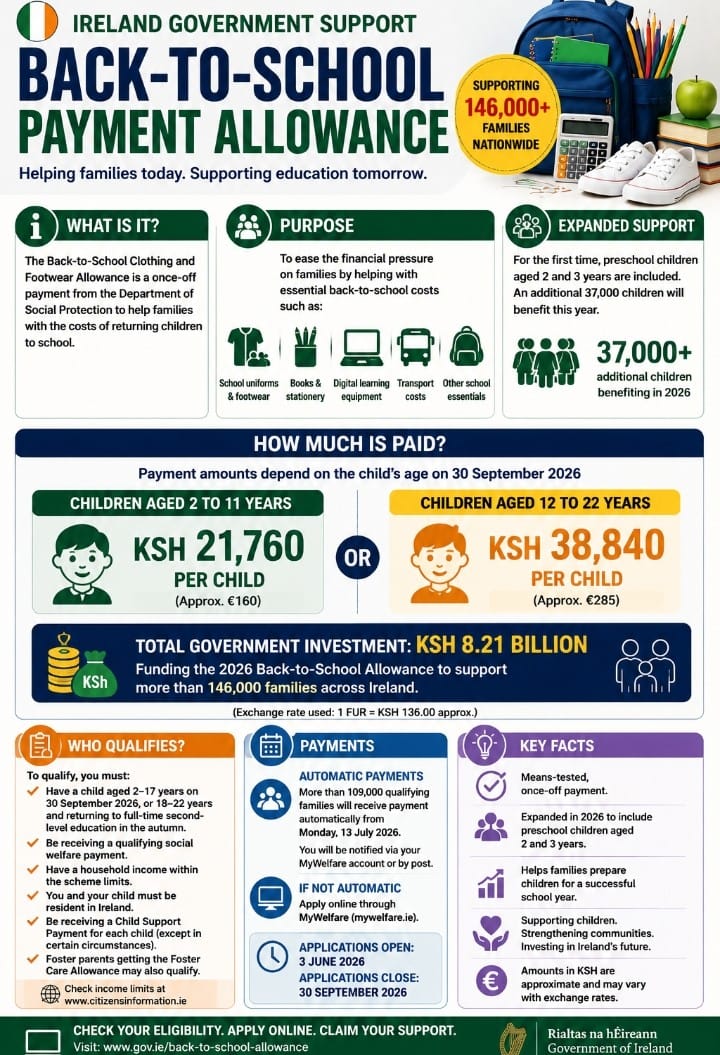
- This year, Ireland has committed €60.4 million to its expanded Back-to-School Clothing and Footwear Allowance
- The financial support programme is expected to benefit more than 146,000 families across the country
- The Irish Government has also invested directly in families, recognising that a child’s ability to learn begins with having the essentials needed to attend school
As governments around the world grapple with the rising cost of education and increasing pressure on household budgets, Ireland has adopted a practical approach that is attracting growing attention. Rather than focusing solely on funding schools and improving infrastructure, the Irish Government has also invested directly in families, recognising that a child’s ability to learn begins with having the essentials needed to attend school.
This year, Ireland has committed €60.4 million to its expanded Back-to-School Clothing and Footwear Allowance, a once-off financial support programme expected to benefit more than 146,000 families across the country. The initiative provides direct payments to eligible households before the start of the academic year, helping parents purchase school uniforms, footwear, books, stationery, digital learning devices and other essential items.
The programme reflects a broader understanding that education is about more than classrooms, teachers and textbooks. It also depends on whether families can afford the everyday costs that accompany a new school year. By helping parents meet those expenses, the government aims to ensure that children arrive at school ready to learn without unnecessary financial hardship.
One of the most significant developments this year is the expansion of the scheme to include preschool children aged two and three. Government estimates indicate that about 37,000 additional children will benefit from the programme as a result of this policy change. The move acknowledges that the financial demands of education begin long before a child enters primary school and demonstrates a commitment to supporting early childhood learning.
The allowance is structured to reflect the changing costs of education as children grow older. Families receive €160 for every eligible child aged 2 to 11 years, while those with children aged 12 to 22 years returning to full-time second-level education receive €285. The higher payment recognises that secondary school education often involves greater expenses, including more specialised uniforms, learning materials and transport costs.
ALSO READ:
KNEC sets July 30 deadline for registration of Grade 10 learners for Senior School Assessments
Another feature that distinguishes Ireland’s approach is its efficient delivery system. More than 109,000 qualifying families receive the payment automatically through the country’s social protection system, eliminating the need for fresh applications in many cases. This reduces administrative burdens while ensuring that financial assistance reaches households before schools reopen. Families who are not automatically enrolled still have the opportunity to apply online before the application deadline.
The programme is also carefully targeted. Rather than offering universal payments, eligibility is determined through a means test based on household income and qualifying social welfare payments. This ensures that government resources are directed towards families facing the greatest financial challenges while maintaining responsible public spending.
At a time when inflation continues to push up the cost of uniforms, transport, school supplies and digital learning equipment, Ireland’s model demonstrates how targeted financial assistance can complement broader investments in education. The policy recognises that educational success is influenced not only by what happens inside the classroom but also by the circumstances children face at home.
Importantly, the initiative promotes educational inclusion by reducing the likelihood that children will begin the school year without the resources they need. It also helps ease the financial pressure on parents, allowing families to focus more on supporting their children’s learning rather than worrying about the immediate cost of school preparation.
Ireland’s back-to-school allowance offers a useful example of how education policy and social protection can work together. Instead of treating family welfare and education as separate priorities, the programme integrates the two, ensuring that children from lower-income households have a stronger foundation for learning.
As countries continue exploring ways to make education more accessible and equitable, Ireland’s approach is likely to remain a point of interest. While every nation faces different economic realities and policy priorities, the principle behind the scheme is widely relevant: supporting families can be an effective way to support education.
In an era where the cost of living continues to challenge households worldwide, Ireland’s investment sends a clear message that educational opportunity is strengthened not only by funding schools, but also by helping families meet the essential costs that allow children to attend school prepared, confident and ready to succeed.
By Hillary Muhalya
You can also follow our social media pages on Twitter: Education News KE and Facebook: Education News Newspaper for timely updates.
>>> Click here to stay up-to-date with trending regional stories
>>> Click here to read more informed opinions on the country’s education landscape
>>> Click here to stay ahead with the latest national news.