- Nearly 700,000 of the 900,000 candidates who sat KCSE in 2024 failed to score the C+ needed for direct university entry, raising questions about their pathways afterwards.
- KUCCPS has shifted its policy since 2023, requiring students to select courses only after KCSE results are released rather than beforehand.
- Schools have been urged to provide stronger career guidance, noting that every KCSE grade, from A to E, has a corresponding tertiary education pathway.
In the recent past, the government could not account for close to 700,000 Form Four leavers who sat KCSE exams in 2024. The statistics are startling: out of around 900,000 candidates who sat the exam, only about 246,000 scored C+ and above, the minimum grade for direct university entry.
So where did the remaining 700,000 Form Four leavers go? Several possibilities exist. Some who missed the C+ cut-off may have given up on furthering their studies altogether. Others may have travelled abroad to study, while some likely joined private institutions across the country.
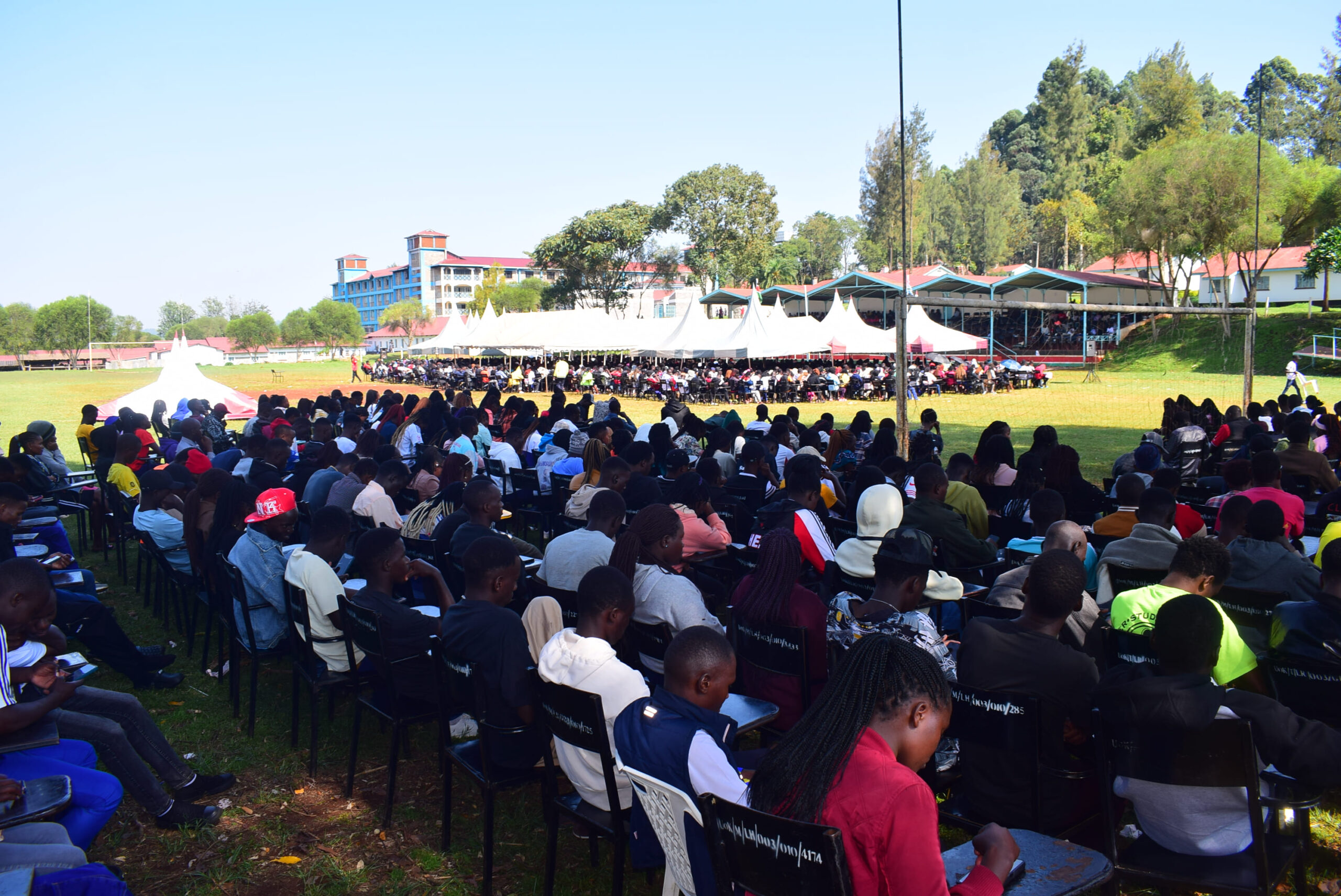
While addressing Form Four candidates in a school in the Mount Kenya region recently, I asked them where they thought the 700,000 had disappeared to, and they jokingly suggested some had simply gotten married. As a career educator, though, my own view is more serious: much of this gap can be attributed to scant guidance and advice on choice of courses. Schools should talk more about career choices, giving Form Fours what Dr Stephen Covey calls “an end in mind” in his classic The 7 Habits of Highly Effective People.
ALSO READ: Government reclaims land for Kajiado East TVC after alleged grab
A Shift in How Students Choose Courses
Students used to access the Kenya Universities and Colleges Central Placement Service (KUCCPS) portal before sitting their KCSE exams. In 2023, however, KUCCPS issued a circular to principals abolishing centre or school application of courses. Today, Form Four leavers choose their courses on the KUCCPS portal only after KCSE results are released.
As a career educator, I support this shift because by the time Form Fours graduate from high school, most are young adults, close to 18 years of age, mature enough to make such decisions. In his book Your Career Questions Answered, Sam Muriuki introduces readers to Ginsberg’s (1951) Career Choices Developmental Pattern, which identifies three stages: fantasy, tentative and realistic.
The fantasy phase occurs between ages 6 and 12, when children dream of glamorous professions without any real commitment, shaped largely by what they observe in media and around them. The tentative phase coincides with adolescence, roughly ages 12 to 17, when teens begin to seriously visualise and align themselves with career paths. As Robert Kiyosaki quotes the Vietnamese monk Thich Nhat Hanh in Cashflow Quadrant: “Knowing the right path in life should be the goal, the highest ideal.”
The final, realistic phase begins at 18, when young adults make career choices based on their actual situation, ability and preference. It is at this stage that career choices become specific, which is why I support choosing courses after KCSE results are released, provided this is preceded by proper guidance. Form Fours should not leave high school without knowing how to further their studies, since KUCCPS has opportunities for every mean grade scored in KCSE, from A to E.
After KCSE results are released, Form Fours should understand that reaching their goals is like ascending a tall building: some will find a lift, while others will need to take the stairs. The journey may be easy for some and long and tedious for others, but everyone can eventually reach the top. Students who miss direct university entry should not give up, since what matters most is what they choose to do with the grades they score. It is wrong for a Form Four to write themselves off over a C or an E in KCSE.
Form Fours can access information on courses across public and private universities, Kenya Medical Training Colleges (KMTCs), secondary teacher-training colleges and public TVET institutions, spanning degree, diploma and certificate (craft and artisan) programmes. A mean grade of C+ and above qualifies a student for degree courses in universities. A mean grade of C- and above qualifies them for diploma courses in colleges, with the exception of Diploma in Nursing at KMTCs, which requires a mean grade of C plain, with a C- in Mathematics and D+ in Biology. A mean grade of D and above opens the door to a craft certificate course, while a mean grade of E qualifies a learner for an artisan certificate course.
ALSO READ:
Redefining school safety: Eliminating dormitory arson through early interception and ownership
How the KUCCPS application process works
According to the KUCCPS School/Centre Application for Degree and TVET Programmes: Principals’ Application Guide, students have 18 choices in total: six degree options (1a, 1b, 1c, 2, 3 and 4), four diploma options, four craft certificate options and four artisan certificate options. Students are advised to apply only for programmes they would genuinely be comfortable pursuing should they secure placement. Where a student does not wish to apply, the choice fields should be left blank, with only contact details filled in; an unfilled portal typically indicates a student is either uninterested in joining a tertiary institution or planning to study abroad.
For degree courses, choices 1a to 1c should represent the same programme at different universities, for example, Medicine at the University of Nairobi, Maseno University and Kabianga University. Where a programme exists at only one or two institutions, students should enter only what is available and skip the rest.
KUCCPS opens its portal for application to degree, diploma and certificate (craft and artisan) programmes, with students required to pay Sh1,500 for the application process and Sh1,050 for inter-university transfers, paid through eCitizen. The process includes a first and second revision of course choices. In placing students, KUCCPS considers merit, academic performance and affirmative action.
When choosing courses, students should weigh factors such as cluster requirements, accreditation, fees, accommodation, location, ranking, marketability, work-study programmes and scholarship opportunities. On cluster points specifically, students should know that each course requires four key subjects, and that cluster requirements differ by university, often higher in city-based campuses due to greater demand. Meeting the C+ cut-off of 46 points alone does not guarantee university placement; KUCCPS places students in their courses of choice only after they also meet the relevant cluster requirements.
Before Form Fours walk out of high school to face the wider world, principals and class teachers should ensure they invite a career educator to speak to them about how to remain active, productive, creative and innovative after Form Four, the best short courses they can pursue while awaiting KCSE results or before joining universities and colleges, avenues for funding tertiary education, available scholarship opportunities and legitimate ways to begin earning an income. Form Fours should also be taken through the dos and don’ts of what comes next after KCSE.
By Victor Ochieng’
Schools interested in such guidance programmes, including online sessions held on Zoom after KCSE results are released, can reach out via vochieng.90@gmail.com or 0704420232.
Get more stories from our website: Education News
To write to us or offer feedback, you can reach us at: editor@educationnews.co.ke
You can also follow our social media pages on Twitter: Education News KE and Facebook: Education News Newspaper for timely updates.
>> Click here to stay up-to-date with trending regional stories