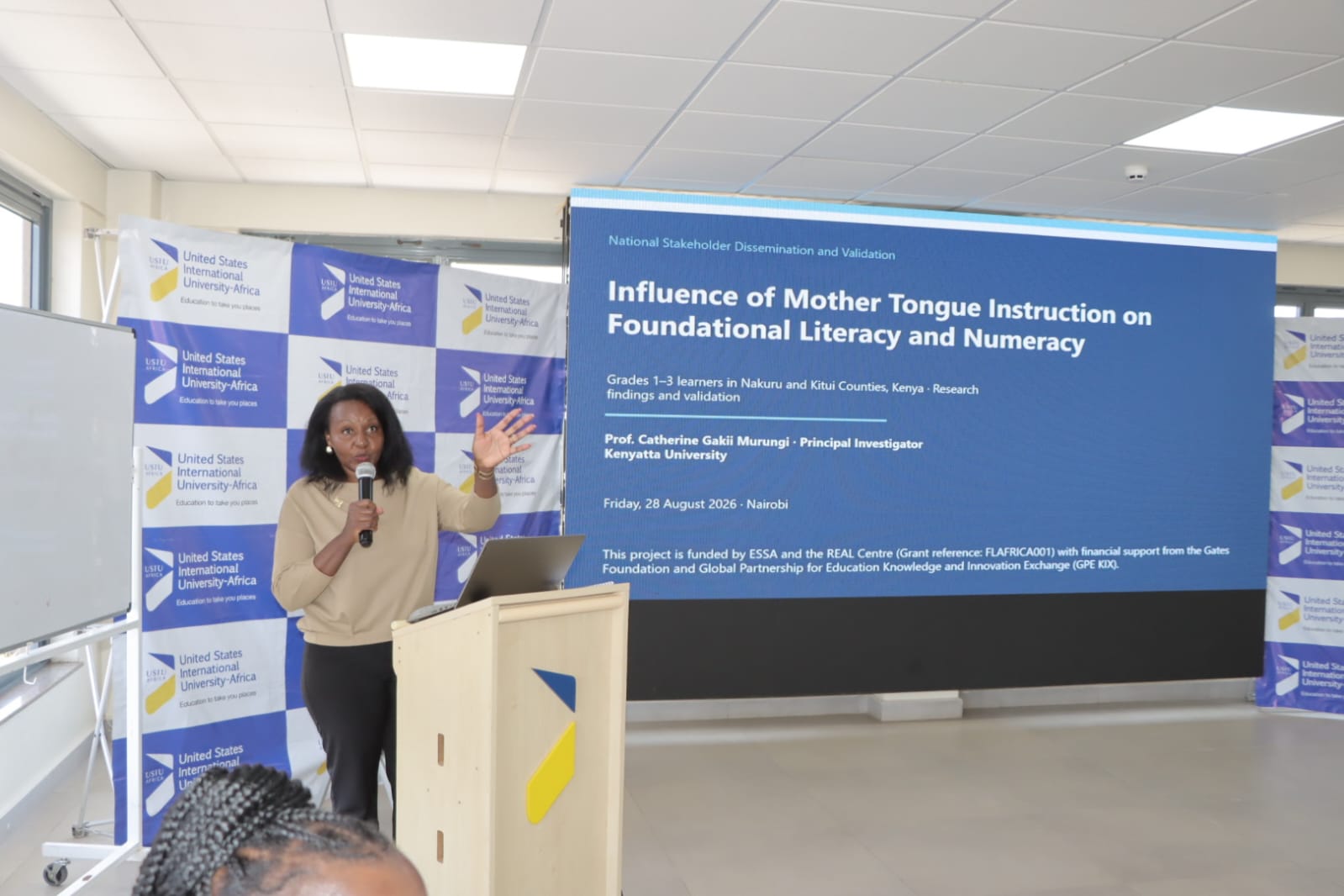
- A study has found that 98.6 per cent of surveyed teachers are aware of Kenya’s language of instruction policy, yet mother tongue accounted for only about one per cent of observed classroom language use.
- The study has proposed school-level linguistic mapping, stronger teacher training and a multisectoral policy review, alongside three possible instructional pathways for different school settings.
A new study has revealed a wide gap between teachers’ awareness of Kenya’s language of instruction policy and its actual implementation in classrooms, sparking debate among education stakeholders on the need to review the five-decade-old policy.
The study, titled Influence of Mother Tongue Instruction on Foundational Literacy and Numeracy among Grades 1–3 Learners in Kitui and Nakuru Counties, was led by Prof. Catherine Gakii Murungi, Professor of Early Childhood Education in the Department of Early Childhood and Special Needs Education at Kenyatta University. It involved 24 schools, 72 teachers and 1,080 learners, and included 48 classroom observations, 38 key-informant interviews and six focus-group discussions with 72 parents and guardians.
Presenting the findings during a stakeholders’ validation and policy briefing meeting at USIU Africa on August 28, Prof. Murungi said 71 of the 72 teachers surveyed, 98.6 per cent, were aware of the government’s language of instruction policy, which provides for use of the language of a school’s catchment area, including a mother tongue or local language, during the early years of education.
Despite that high awareness, classroom observations showed mother tongue or local language accounted for only about one per cent of observed classroom language use, and none of the 48 lessons observed was predominantly taught in a mother tongue. English accounted for approximately 65 per cent of observed language use and Kiswahili about 34 per cent; limited local-language use was recorded in Kitui, but none of the 24 lessons observed in Nakuru used mother tongue or local language at all.
ALSO READ:
Why some teachers don’t want to be called “mwalimu” outside the school compound
“The most striking finding was the gap between policy awareness and classroom practice,” Prof. Murungi said, adding that awareness does not automatically translate into implementation. She pointed to teacher preparation, availability of learning materials, teachers’ language competencies, classroom linguistic diversity, institutional support and community expectations as factors shaping classroom practice. Only seven of the 72 teachers, about 10 per cent reported receiving formal training specifically in mother-tongue instruction, which Prof. Murungi said leaves many teachers aware of the policy but without the specialised preparation, guidance and resources to implement it. She called for multilingual teaching approaches to be incorporated into both pre-service and in-service teacher education.
The study also assessed learners’ foundational literacy and numeracy, recording an average literacy score of 43.63 out of 76 and an average numeracy score of 40.32 out of 90. Prof. Murungi cautioned that the study did not conclude that mother tongue instruction produced better or poorer learning outcomes, noting that because it was scarcely occurring in the observed classrooms, its effectiveness could not be adequately evaluated. “Our study is not saying that mother tongue works or does not work,” she said. “Our strongest finding is that there is a substantial gap between policy awareness and classroom implementation.”
She posed a direct question to representatives of the Ministry of Education, Quality Assurance and Standards, and the Kenya Institute of Curriculum Development (KICD) at the dissemination: does Kenya still need the current language-in-education policy, and if so, how should it be implemented? The question prompted stakeholders to examine whether the policy, rooted in the 1976 Gachathi Commission, still reflects the linguistic realities of Kenyan communities five decades later. Responding, Ms Ann Gachoya, Director of Education and Deputy Head of the Directorate of Primary Education, said she was awaiting Prof. Murungi’s policy brief, provided it recommends a review of the policy.
Beyond the policy review, Prof. Murungi proposed school-level linguistic mapping to establish the languages understood by learners and teachers before an instructional approach is selected, as well as factoring in teachers’ language competencies during deployment. The meeting discussed three context-responsive options: a local-language pathway for schools where learners and teachers share a common language; a multilingual pathway for linguistically diverse schools; and a transition pathway providing planned movement from a familiar language to Kiswahili or English. Many stakeholders considered Kiswahili more workable in urban, peri-urban and multilingual schools, while local-language instruction was viewed as more feasible in linguistically homogeneous settings.

Although outside her research focus, Prof. Murungi reminded participants that indigenous languages must be protected from disappearing, and participants proposed that predominant indigenous languages could be taught in schools for language development and preservation without necessarily being made examinable subjects. Stakeholders also called for improved teacher preparation, adequate teaching and assessment materials, and greater engagement with parents and communities.
ALSO READ: Kaimosi Friends University quashes rumours over Vokoli campus plans
The project is funded by Education Sub-Saharan Africa (ESSA) and the Research for Equitable Access and Learning (REAL) Centre, with financial support from the Bill & Melinda Gates Foundation and the Global Partnership for Education Knowledge and Innovation Exchange (GPE KIX). ESSA Senior Manager for Foundational Learning, Dr Dominic Okullo, said the organisation takes a systems approach, identifying challenges and co-designing solutions with local education researchers, higher education leaders, policymakers, funders and employers, to ensure research generates actionable insights for decisions, policy and practice. Prof. Murungi said no single institution can address the implementation gap independently.
The stakeholder discussions identified several priorities for strengthening implementation: a multisectoral review of the language of instruction policy to reflect current linguistic, demographic and educational realities; school-level linguistic mapping before selecting an instructional pathway; strengthened pre-service and in-service teacher preparation for local-language, multilingual and language-transition pedagogy; development, financing and distribution of appropriate teaching, learning and assessment materials; and alignment of teacher deployment, classroom monitoring, assessment and language transition with each school’s linguistic realities and instructional pathway.
By Obegi Malack
Get more stories from our website: Education News
To write to us or offer feedback, you can reach us at: editor@educationnews.co.ke
You can also follow our social media pages on Twitter: Education News KE and Facebook: Education News Newspaper for timely updates.
>>> Click here to stay up-to-date with trending regional stories