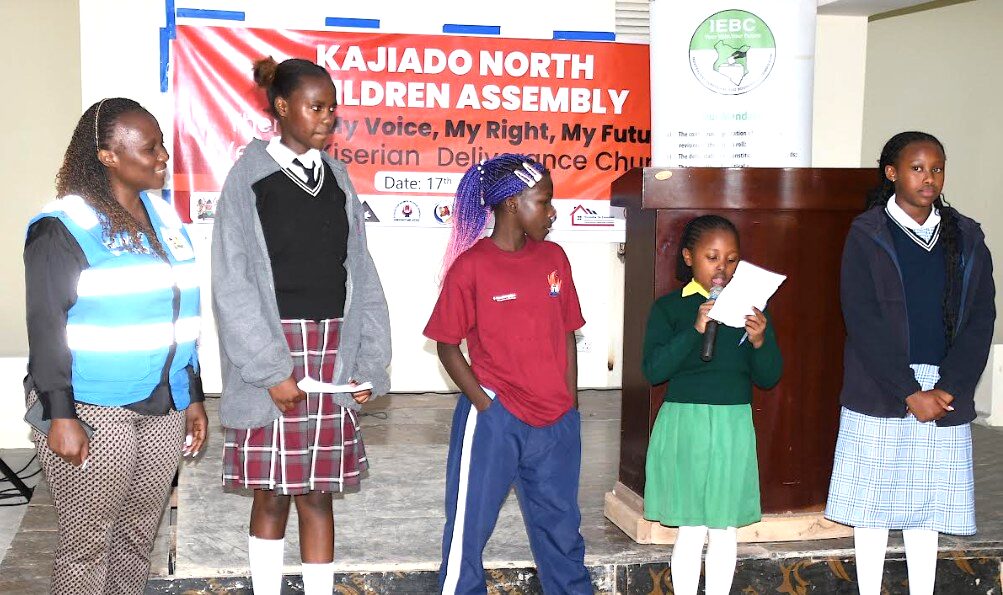
The involvement of school-going children in elective leadership is increasingly being recognised as a vital platform for them to articulate and address challenges affecting their lives.
This was evident during the Kajiado North Children Assembly elections held in Kiserian, where stakeholders emphasised the importance of child participation in governance and decision-making processes.
Kajiado North Sub-county Children Officer Nancy Kemunto said the State Department for Children Services is prioritising the inclusion of children in matters that impact their welfare, noting that the assemblies provide a structured avenue for civic engagement.
“The reason why we are here is to ensure that we have given a platform to our children to exercise their civic rights by electing their leaders, and that is child participation, which is very key in a child’s life,” she said.
Kemunto underscored that child participation is anchored in law, citing the Constitution of Kenya 2010 and CAP 141 of the Children Act.
“It is just a way of exercising what even the law mandates us to do. We are guided by the laws of Kenya, which ensure a child participates at all levels where they can be able to speak,” she added.
Learners taking part in the elections said the initiative offers a rare opportunity to raise issues that often go unheard.
Jasmine Sianto, a student at Olekasasi Comprehensive School and a presidential candidate in the assembly, said she was driven by the desire to champion children’s rights.
“The reason as to why I’m running for this seat is to fight for children’s rights. Through me, I can bring children’s concerns to be heard. There are problems a student may not tell their parents, but through a leader like me, I can help communicate them,” she said.
Sianto noted that the leadership role would also help her better understand the challenges facing learners both at home and in school.
Prudence Njiru, a gubernatorial candidate from Kiserian Comprehensive School, said the process exposes children to democratic practices and prepares them for future civic responsibilities.
“As for myself, I have four years to vote for the country’s President, so this helps us to understand the protocols, what to do in an election and how to choose leaders,” she said.
Stakeholders at the event also highlighted the challenges facing children in the community, calling for collective action to address them.
Ben Muia, Director of Nyumba ya Tumaini and a child protection practitioner, pointed out that many children grapple with issues such as drug and alcohol abuse, family separation and poverty.
“Some of the challenges that prevent these children from going to school are simple things like uniforms, and these are matters that actually affect these children seriously,” he said.
Held under the theme “My Right, My Future,” the elections brought together learners from various comprehensive schools across Kajiado North Sub-county.
READ ALSO: Nakuru children head to polls to elect leaders for National Assembly
Positions contested included President and Deputy President, Governor and Deputy Governor, Speaker and Clerk, among others.
Participants and organisers expressed optimism that the Children Assembly model will continue to empower young people, nurture leadership skills and provide a meaningful platform for addressing issues affecting children.
By Kimutai Langat
You can also follow our social media pages on Twitter: Education News KE and Facebook: Education News Newspaper for timely updates.
>>> Click here to stay up-to-date with trending regional stories
>>> Click here to read more informed opinions on the country’s education landscape
>>> Click here to stay ahead with the latest national news