



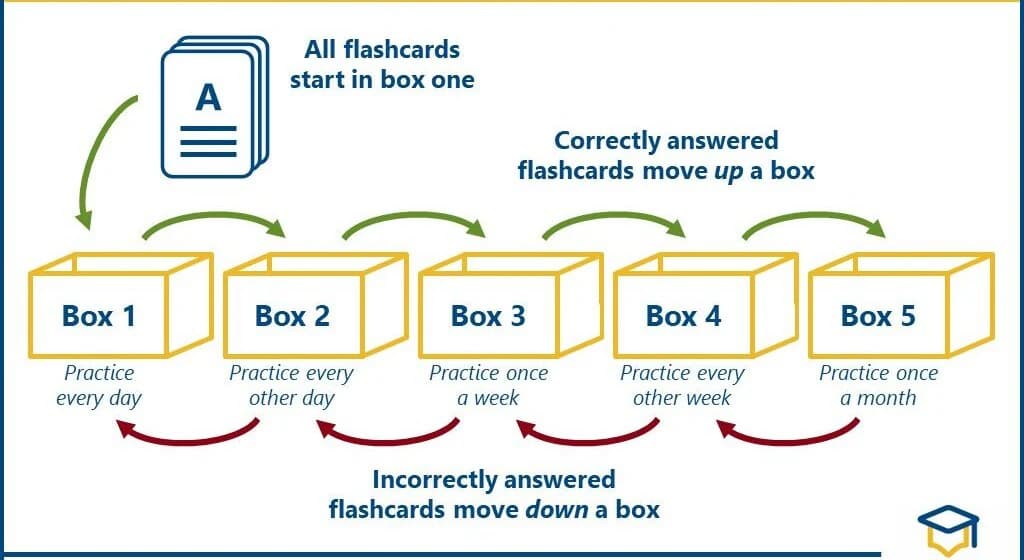




There is what is known as the Leitner technique. While using it, learners make wise use of flashcards and spaced repetition to remember information for a long time. So, it involves arranging flashcards into different boxes according to how well a learner can remember the information. Basically, cards containing information that a learner remembers correctly are viewed less frequently, while cards containing information that the learner finds difficult to understand are viewed more frequently. Therefore, the unique technique assists learners in studying effectively. By employing it, they identify areas of weakness, leading to improvement in academic performance.
Ideally, the Leitner technique contributed to the practical applications of two other important study techniques. Foremost, spaced repetition, which encourages reviewing information at increasing intervals instead of studying everything repeatedly in a single session or sitting. Secondly, active recall, which advocates for trying to remember information before looking at the answers splashed in sources of knowledge – books.
More importantly, the Leitner technique works well when combined with other techniques such as mind-mapping, Cornell note-taking, Feynman (peer teaching), group discussions, et cetera. Advisedly, it is important to approach study in that manner because different methods develop unique learning skills. For instance, flashcards are particularly useful for recall, but are not sufficient for every type of learning.
Provenance of Leitner Technique
Leitner technique was developed in the 1970s by Sebastian Leitner (1919-1989), a German Science journalist and author. He popularised it in his book in 1972, which was translated as So Learn How to Learn. Sebastian Leitner developed the unique technique to make learning more efficient by combining flashcards with a systematic review schedule. While selling the good idea, he anchored it on the cogent argument that learners should spend more time reviewing information they have difficulty remembering, and less time reviewing information they already know or understand.
Application of Leitner Technique
It is a flashcard-based study strategy in which cards are divided into groups or boxes according to the learner’s ability to recall information correctly. Each box has a different review frequency. So, cards in the first box are reviewed frequently. Cards in the second box are reviewed less frequently. Cards in the third box are reviewed after longer intervals. Cards in the higher-level boxes are reviewed less often because the learner demonstrates better recall. When a learner answers a question correctly, the card moves to the next box. Whereas when the learner answers incorrectly, the card returns to the first box. The main principle is that difficult information receives more attention, while well-understood information receives less frequent reviews.
Materials Needed for Leitner Technique
The learner requires the following materials to apply the technique: Firstly, flashcards, which are small pieces of paper or digital cards containing questions and answers. Secondly, 3-5 boxes or containers for organising the cards. Thirdly, a study timetable to act as a schedule indicating when each box should be reviewed. Then, pens or markers for writing questions, answers, and important information. Additionally, notebooks for recording difficult concepts and monitoring progress.
How the Leitner Technique Works
The technique works well through systematic movement of flashcards between boxes. How? In the first step, you prepare the flashcards. Write questions on one side of each card, and their answers on the other side. Prepare cards from the topics you intend to study. In the second step, place all cards in box 1. Initially, all new flashcards are placed in the first box. Box 1 contains new information and information the learner has difficulty remembering.
In the third step, test yourself. Read the question on each flashcard, and attempt to answer questions without making references to books. Turn the card over to check whether your answer is correct. In the fourth step, move the answered cards correctly. If you answer a question correctly, move the card to the next box. For example, a card moves from box 1 to box 2 after a correct answer. In the fifth step, return incorrectly answered cards. If a question is answered incorrectly, return the card to box 1. This ensures that difficult information receives more frequent attention.
In the sixth step, review each box according to a schedule. Assign different review intervals to the boxes. For example, box 1 is reviewed every day so as to learn new and difficult information. Box 2, to be reviewed every two days so as to reinforce information recalled correctly. Box 3 is to be reviewed every four days so as to strengthen developing knowledge. Box 4 to be reviewed every seven days so as to consolidate learning. Box 5 to be reviewed every 14 days so as to maintain long-term recall. Largely, the intervals are just examples rather than compulsory rules per se. Therefore, learners can always adjust them according to the subject, difficulty of the material, and time available before examination.
In the seventh step, monitor your progress and success. Observe which cards remain in box 1, and which cards progress to higher boxes. Cards that repeatedly return to box 1 indicate areas that require additional study. In the eighth step, continue reviewing. Continue testing yourself and moving cards between boxes until you can consistently recall the information. Remember that a card in a higher box is not permanently mastered; it may need to return to box 1 if you can no longer remember its answer.
Victor Ochieng’ rolls out talks and training services in schools. He speaks to students about useful Study Strategies, Skills, Methods, habits, and Techniques. vochieng.90@gmail.com. 0704420232


Reader Discussion (0)
Sign in to comment