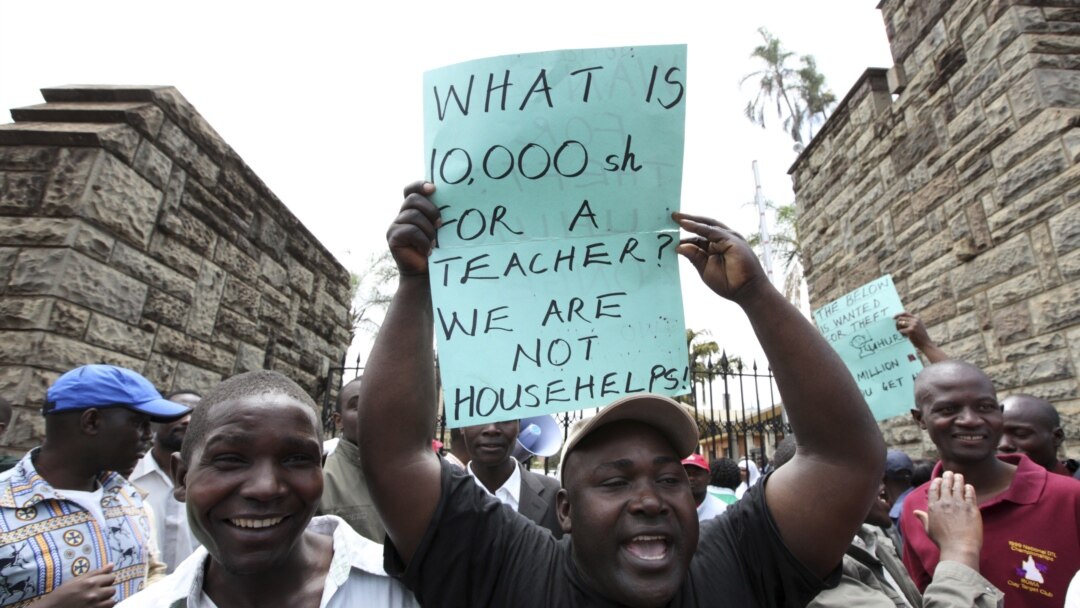
- The latest CBA awarded teachers increases of KSh693–KSh2,055, but educators argue the figures fail to restore purchasing power or match rising living costs.
- Teachers highlight expanded responsibilities under Competency‑Based Education, saying the agreement ignores the heavy demands of assessments, reports, and digital records.
- Stakeholders urge TSC, SRC, and Treasury to anchor future CBAs on inflation, taxation, and cost of living, while also addressing allowances, medical cover, and staffing shortages.
The conclusion of the latest Collective Bargaining Agreement (CBA) has sparked widespread debate within Kenya’s education sector, with many teachers arguing that the negotiated salary increments fall far short of addressing the economic realities confronting the profession. While the agreement provides basic salary increases ranging from KSh693 to KSh2,055 depending on job grade, many educators contend that the figures neither restore their purchasing power nor reflect the expanding demands of implementing the Competency-Based Education (CBE) curriculum. To them, the agreement represents not meaningful progress but a missed opportunity to improve the welfare of the country’s most important public servants.
Rising Costs Undermine Modest Pay Increments
Across staffrooms and professional forums, many teachers have described the increments as “a slap in the face” after years of waiting for a salary review that would genuinely improve their lives. They argue that such modest adjustments are quickly wiped out by rising food prices, rent, transport costs, electricity bills, taxation and other household expenses. In practical terms, they say, the increase is barely noticeable by the time the salary reaches their accounts.
Their frustration is understandable. Inflation has steadily eroded teachers’ incomes while the cost of living has continued to climb. Families are spending more on basic necessities than ever before, yet wage growth has remained largely stagnant. A salary review that fails to bridge this widening gap risks becoming little more than a statistical exercise rather than a meaningful intervention in workers’ lives.
The debate also raises difficult questions about the purpose of collective bargaining itself. A CBA is intended to protect workers from economic hardship by ensuring that salaries and working conditions evolve alongside changing economic realities. When the outcome leaves a significant number of teachers feeling poorer despite receiving an increment, many inevitably question whether the process has achieved its intended objective.
CBE Workload Intensifies Without Matching Support
The implementation of Competency-Based Education has made the situation even more complex. Teachers are no longer confined to classroom instruction. They are expected to conduct continuous learner assessments, prepare detailed progress reports, supervise projects, maintain digital records, engage parents regularly, mentor learners individually and undertake extensive administrative responsibilities. These additional duties require more time, more effort and greater professional commitment.
Yet many teachers argue that these expanded responsibilities have not been matched by corresponding improvements in remuneration or staffing. The result is a workforce that is increasingly overburdened, with many educators taking work home, sacrificing personal time and experiencing growing levels of stress. It is difficult to expect excellence from professionals whose workload continues to expand while their purchasing power steadily declines.
Teacher welfare has never been merely an employment issue; it is a national development issue. Every doctor, engineer, lawyer, entrepreneur, scientist and public servant begins their journey under the guidance of a teacher. When teachers are financially strained, emotionally exhausted and professionally demoralised, the effects eventually filter through the entire education system and ultimately affect national productivity.
For this reason, many education stakeholders argue that the government must approach teacher welfare with a more humane perspective. Fiscal discipline is important, and public resources are finite. However, balancing the national budget should not come at the expense of those entrusted with educating future generations. A government that asks teachers to implement major education reforms, embrace new technologies and shoulder increasing responsibilities should equally demonstrate empathy by ensuring their salaries enable them to live with dignity.
Having a human face in public policy means recognising that behind every payroll number is a teacher supporting a family, paying rent, educating children, caring for elderly parents and serving communities. It means appreciating that modest salary adjustments which appear reasonable on paper may have little practical value when inflation and taxation continue to erode household incomes. Sound economic management and compassion are not mutually exclusive; responsible governance requires both.
Many teachers are therefore urging the Teachers Service Commission (TSC), the Salaries and Remuneration Commission (SRC), the National Treasury and teachers’ unions to approach future negotiations with greater seriousness and sensitivity. They argue that remuneration reviews should be anchored on objective indicators such as inflation, taxation, purchasing power and the actual cost of living rather than on fiscal limitations alone. A negotiation process that genuinely considers these realities is more likely to produce agreements that are both sustainable and acceptable.
Teachers are equally calling for broader consultation before future CBAs are concluded. They want stronger grassroots participation, greater transparency during negotiations and regular communication from their representatives. Such engagement would not only improve trust but also ensure that negotiated outcomes reflect the priorities of those working in classrooms every day.
ALSO READ:
KNUT withdraws 59 teachers from Isiolo schools over rising insecurity
Beyond salaries, many educators believe future agreements must comprehensively address housing, commuter, hardship and responsibility allowances, timely promotions, expanded medical cover, mental wellness support and continuous professional development. These are not luxuries but essential components of a modern and motivated teaching service.
There is also an urgent need to recruit more teachers to ease the heavy workload associated with CBE, particularly in schools grappling with severe staffing shortages. No curriculum reform can succeed if it depends on overstretched teachers working under relentless pressure without adequate support.
Ultimately, the growing dissatisfaction surrounding the latest CBA should not be dismissed as mere discontent over pay. It reflects a broader concern about fairness, recognition and respect for one of the country’s most essential professions. Many teachers believe the current agreement does not adequately reflect the value of their contribution or the realities they face each day.
As Kenya continues to pursue ambitious education reforms, the welfare of teachers must remain at the centre of policy decisions. A government that invests in teachers invests in learners, communities and the nation’s future. Demonstrating a human face in collective bargaining is therefore not an act of generosity—it is a recognition that quality education depends on motivated, respected and fairly compensated teachers. Without that commitment, even the most ambitious education reforms risk falling short of their promise.
By Our Reporter
You can also follow our social media pages on Twitter: Education News KE and Facebook: Education News Newspaper for timely updates.
>>> Click here to stay up-to-date with trending regional stories
>>> Click here to read more informed opinions on the country’s education landscape
>>> Click here to stay ahead with the latest national news.