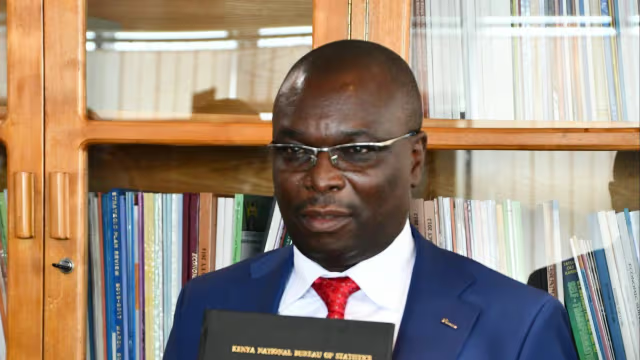
The Kenya National Bureau of Statistics (KNBS) has begun its census on Technical and Vocational Education and training (TVET) institutions today, May 20, 2026; the first exercise since the Country gained independence in 1963.
Speaking during the launch, KNBS Director General Dr. George Obudho stated that the nationwide census will run across all 47 counties, lasting for at least 40 days and conclude around June 28.
“We will conduct a census on both public and private TVETs within the country to have data and statistics that will help inform performance, status and future plans,” said Dr Obudho in Nakuru during training for at least 150 research and data collection assistants and 41 supervisors.
“We want to know the number of institutions, enrolment numbers, staffing levels, infrastructure among other details,” he added
He highlighted that the information would be helpful when it comes to policy making to improve the institutions.
“We also have to prepare students for the job markets and the census will tell exactly what they need to succeed,” he noted.
ALSO READ:
South Rift TVET Fair highlights innovation and skills excellence
He added that the data collected will also confirm the institution’s capacity in information communication technology (ICT). “We are digitizing students and we have to know if there is equipment to help them get the right skills that would feed into the job market directly.” He said.
The Rift Valley Regional Director TVET, Rosemary Kimani, affirmed that the institutions were ready for the exercise saying that the bureau has the full support as they conduct the TVET census.
“We will be the greatest beneficiaries of this georeferenced data because it is going to help us in terms of planning, infrastructure, access, inclusivity, and even in digitization,” she said.
She further noted that since TVETs have shifted to a Competency-Based Education and Training curriculum which offer practical skills instead of the earlier accumulated theoretical knowledge, a lot of equipmwnt and practical resources were needed, hence the need for census.
“We require a lot of equipment and resources, and therefore, this data is going to give us the direction in which to take so that we are able to offer quality learning,” said Kimani.
Kirui Barnabas, representing the Kenya National Association of Private Colleges (KENAPCO), emphasized their data was important to push for reforms and funding.
“We have around 400 memberships, meaning we have a huge source of data which would be able to assist the KNBS especially in getting the required amount of data across the country,” said Barnabas.
KNBS has done a similar census on Early Education centress, and primary, junior and senior schools.
By Frank Mugwe
You can also follow our social media pages on Twitter: Education News KE and Facebook: Education News Newspaper for timely updates.
>>> Click here to stay up-to-date with trending regional stories
>>> Click here to read more informed opinions on the country’s education landscape