- Kamagambo University enters Kenya’s higher education sector with a strong government emphasis on academic quality.
- The institution has been challenged to prioritise qualified staff, research capacity and strong academic systems.
- Its growth comes as universities prepare for the first CBE cohort expected in 2029.
Kamagambo University has entered Kenya’s higher education landscape with a clear warning from the government: gaining authority to operate is only the beginning, and the institution will ultimately be judged by the quality of its graduates, research and contribution to society.
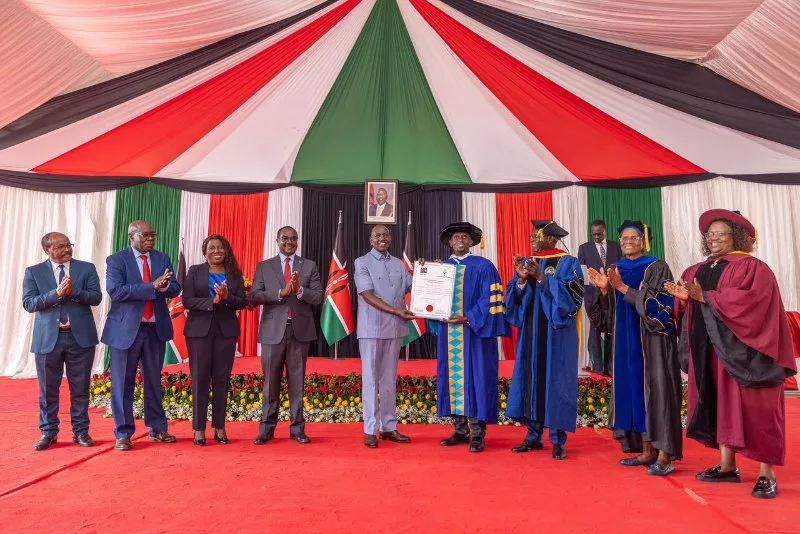
Education Cabinet Secretary Julius Ogamba issued the challenge on Tuesday during the award of the university’s Letter of Interim Authority at Kisumu State Lodge, following a recommendation by the Commission for University Education (CUE).
The approval makes Kamagambo University Kenya’s 90th authorised university and the third private university established by the Seventh-day Adventist Church, after the University of Eastern Africa, Baraton and Adventist University of Africa.
Located on the border of Migori and Kisii counties, along the Rongo–Kisii road, the institution now has an opportunity to expand access to university education in the region. But Ogamba cautioned that expansion must not come at the expense of academic standards.
He urged the university to invest first in qualified academic staff, facilities, research capacity and strong institutional systems before significantly increasing student enrolment.
“The true measure of Kamagambo will be the quality of its graduates, the value of its research and its contribution to the economy of Nyanza and Kenya as a nation,” Ogamba said.
Quality before expansion
The message places quality assurance at the centre of the university’s transition from an institution with interim authority to one seeking a full charter. Rather than measuring growth by the number of programmes or students, the institution will have to demonstrate that its graduates possess relevant knowledge, practical skills and the ability to address real economic and social challenges.
Kamagambo has already positioned entrepreneurship prominently in two of its first three programmes. Ogamba, however, urged the university to broaden its academic ambitions carefully, particularly in science, technology, engineering and mathematics, applied sciences, digital technology, ethical artificial intelligence, modern agriculture and green engineering.
For a university serving the wider Nyanza region, he said academic programmes should also respond to local challenges, including rural healthcare, agricultural productivity, entrepreneurship and technological development.
The quality challenge is becoming even more significant as Kenya prepares for the transition of learners from the Competency-Based Education system into universities.
Ogamba said the first cohort of learners educated under the new system is expected to enter university in 2029. These students are being prepared around problem-solving, creativity and practical application of knowledge, requiring universities to rethink how they teach, assess and prepare students for employment and enterprise.
“Traditional lecture models will not serve them,” the CS said, urging universities to modernise their teaching approaches.
The warning extends beyond Kamagambo. CUE and universities will need to prepare for a higher education system receiving learners whose educational experiences and expectations will differ from those of previous cohorts.
The challenge will therefore be to ensure that the transition from CBE to university does not become a disconnect between competency-based learning at school level and conventional teaching methods at university.
Programmes tied to national needs
President William Ruto, who also addressed the ceremony, similarly called on Kamagambo to produce graduates capable of responding to Kenya’s economic and social needs while maintaining high academic and ethical standards.
He urged the institution to train teachers capable of delivering competency-based education and theologians able to provide moral leadership, while developing business graduates who can strengthen enterprises, cooperatives and value chains.
Ruto also linked the university’s future programmes to the country’s wider development needs, pointing to agriculture, healthcare, affordable housing, the digital economy and renewable energy as areas requiring highly skilled professionals.
His message was that university education should not end with the awarding of certificates. Students should be exposed to businesses, develop ideas, build prototypes, understand markets and acquire practical experience that can translate into employment and enterprise.
That approach places considerable responsibility on Kamagambo’s leadership, faculty and trustees as the institution establishes its academic identity.
The university must build a culture in which teaching, research, innovation, ethics and community engagement reinforce one another. Its location also gives it an opportunity to develop programmes and research responding to challenges affecting communities in Nyanza and beyond.
The next test, therefore, will not simply be how quickly Kamagambo grows. It will be whether the institution can expand without weakening the academic standards that underpin its credibility.
Building towards a full charter
Ruto urged the university’s trustees and leadership to govern wisely, while challenging its faculty to teach rigorously, conduct meaningful research and protect academic standards.
He also called on residents of Migori and the wider Nyanza region to support the institution while holding it accountable for the quality of education it provides.
The Letter of Interim Authority gives Kamagambo a foundation from which to build. The more difficult task is to demonstrate that the university can convert that authority into a durable reputation for quality, relevant scholarship and graduates equipped for Kenya’s changing economy.
As the country prepares for the arrival of the first CBE university cohort in 2029, the pressure on universities to rethink teaching, technology, research and employability will only increase.
READ ALSO:
For Kamagambo, the immediate priority is therefore clear: build depth before breadth, strengthen quality before expansion and ensure that every new programme responds to both academic standards and the needs of the society the university is established to serve.
By Hillary Muhalya
Get more stories from our website: Education News
To write to us or offer feedback, you can reach us at: editor@educationnews.co.ke
You can also follow our social media pages on Twitter: Education News KE and Facebook: Education News Newspaper for timely updates.
>> Click here to stay up-to-date with trending regional stories
Caption: President William Ruto presents Kamagambo University with a Letter of Interim Authority at Kisumu State Lodge on September 15, 2026, marking its entry into Kenya’s university system as it begins the journey towards attaining a full charter.