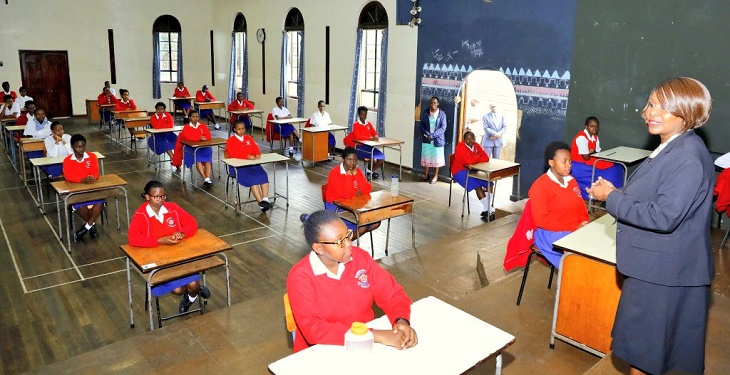
Dear reader, in the third term, as schools prepare Form Four candidates to sit and write KCSE exams, teachers should assess and ascertain certain things in line with best academic practices and nonpareil programmes. Foremost, teachers should ascertain whether they have kept on discussing targets set when the year was still young. For a great management of the candidate class, right at the beginning of the year, during launch of the KCSE class, the school mean score or class target is set right. Form Four candidates are guided on how to set personal targets. Other targets set include school recognition target, number of candidates to matriculate directly into university by scoring C+ (plus) and above, number of Form Four candidates to feature in the top 20 or top 100 in the country. Some schools also set the lofty target of producing the top student in the country. I mean, the KCSE valedictorian.
Secondly, as part of assessment of preparedness for KCSE, teachers should ascertain whether they have explored different forms of ability grouping in the candidate class in line with Differentiated Instruction (DI) or Differentiated Learning (DL) popularised by the American educator and scholar, Carol Ann Tomlinson – Professor Emeritus at the University of Virginia (School of Education). DI or DL is a proactive approach to teaching geared towards ensuring that every learner has equal opportunity to access success in class. It is a stupendous strategy where teachers modify their teaching methods, models, materials, activities and assessments to meet the diverse learning needs, abilities, interests, and backgrounds of learners. More so, when focusing on mastery of relevant content taught. The philosophy acknowledges that learners are wired differently. So, schools are called upon to embrace groups galore. More so, ability grouping and group discussions.
In that regard, there are 5 approaches to ability grouping, namely: General, subject-based, academic villages, parenting groups or family units and pairing of students. Schools that achieve success in KCSE through genuine means explore any of the aforesaid strategies. As an education consultant, I firmly believe the means justified the end, and not vice versa. Therefore, upon timely and comely completion of syllabi, schools administer a shedload of standard exams in the candidate class. The smorgasbord of assessments acts as a good guide in excellent exploration of general ability grouping. Classes are not fixed like the Laws of Medes and Persia. Aptly put, a subsequent slew of assessments can lead to the formation of new streams.
ALSO READ:
Schools reopen for Third Term amid funding shortfall ahead of national exams
In an actual sense, a well-staffed school should even have teachers who can handle different ilk of learners based on levels of ability. For in some sense, a staff or a particular department is like a fortunate football team. For the team to score more and scoop victory, the team knows who is a stupendous striker, marvellous midfielder, or deft defender. Withal, other forms of ability grouping include formation of academic villages, parenting groups or family units, subject-based ability grouping, and pairing of top achievers with struggling students. Broadly, the stupendous strategy assists schools to fatten the head, and cut or shorten the colossal size of the tail.
Thirdly, teachers should consider the existence of active and productive discussions as a way of preparing Form Four candidates for KCSE exams. Formation of effective group discussions contributes to content mastery and retention. Largely, groups should be a cocktail and dovetail of abilities. Then, no group should execute any task that is outside the framework of scheduled timetabled activities. Apart from the common group discussions that are ubiquitous in our schools, there are four major types of group discussions, namely: Socratic seminars, fish-bowls, jigsaws, think-pair-shares and round-robins. Ideally, pertaining to memory and mastery of content, permit me to quote or dote on the Learning Pyramid or Cone of Learning, or Dale’s Cone of Experience.
Somewhat, the model explains methods sedulous students oft adopt to attain and retain knowledge. The model shows that active learning leads to better understanding and long-term retention as compared to passive learning. It was proposed by Edgar Dale (1900-1985), an American educator and professor at Ohio State University, who became a pioneer in audio and visual instruction. Therefore, also called Dale’s Cone of Experience. It focuses on levels of learning from top to bottom. More so, how students master and memorise content taught or read. By distributing percentages, this is how it cascades: Lecture 5%, reading 10%, audio-visual 20%, demonstration 30%, group discussion 50%, practise by doing 75% and teaching others 90%. Active learning is powerful. So, students should enhance retention through practise, discussion and teaching others. Too true; variety makes learning both enjoyable and memorable. No wonder it is important to merge many methods. Then, the more senses involved, the stronger the encoding.
Over 62,000 JSS teachers demand answers over unpaid ICT training allowances
Again, teachers assess their effectiveness in preparing Form Fours only when they expose them to a shedload of standard exams in line with Bloom’s Taxonomy. Schools that rise to the acme of their game in KCSE expose Form Four candidates to standard exams, which agree with Bloom’s Taxonomy: training them on both low and high-order thinking skills. In 1956, Benjamin Bloom (1913-1999), at the University of Chicago, with four collaborators — Max Englehart, Edward Furst, Walter Hill and David Krathwohl — published a framework for categorising educational goals known in popular parlance as: Taxonomy of Educational Objectives or Bloom’s Taxonomy. So, exams obeying this model test: Recall, knowledge, comprehension, application, analysis, synthesis and evaluation.
Additionally, assess Form Four’s preparedness for KCSE only when they have read and implemented a raft of recommendations splashed in KNEC reports in all subjects. For every year, KNEC publishes reports and recommendations per subject after marking of KCSE exams. They point out mistakes made. As well as correcting mistakes made. Reports also talk about subjects that require affirmative action in the following year. So, the onus is on subject teachers to pore over and implement the raft of recommendations raised. It is imperative to focus on real reasons that caused poor performance the previous year. Then, come up with possible solutions as a remedy for poor performance.
Advisedly, teachers handling Form Four candidates assess whether they are on the right track in the KCSE preparations only when, indeed, they are exploring team teaching as part of a joint effort. Ideally, in team teaching, teachers meet regularly. Teachers compare notes in relation to pedagogy and methodology. Teachers confab about best academic practices, nonpareil programmes and insightful instructional materials they can use in order to rise to stardom in the great agora of peerless performance. Again, team teaching encompasses setting and marking exams together. Such positive initiatives promote healthy competition and team spirit. Indeed, through thorough approaches to team teaching, tutors impress upon themselves and learners the essence of collaboration as a master key unlocking doors of roaring success.
KSh18 billion in school accounts? President’s claim meets questions over supplier debts
Furthermore, Form Four teachers assess their approaches to preparing the candidate class for KCSE by engaging subject experts and examiners in all subjects. Likewise, they establish whether the raft of recommendations made by experts has been implemented to the hilt. Being that charity begins at home, some schools have home-grown examiners they can engage first before they look further afield. Then, when a school lacks teachers with basic training as examiners, it means that if they do not invite such experts, doom will loom large. They may also fail to find what in The Alchemist, the brilliant Brazilian penman called Paulo Coelho, calls the elixir or alchemy of transforming metal into gold. This may lead to a lot of activity without productivity. For there are some schools where teachers create more contact hours with students by expanding teaching and learning time. Unfortunately, woe betide them. How? They continue to register poor performance ad nauseam. Therefore, schools must strive to get it right.
Finally, teachers can only be sure of having prepared Form Four candidates for KCSE when they arrive in wonderful ways of making learners develop confidence to sit and write exams. Meaning, they should explore manifold psycho-social and spiritual programmes to assist Form Four candidates develop faith, which is the perfect antidote to FEAR: False Evidence Appearing Real. In literary standards, seeing is believing. But in Biblical standards, believing is seeing. Napoleon Hill wrote, “Whatever the mind can conceive and believe it can achieve.” In Hebrews 11:1, we read, “Faith is the substance of things hoped for, the evidence of things not seen.” By the same token, teachers should engage speakers who can assist Form Four candidates overcome failure, tackle tension, arrest anxieties, manage stress, dodge doubts and prevent panic.
By Victor Ochieng’
Victor Ochieng’ speaks to Form Four candidates on Homestretch: Finishing the Last Lap Strong. He trains Principals and teachers on Best Academic Practices, with a special bent on Great Management of the Candidate Class. vochieng.90@gmail.com. 070442023
Get more stories from our website: Education News
To write to us or offer feedback, you can reach us at: editor@educationnews.co.ke
You can also follow our social media pages on Twitter: Education News KE and Facebook: Education News Newspaper for timely updates.
>>> Click here to stay up-to-date with trending regional stories