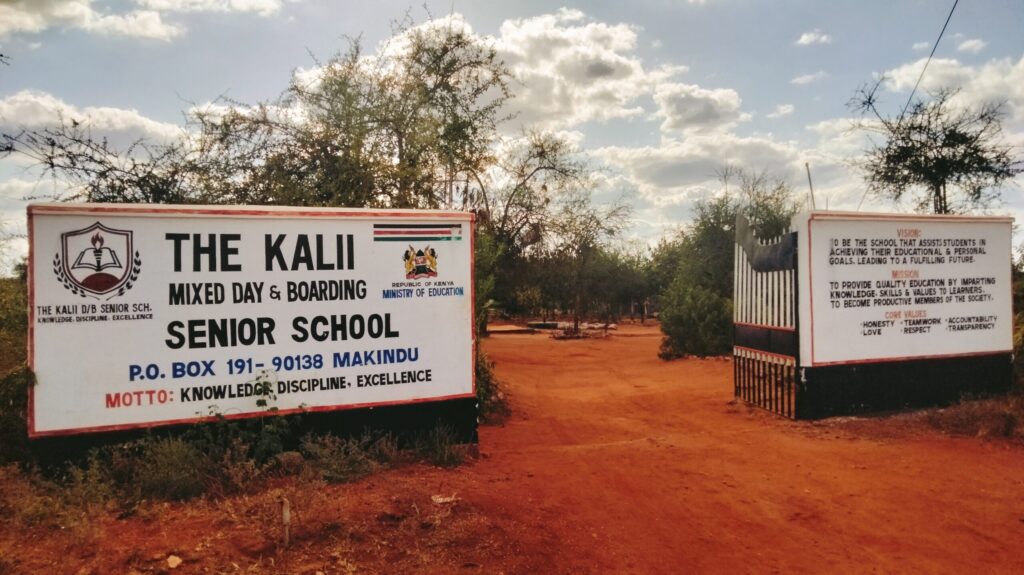
The principal of Kalii Senior School in Makueni County has turned a teacher shortage crisis into an opportunity by embracing e-learning, enabling students to continue learning despite the absence of subject teachers.
For principal Lilly Kabata, challenges are meant to be solved rather than endured.
“Every problem has a solution. Instead of sitting and waiting for help, you should do what you can with the resources available,” she says.
Speaking to Education News, Kabata recalls how the school was left without a Physics teacher last year after the instructor left to pursue further studies. Determined not to let the students abandon the subject, she improvised by using her personal laptop and mobile phone to connect learners with a teacher remotely.
“My students were passionate about Physics and did not want to drop the subject. I arranged for online lessons using my laptop. Even when the laptop battery ran out and we had no electricity at the school, I continued using my phone to facilitate the lessons. The effort paid off because none of the students scored an E in the KCSE examination,” she said.
Located in a remote area and grappling with limited resources, Kalii Secondary School currently has a student population of 47. The institution is served by only five Teachers Service Commission (TSC) teachers and three Board of Management (BoM) teachers, who also provide mentorship and guidance to learners.
The school’s journey has been one of resilience. Established in 2016, it was later closed due to low enrolment before reopening in 2020 after Kabata was posted there by the TSC. At the time, the school had only seven students.
ALSO READ:
KUPPET welcomes appointment of John Lekakeny Ololtuaa as Basic Education PS
The school presented its first Kenya Certificate of Secondary Education (KCSE) candidates in 2023. The seven candidates posted a mean score of 3.27, with one student securing university admission despite learning under trees because of inadequate infrastructure.
In 2024, the school registered 10 candidates and improved its mean score to 3.8. In 2025, 13 candidates attained a mean score of 4.08, with two students qualifying for university admission. This year, the school has registered 17 KCSE candidates.
“Despite our challenges, we continue to outperform some larger schools around us. We have not recorded any overall grade E in KCSE results, except in a few subjects where teacher shortages persist,” Kabata noted.
She also paid tribute to a dedicated Business Studies teacher who passed away before the release of the KCSE results. Under his guidance, the subject’s mean score improved dramatically from 2 to 7.
“He was also a KCSE examiner and played a key role in improving our performance. His contribution will always be remembered,” she said.
Beyond academics, Kabata has championed agricultural projects to support the school’s sustainability. Upon her arrival, she introduced farming initiatives that were enthusiastically embraced by both the Board of Management and students.
The school grows pigeon peas, green grams (ndengu), cowpeas and maize. According to the principal, the initiative has not only improved food security at the school but has also inspired neighbouring institutions to adopt similar projects.
“The harvest helps us reduce food costs while improving the nutritional value of meals served to students,” she explained.
ALSO READ:
Prof. Shaukat: Govt to convert university research, innovations into job creating enterprises
The school has also ventured into poultry farming, with plans to supplement students’ diets with eggs and chicken. Surplus produce will be sold to generate income, some of which will be used to support learners from needy backgrounds.
Parents have also played a critical role in the school’s development by moulding bricks for the construction of a kitchen and supporting plans to complete an unfinished classroom.
Despite persistent water shortages, the school has undertaken environmental conservation efforts by planting trees, including fruit trees, to improve the learning environment.
Kabata praised the school’s alumni for supporting infrastructure development, including the construction of the principal’s office, staffroom and school gate.
“They are always willing to support the school in whatever way they can,” she said.
She also acknowledged the support of the National Government Constituencies Development Fund (NG-CDF), which financed the construction of a science laboratory, two classrooms and sanitation facilities. The girls’ toilets were built through community support.
However, she noted that the institution still requires additional infrastructure to cater for growing enrolment and improve learning conditions.
“We have embraced rainwater harvesting, but we need more water tanks and guttering systems to store enough water throughout the year as we seek a permanent solution,” she said.
Among the school’s pressing needs are electricity, adequate water supply, a perimeter fence, a school van, teachers’ quarters, additional classrooms and more teachers.
Despite these challenges, Kalii Mixed Secondary School continues to nurture talent beyond the classroom, with students excelling in football, netball, athletics and chess.
By Lydia Ngoolo
You can also follow our social media pages on Twitter: Education News KE and Facebook: Education News Newspaper for timely updates.
>>> Click here to stay up-to-date with trending regional stories
>>> Click here to read more informed opinions on the country’s education landscape