










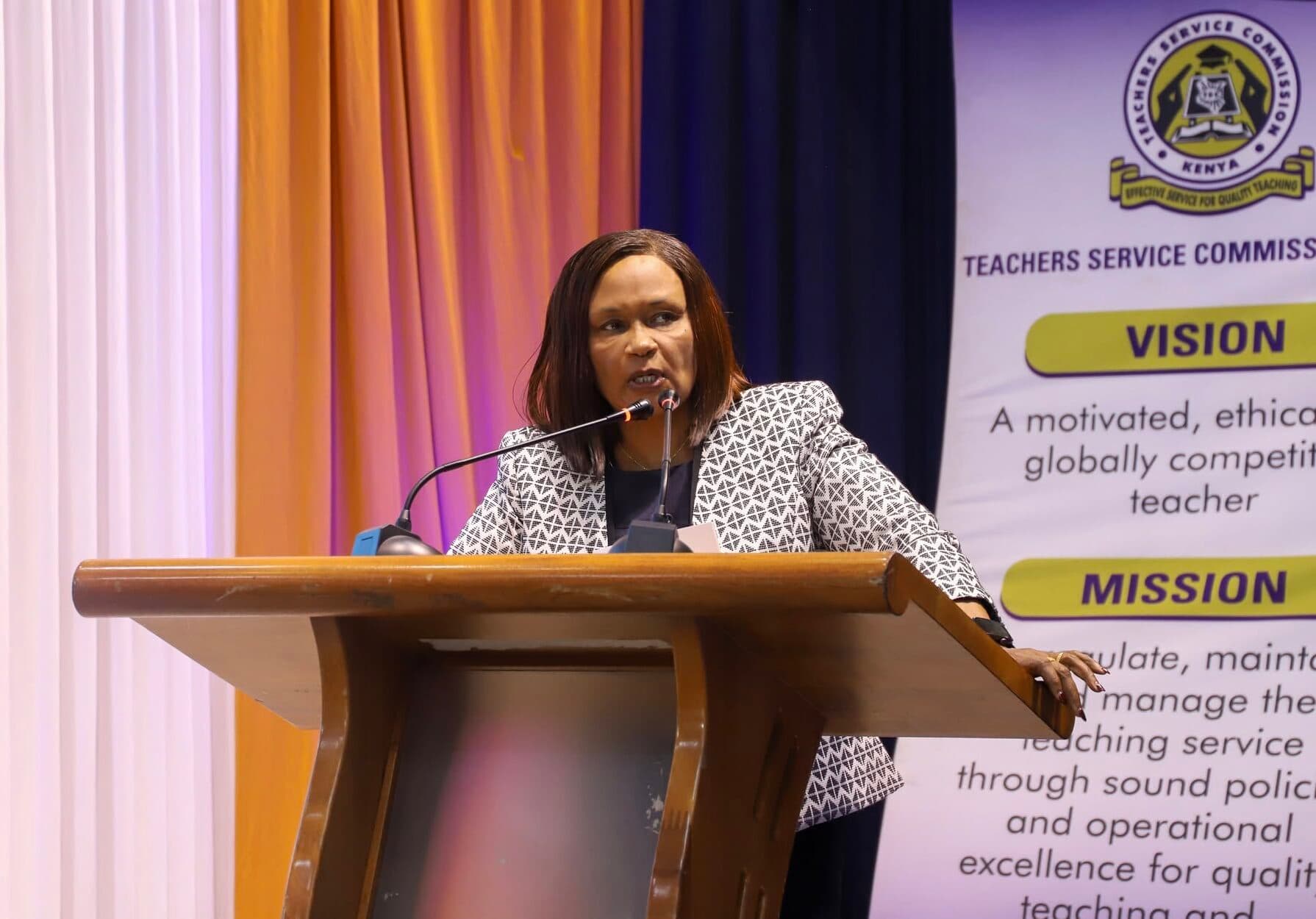
Evaleen Mitei’s 326 days at the helm of the Teachers Service Commission (TSC) represent a case study in how institutional leadership can evolve from formal designation to functional authority. When she assumed office in an acting capacity, the expectation—both within the Commission and among external stakeholders—was one of cautious continuity.
Acting appointments, particularly in large public bureaucracies, often signal a holding pattern: minimal disruption, limited reform appetite, and a general reluctance to initiate bold structural shifts. Yet, over the course of these 326 days, a different pattern has emerged.
What defines Mitei’s tenure is not dramatic policy overhauls or headline-grabbing reforms, but rather the steady consolidation of administrative coherence. In education systems, especially one as expansive and politically sensitive as Kenya’s, effectiveness is rarely about spectacle. It is about systems working—quietly, predictably, and consistently. That is precisely where her leadership has gained traction.
At the beginning of her tenure, her authority was positional. As acting CEO, her mandate derived from appointment rather than entrenched legitimacy. Stakeholders—teachers, unions, county directors, and school heads—engaged her office with a degree of reservation. Acting leaders are often perceived as transitional figures, with limited tenure and therefore limited incentive to undertake decisions that may carry long-term consequences. This perception can undermine decisiveness and slow down institutional momentum.
However, Mitei’s approach has systematically eroded that perception. Through consistent decision-making, she has established a pattern of predictability within TSC operations. Predictability, in bureaucratic systems, is not a trivial achievement; it is the foundation upon which trust is built.
When teachers understand how transfer requests are processed, when promotions follow a discernible logic, and when communication from headquarters maintains clarity and regularity, the system begins to feel stable. Over time, this stability shifts attention away from the “acting” label and toward the outcomes being delivered.
ALSO READ:
https://educationnews.co.ke/mp-ichungwah-slams-moe-over-uniforms-school-feeding-programme/
One of the most notable aspects of her tenure has been operational discipline. TSC’s core mandate—teacher recruitment, deployment, discipline, and professional development—requires tight administrative control.
Any slippage in these areas quickly translates into classroom-level disruptions. Under Mitei, there has been a visible tightening of internal processes. Documentation flows have become more streamlined, response timelines more predictable, and enforcement mechanisms more consistent. These are not reforms that generate public applause, but they are the backbone of institutional effectiveness.
Her leadership has also demonstrated a calibrated engagement with teacher unions. Historically, relations between TSC and unions have oscillated between cooperation and confrontation, often influenced by broader political currents. In the past 326 days, the interaction has leaned toward structured engagement rather than reactive negotiation.
This does not mean the absence of tension—tension is inherent in employer-union dynamics—but it reflects a shift toward procedural clarity. Meetings, consultations, and responses have followed a more institutionalized rhythm, reducing the likelihood of abrupt escalations.
Another dimension of her impact lies in the management of the Competency-Based Curriculum (CBC) transition. The CBC framework has fundamentally altered expectations placed on teachers, demanding new pedagogical approaches, continuous assessment strategies, and increased documentation. For TSC, this transition is not merely curricular; it is operational.
Teachers require support, training, and clear policy direction. Mitei’s tenure has emphasized alignment—ensuring that TSC’s administrative structures support the pedagogical demands of CBC. This has included reinforcing teacher capacity-building initiatives and clarifying performance expectations within the new system.
ALSO READ:
https://educationnews.co.ke/cs-ogamba-under-pressure-from-mps-over-lax-enforcement-of-school-uniform-policy/
Crucially, her leadership has avoided the trap of over-centralization. While TSC remains a highly centralized institution, effective management requires a degree of functional decentralization. County and sub-county offices must operate with enough autonomy to address localized challenges while remaining aligned with national policy.
Over these 326 days, there has been a subtle but important strengthening of these lower administrative tiers. By enabling them to execute their mandates more effectively, the Commission as a whole becomes more responsive.
The shift from positional to functional authority is most evident in how stakeholders now relate to her office. Initially, interactions were framed by her acting status—decisions were interpreted as provisional, and long-term commitments were viewed with caution.
Today, the interaction is increasingly outcome-driven. Teachers seeking transfers, principals managing staffing gaps, and unions negotiating terms are engaging with a system they perceive as stable. The focus has moved from “who is in charge” to “how effectively the system is working.”
This transformation is not accidental. It is the result of leadership that prioritizes continuity over disruption, clarity over ambiguity, and systems over personalities. In many ways, Mitei’s tenure underscores a critical lesson in public sector leadership: legitimacy is not conferred solely by title; it is constructed through performance. Each consistent decision, each resolved case, each clear communication contributes incrementally to that legitimacy.
At the same time, it is important to recognize the limitations inherent in an acting position. Strategic reforms that require long-term political backing may remain constrained. The absence of a substantive appointment can still influence perceptions at higher policy levels, particularly within government structures. However, within the operational domain of TSC, these limitations have been mitigated by the strength of administrative execution.
As the 326-day mark passes, the defining characteristic of Mitei’s leadership is not that she has transformed TSC in a dramatic sense, but that she has stabilized and refined its functioning. In complex systems, this form of leadership is often undervalued precisely because it lacks visible drama. Yet, for teachers in classrooms, for school heads managing daily realities, and for a system navigating the demands of CBC, stability is not merely desirable—it is essential.
Ultimately, what her tenure illustrates is a quiet but significant shift: from authority that is granted to authority that is earned. And in that shift lies the enduring impact of her 326 days in office.
By Ashford Kimani
Ashford teaches English and Literate in Gatundu North Sub-county and serves as Dean of Studies.
You can also follow our social media pages on Twitter: Education News KE and Facebook: Education News Newspaper for timely updates.
>>> Click here to stay up-to-date with trending regional stories
>>> Click here to read more informed opinions on the country’s education landscape



Reader Discussion (0)
Sign in to comment