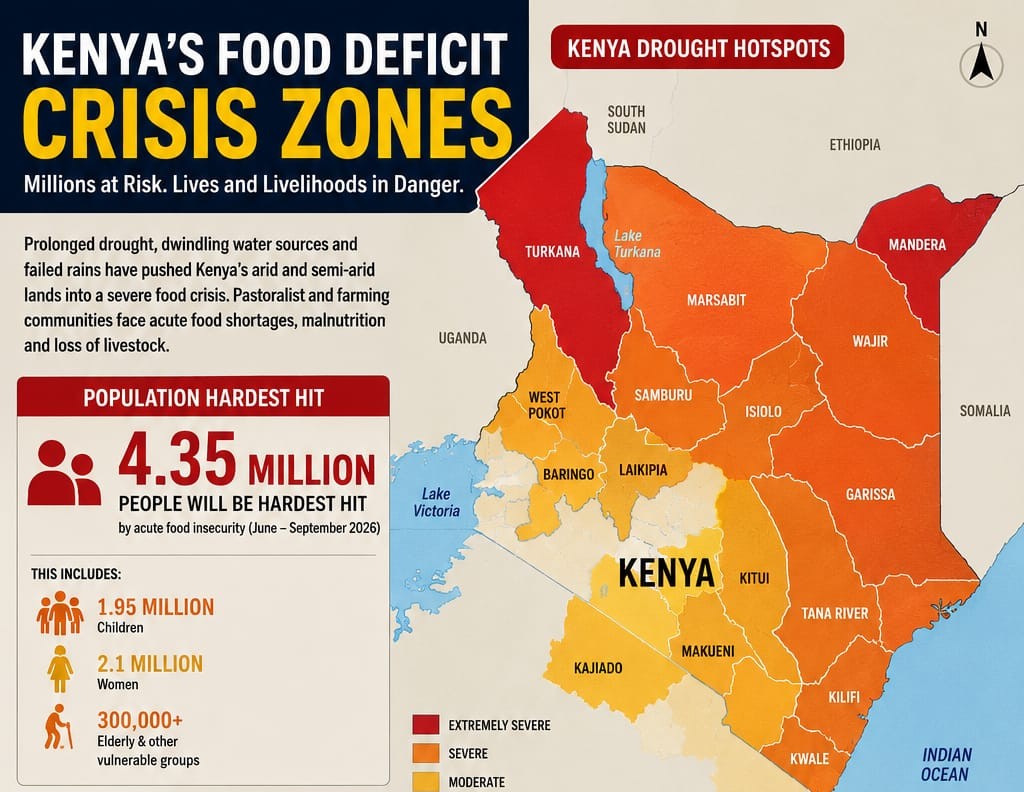
- Kenyan schools have been warned to prepare for higher food costs in 2027 as food and transport inflation have risen sharply.
- Planners have proposed a 10 per cent cost-increase scenario for budgeting, illustrated by boarding schools’ food budgets rising from KSh10 million to roughly KSh11 million.
- Officials have cautioned that parents must not automatically absorb rising costs, urging schools instead to strengthen procurement and financial planning.
Kenya’s emerging food-security pressures are increasingly becoming a material concern for the education sector, with schools likely to face significantly higher costs in feeding learners in 2027. The issue extends beyond the price of maize or beans to the full cost of running a school feeding system — food procurement, cooking fuel, transportation, storage and water. Where these costs rise faster than institutional resources, school managers may be compelled to make difficult trade-offs within already constrained budgets.
The warning is grounded in current inflation data. The Kenya National Bureau of Statistics reported that food and non-alcoholic beverages recorded annual inflation of 8.6 per cent in June 2026, against overall inflation of 6.4 per cent, while transport inflation stood even higher at 16.1 per cent, creating an additional channel through which costs can reach schools. These figures do not mean school food costs will rise by exactly 8.6 per cent, since school procurement baskets differ from the national consumer basket, but they provide a strong basis for institutions to reassess their financial assumptions ahead of the 2027 academic year.
For planning purposes, a 10 per cent increase in food costs is being proposed as a reasonable central scenario, with a contingency buffer of about 10 to 15 per cent recommended where approved financial frameworks allow. This is intended strictly as a budgeting scenario rather than a forecast. For a boarding school currently spending KSh10 million annually on food, a 10 per cent rise would push the requirement to approximately KSh11 million; a KSh20 million food budget would rise to about KSh22 million. In a favourable production season, the increase could be lower, while a severe agricultural or supply-chain disruption could push specific commodities well above the planning assumption.
ALSO READ:
President Ruto Praises Ogamba for Spearheading Education Reform Bills
Schools Face Unique Exposure
Food expenditure differs from other school cost centres in that it cannot be deferred the way maintenance or non-essential activities can. Boarding schools are especially exposed, providing multiple meals daily throughout the term and requiring substantial volumes of cereals, pulses, vegetables, cooking oil and milk. Even modest price increases across several food items can translate into significant aggregate pressure, compounded by rising transport, fuel and storage costs.
Where institutions operate within fixed budget ceilings, this pressure risks crowding out funding for maintenance, sanitation, water, electricity, learning materials, ICT services and co-curricular programmes. The Ministry of Education’s National Education Sector Strategic Plan emphasises accurate costing and prudent resource allocation, and food-price pressures are expected to be managed through disciplined planning rather than ad hoc adjustments.
The challenge also extends to publicly supported school feeding programmes, which the Ministry of Education runs through both in-kind food distribution and cash-transfer mechanisms based on verified enrolment, school days, per-child daily rates, bank balances and carry-over stocks. If food prices rise while per-child allocations remain unchanged, the real value of this support declines, making periodic review of feeding allocations necessary, particularly in regions where food prices consistently exceed national averages.
Production Gains Offer Some Cushion
Kenya’s recent agricultural performance offers grounds for measured optimism. The Ministry of Agriculture reported that maize production rose from 34 million bags in 2022 to 67 million bags in 2025, while maize imports fell from 9.9 million bags to 3.3 million bags over the same period. The government has also allocated KSh64 billion to agriculture in the 2026/27 financial year to support productivity and food security. However, a strong harvest in one season does not guarantee stability in the next if adverse weather, pests or supply-chain disruptions occur, and climate variability remains the biggest source of uncertainty, since a shock affecting one season’s production may only show up in school food prices months later.
Improved procurement practices — tracking market trends, minimising wastage, strengthening storage, comparing suppliers — are seen as ways schools can mitigate some of this pressure. A well-structured home-grown school meals programme, linking schools directly with local farmers, could also provide stable demand for producers while giving schools access to locally sourced food, though such arrangements would require strong governance around supplier reliability, food safety and timely payment.
Parents Should Not Absorb the Shock
Rising food costs within schools should not automatically translate into arbitrary or unapproved charges for parents, as any adjustment to fees or levies must follow established legal and policy approval processes. The recommended first response to financial pressure is improved planning, stronger procurement controls and engagement with education authorities, rather than shifting the burden onto households.
Archbishop Njenga captain Hilder Natecho joins Ulinzi Starlets after impressive 2026 KSSSA campaign
Several broader lessons are emerging: integrating food security into education planning, stress-testing school budgets against multiple scenarios of 5, 10, 15 and 20 per cent increases, deepening investment in climate-resilient agriculture and soil health, improving post-harvest storage to reduce losses, securing predictable financing for feeding programmes, and strengthening regional food cooperation within East Africa.
The central question for 2027 is not whether food costs will rise by an exact percentage, but whether schools are adequately prepared for a range of possible outcomes — using 10 per cent as a working planning figure while stress-testing budgets against steeper increases across the full food system, from commodities and cooking fuel to transport, storage and kitchen operations.
By Hillary Muhalya
You can also follow our social media pages on Twitter: Education News KE and Facebook: Education News Newspaper for timely updates.
>>> Click here to stay up-to-date with trending regional stories
>>> Click here to read more informed opinions on the country’s education landscape
>> Click here to stay ahead with the latest national news.