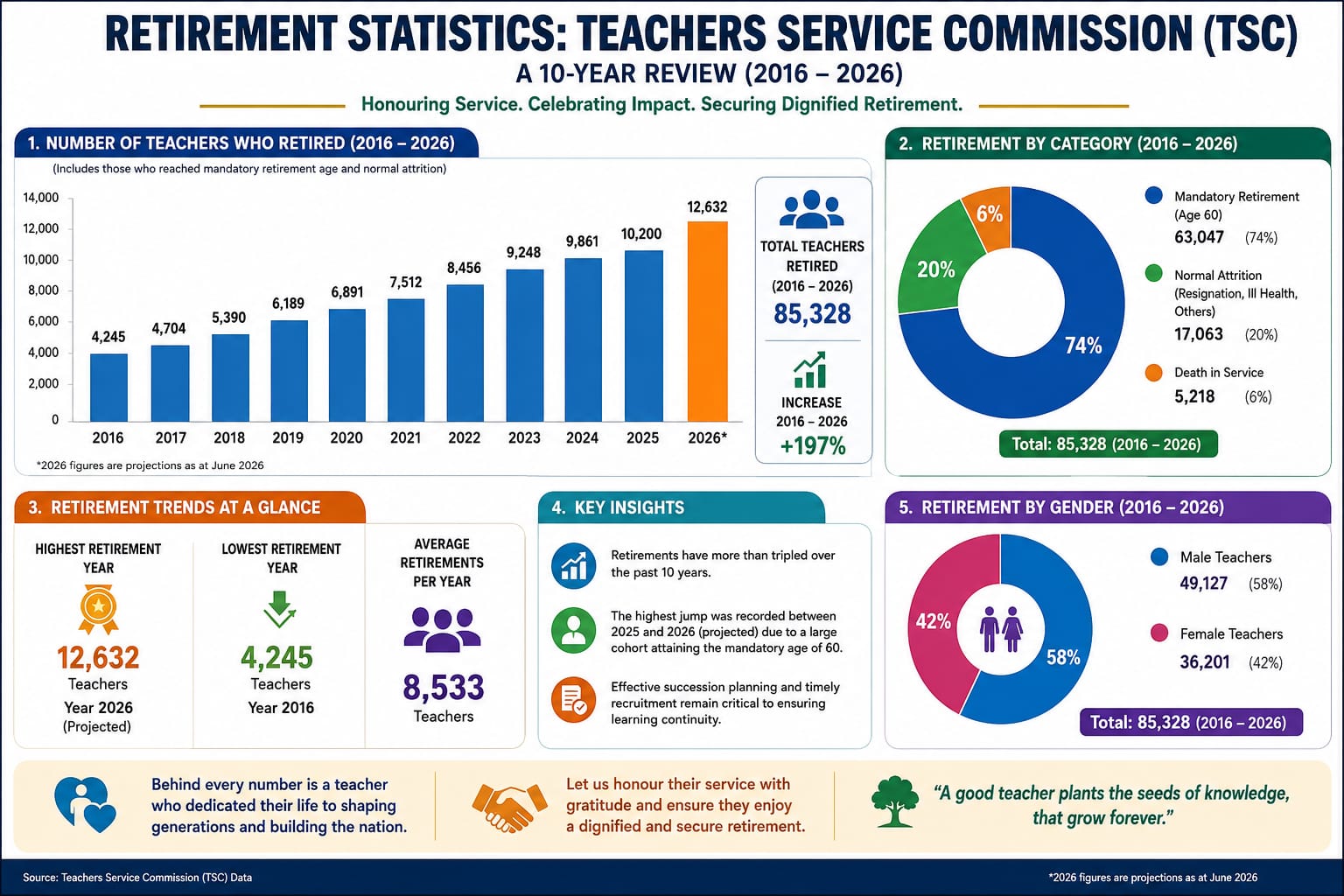
For thousands of Kenyan schools, June 30, 2026, marks far more than the end of another academic term; it marks the end of an era. A record 12,632 teachers are retiring from public service, ushering in one of the largest workforce transitions in Kenya’s education history.
The mass retirement, occasioned largely by teachers attaining the mandatory retirement age of 60 alongside normal staff attrition, comes at a defining moment as the country strengthens the implementation of the Competency-Based Curriculum (CBC) and the broader Competency-Based Education (CBE) framework.
This year’s retirement wave is the largest in recent years. In 2025, about 10,200 teachers retired after attaining the mandatory retirement age. The 12,632 educators leaving in 2026 represent the highest documented retirement cohort in the recent past, underscoring the growing impact of an ageing teaching workforce and the urgency of succession planning.
Their departure will leave schools without thousands of experienced educators who have spent more than three decades nurturing learners, mentoring young teachers and providing leadership in institutions across the country. Many of the retiring teachers educated the professionals who today serve Kenya as doctors, engineers, judges, entrepreneurs, security officers, religious leaders and public servants.
To cushion schools from staffing shortages, the Teachers Service Commission (TSC) has embarked on measures that include absorbing intern teachers into Permanent and Pensionable employment and promoting more than 21,000 teachers into higher grades to strengthen leadership succession.
ALSO READ:
Renowned scientist Prof. Geoffrey Maloiy appointed Maasai Mara University Council chairperson
The Government has also introduced an electronic pension management system linking the TSC and the National Treasury to accelerate pension processing and reduce the delays that have, for years, frustrated retired public servants.
Yet retirement is more than leaving the payroll. It is a major life transition that requires preparation, support and wise decision-making.
For many teachers, the greatest adjustment is moving from a guaranteed monthly salary to living on pension income. Others must cope with increasing healthcare needs, changing family responsibilities and the emotional challenge of leaving a profession that has defined their identity for decades.
These realities place a greater responsibility on the Government to honour its commitment by ensuring that retirees receive their pension benefits promptly, access affordable healthcare and benefit from financial literacy programmes and counselling services. A dignified retirement is the least the nation can offer men and women who dedicated their lives to educating generations of Kenyans.
Families also have a critical responsibility. They should receive retired teachers with appreciation and respect, recognising the sacrifices they made over the years. Retirement should never become a period of neglect or isolation but a time when families strengthen bonds, seek the wisdom of their elders and support them as they begin a new chapter of life.
The retirees themselves must also embrace retirement with wisdom and discipline. Experts advise that the first rule is to avoid rushing into major financial decisions after receiving pension or gratuity payments. Careful budgeting, prudent investment and protection from fraudsters are essential for long-term financial security.
Equally important is maintaining good health through regular medical check-ups, healthy eating, physical exercise and an active lifestyle. Retirement should also be viewed as an opportunity to pursue new interests such as farming, consultancy, writing, entrepreneurship, environmental conservation, mentorship or community service rather than withdrawing completely from productive life.
Retirees are encouragedr to remain socially connected with family, former colleagues and community groups, as strong relationships play a vital role in preventing loneliness and promoting emotional well-being. They should also organise their personal affairs by keeping important documents up to date, planning their estates and ensuring their families understand their wishes.
At the same time, there are pitfalls that retirees should avoid. Financial experts caution against extravagant spending, impulsive investments and schemes promising unrealistic returns. Pension benefits should not be exhausted on luxury purchases or risky ventures without careful planning. Retirees should also avoid isolating themselves from society or neglecting their health, as both can significantly diminish their quality of life.
ALSO READ:
Oburu Odinga calls for review of ban on corporal punishment in schools
Ultimately, retirement should not be viewed as the end of usefulness but as the beginning of another phase of service. The experience accumulated over decades in the classroom remains a priceless national resource that can continue benefiting schools, families and communities through mentorship, volunteerism, leadership and lifelong learning.
As schools prepare to welcome a new generation of teachers, Kenya must also honour those taking their final bow. Their names may leave the Government payroll, but their influence will continue to be felt in every learner they inspired and every profession built on the foundation they laid.
The retirement of 12,632 teachers is therefore more than a workforce transition. It is a defining national moment that calls upon the Government to fulfil its promises, families to embrace their returning heroes and retirees themselves to approach the next chapter of life with prudence, purpose and optimism. If all three play their part, retirement will not mark the end of a meaningful life, but the beginning of a rewarding new journey built on dignity, security and the enduring legacy of service.
By Hillary Muhalya
You can also follow our social media pages on Twitter: Education News KE and Facebook: Education News Newspaper for timely updates.
>>> Click here to stay up-to-date with trending regional stories
>>> Click here to read more informed opinions on the country’s education landscape