- Prof John Okumu has been installed as Kenyatta University’s seventh Vice-Chancellor amid financial constraints, pending bills and rising infrastructure demands.
- Prof Okumu has placed financial discipline, revenue diversification and staff welfare at the centre of his agenda, alongside the ongoing construction of a 2,500-bed student hostel.
- Prof Okumu has committed to implementing CBE at university level and strengthening early intervention systems for students facing academic or personal difficulties.
Kenyatta University’s new Vice-Chancellor inherits a university facing a difficult balancing act: rescue its finances, modernise infrastructure, protect academic quality and prepare thousands of students for a rapidly changing economy. Prof John Okumu has taken charge of Kenyatta University at a moment when the institution needs more than a change of guard; it needs a turnaround.
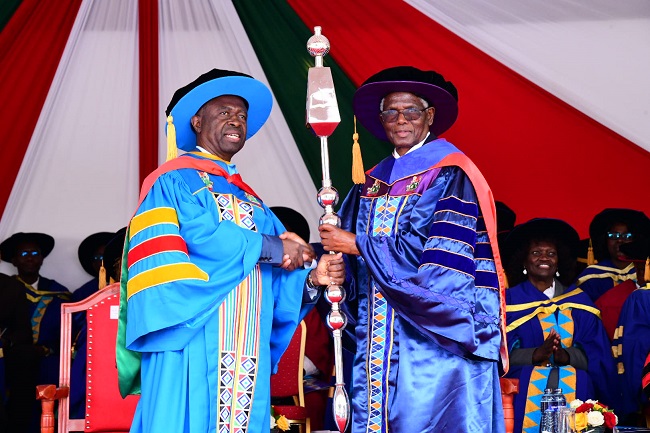
Installed on Friday, August 28, 2026, as the university’s seventh Vice-Chancellor, Okumu inherits an institution grappling with financial constraints, pending bills, infrastructure demands, changing expectations in higher education and the challenge of implementing Competency-Based Education (CBE). Kenyatta University confirmed the formal handover of the instruments of power from Prof Paul Wainaina to Okumu during the installation ceremony, at which the university also welcomed more than 15,000 newly admitted first-year students, underlining the scale of the institution and the responsibility now placed on its management.
The new Vice-Chancellor is not walking into unfamiliar territory. A long-serving Kenyatta University academic and former Deputy Vice-Chancellor in charge of Academics, Okumu knows the institution from the inside, and his appointment followed a competitive recruitment process in which he emerged as the leading candidate, according to reporting by NTV. That institutional experience could become one of his greatest advantages, but it also means expectations will be exceptionally high. The central question confronting his administration is straightforward: can Prof Okumu turn Kenyatta University from an institution managing financial pressure into one capable of funding its ambitions sustainably? That will be the defining test.
ALSO READ:
Kaimosi Friends University quashes rumours over Vokoli campus plans
The financial balancing act
Public universities across Kenya are operating in an increasingly difficult environment, with government support under pressure and operational costs continuing to rise even as institutions must invest in technology, infrastructure, research, staff development and student services. For KU, the challenge is magnified by its size: more students mean greater pressure on lecture rooms, laboratories, libraries, accommodation, ICT infrastructure, welfare services and teaching staff. It is against this backdrop that Okumu has placed financial discipline at the centre of his agenda, with his administration planning to strengthen financial controls, diversify revenue sources and improve efficiency in service delivery.
That strategy will be critical, though revenue diversification must be pursued carefully, since universities cannot simply chase income at the expense of their academic mission. The real challenge will be finding sustainable revenue streams while protecting affordability, quality and the institution’s public-service mandate. Pending bills present another immediate test, since unresolved financial obligations can affect suppliers, contractors, staff operations and development projects; clearing the backlog while maintaining essential services will require careful prioritisation and strict financial management.
Infrastructure and the CBE transition
One of the most visible projects associated with Okumu’s agenda is the ongoing construction of a modern two-tower G+14 student hostel capable of accommodating about 2,500 students, a project that could ease pressure on accommodation while demonstrating the administration’s commitment to student welfare. But the infrastructure deficit goes beyond hostels: Okumu has identified laboratories, lecture spaces, libraries, ICT infrastructure, student facilities and staff workspaces as areas requiring continued investment. His stated approach of prioritisation, resource mobilisation, value for money and long-term sustainability will be crucial, since the university cannot afford to build for prestige alone; every major project must answer a simple question: will it materially improve teaching, research, student welfare or institutional productivity?
ALSO READ: Panic at Nyakorere Secondary in Kisii as contractor threatens to evict students over unpaid dues
The CBE transition presents another major assignment. Kenya’s education system is moving towards an increasingly competency-focused model, and universities must prepare to receive learners whose educational experiences, assessment methods and expectations have been shaped by the new system. For KU, implementing CBE will require more than changing course titles; it will demand curriculum review, new approaches to teaching and assessment, stronger links between learning and industry, expanded digital capabilities and greater emphasis on practical competencies, so that graduates leave with more than academic certificates. This philosophy is reflected in Okumu’s vision of producing competent, ethical, innovative and resilient graduates capable of creating opportunities rather than simply waiting for jobs.
Staff, students and the road ahead
The transformation cannot be student-focused alone. Okumu has identified staff as the university’s most important resource and pledged to improve working conditions, welfare, professional development, continuous learning and career progression opportunities, a commitment that could prove decisive, since a university cannot produce world-class graduates with demoralised lecturers, inadequate facilities or limited growth opportunities. His administration will need to build trust with academic and non-academic staff while managing the institution’s financial realities.
Student welfare is equally important. Okumu has promised to strengthen mechanisms for identifying students experiencing academic or personal difficulties early enough to allow intervention before those challenges compromise their studies, a significant shift from waiting for problems to become crises, and a recognition that academic success is shaped by mental, social, financial and personal circumstances as much as by ability.
ALSO READ: School Principals warn of learning disruption over capitation shortfall
Ultimately, the new Vice-Chancellor will be judged by results. Kenyatta University already has the infrastructure of a major institution, a large student population, experienced academics and a substantial history in Kenya’s higher education sector; what it needs now is a sustainable strategy connecting those assets to measurable outcomes. It must strengthen its finances without compromising quality, expand infrastructure without accumulating unsustainable obligations, embrace technology without abandoning those who need support to adapt, implement CBE while keeping academic standards high, and produce graduates competitive both in Kenya and across an increasingly interconnected global economy.
Prof Okumu’s installation therefore represents more than a ceremonial transition; it is the beginning of a high-stakes test of institutional leadership. His predecessor, Prof Paul Wainaina, handed over the instruments of administration after two terms, describing Okumu as hardworking and grounded, and Okumu now has the opportunity to turn that reputation into an era defined by financial stability, academic excellence, innovation and institutional renewal. The first measure of success will not be the number of speeches delivered or projects announced; it will be whether the university becomes financially healthier, whether students experience better learning and living conditions, whether staff feel valued, and whether KU emerges stronger and more relevant to Kenya’s changing economic and social needs. Prof John Okumu has taken the helm. The real work begins now.
By Hillary Muhalya
Get more stories from our website: Education News
To write to us or offer feedback, you can reach us at: editor@educationnews.co.ke
You can also follow our social media pages on Twitter: Education News KE and Facebook: Education News Newspaper for timely updates.
>>> Click here to stay up-to-date with trending regional stories