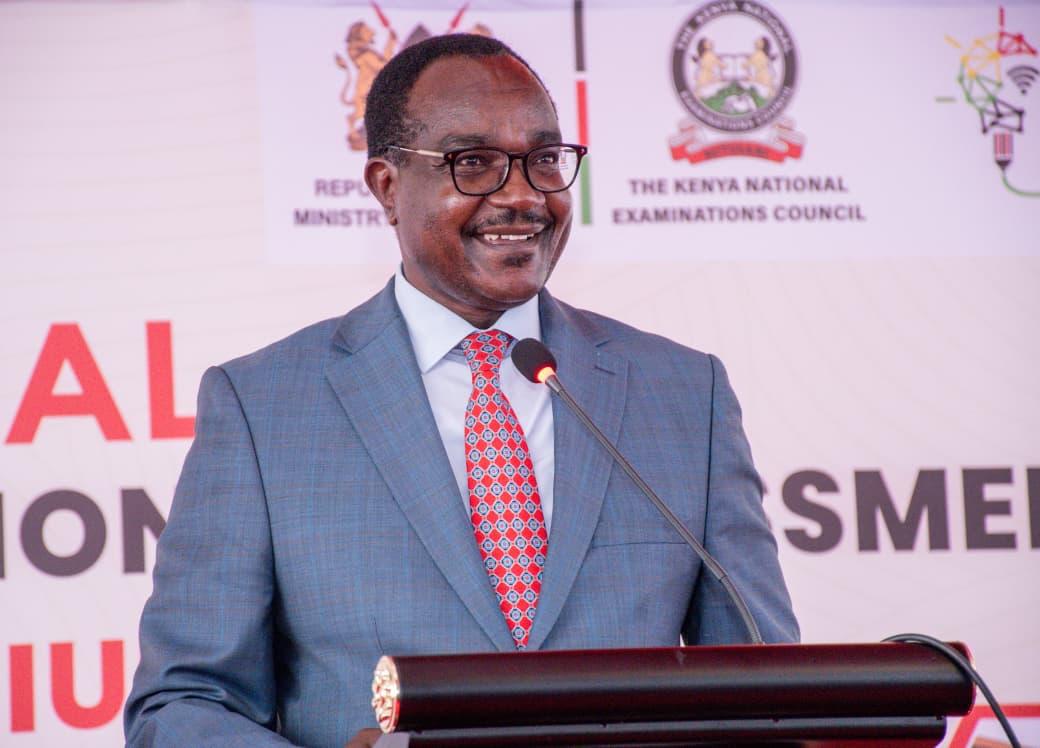
- Education CS Julius Ogamba played a central role in efforts to resolve the county bursary dispute.
- The process led to intergovernmental agreements allowing counties to support vulnerable learners within a legal framework.
- The arrangements seek to improve coordination, accountability and access to education funding for needy students.
Thousands of vulnerable learners faced uncertainty over school and college fees when county governments were stopped from issuing bursaries in early 2025, triggering a government push to find a legal and workable way of restoring the crucial education support.
At the centre of that effort was Education Cabinet Secretary Julius Migos Ogamba, who moved to engage the Controller of Budget and governors as the dispute threatened to leave needy learners without one of the financial lifelines that had helped keep them in school.
The crisis followed a January 2025 directive by Controller of Budget Margaret Nyakang’o restricting counties from issuing bursaries for education functions assigned to the National Government unless the required legal framework was in place. The Controller cited the constitutional allocation of functions between the national and county governments.
For families dependent on county assistance, the decision created immediate uncertainty, particularly for secondary school students and young people pursuing university and TVET education.
Ogamba responded publicly, saying the National Government was engaging the Controller of Budget in search of a “win-win solution” that would protect learners while addressing concerns over the constitutional basis of county bursary spending.
The issue subsequently reached the political level, with the government engaging governors and the Controller of Budget through intergovernmental discussions aimed at establishing a framework that would allow counties to continue supporting vulnerable learners. An agreement reached through the Intergovernmental Budget and Economic Council allowed counties with established education funds to continue bursary support, while others could create such funds or enter agreements with the Ministry of Education.
The intervention helped turn the dispute into a wider intergovernmental discussion on how counties could participate in education support without taking over functions constitutionally assigned to the National Government.
From bursary crisis to intergovernmental framework
The legal position remained contested for several months, with court proceedings producing conflicting directions over implementation of the Controller of Budget’s January circular.
But the government response did not stop at restoring access to bursary support.
Under Ogamba’s leadership, the Ministry of Education began developing formal partnerships with county governments. Murang’a and Mandera became the first counties to sign Intergovernmental Partnership Agreements with the Ministry in May 2025, establishing a formal framework for bursary and scholarship administration.
The framework was later extended to other counties. Kisumu and Marsabit, for example, entered similar agreements with the Ministry in late 2025 to support the issuance of bursaries and scholarships for poor and vulnerable learners in basic education, TVET institutions and universities.
The approach sought to replace ad hoc arrangements with a more coordinated system in which national and county governments could work together while maintaining their respective constitutional responsibilities.
Ogamba has also advocated stronger coordination of bursary and scholarship programmes to improve accountability and ensure that support reaches learners who need it most.
The issue is significant because Kenya operates several education-support programmes across different levels of government and institutions. Without adequate coordination, duplication can arise while other eligible learners remain outside available support systems.
The county bursary dispute ultimately became more than a disagreement over who should finance education support.
It exposed the need for a clearer mechanism through which national and county governments can collaborate to protect vulnerable learners without blurring their constitutional mandates.
Ogamba’s early engagement with the Controller of Budget, followed by broader intergovernmental discussions and the subsequent development of partnership agreements, formed part of the government’s effort to address that gap.
For parents and learners, the most important outcome is the continued availability of financial assistance where county bursaries are provided.
READ ALSO:
For policymakers, however, the longer-term question is whether the emerging framework can deliver bursary support consistently, transparently and to the learners who need it most.
By Hillary Muhalya
Get more stories from our website: Education News
To write to us or offer feedback, you can reach us at: editor@educationnews.co.ke
You can also follow our social media pages on Twitter: Education News KE and Facebook: Education News Newspaper for timely updates.
>> Click here to stay up-to-date with trending regional stories