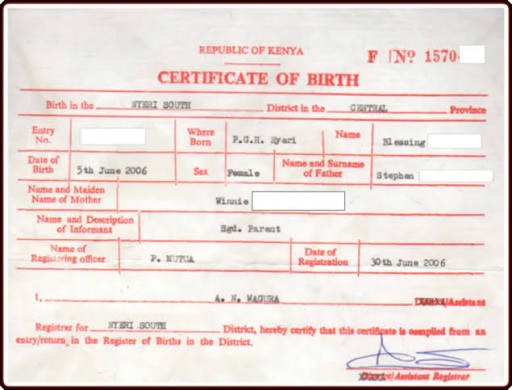
- The birth certificate has become Kenya’s most critical legal document, underpinning access to education, healthcare, IDs, passports, employment, and digital government services.
- Online applications via eCitizen have simplified access, but physical verification at Civil Registration Offices or Huduma Centres remains mandatory to prevent fraud and ensure integrity.
- Government plans to introduce a Unique Personal Identifier (UPI) at birth, linking civil registration with education, healthcare, and immigration databases to create a seamless digital identity system.
As Kenya deepens its digital transformation agenda, the birth certificate has become the country’s most critical legal document, underpinning access to education, healthcare, national identification, travel, employment, and a wide range of government services. Once regarded simply as proof of birth, it now serves as the foundation for nearly every stage of a Kenyan’s life.
From enrolling a child in school to registering for national examinations, applying for a national identity card, or securing a passport, the birth certificate has become indispensable. The rollout of platforms such as eCitizen and the Kenya Education Management Information System (KEMIS) has further elevated its importance, ensuring that accurate birth records are central to learner tracking, government capitation, school transfers, and educational planning.
Education authorities emphasise that examination registration depends on the birth certificate to verify official names, dates of birth, and identity. This prevents errors that could delay certification, university admission, or future employment. Parents and guardians are therefore urged to register births promptly to avoid last‑minute challenges when learners are admitted to schools or registered for exams.
Beyond education, the document is required when applying for a national ID at age 18, acquiring a passport, registering for the Social Health Authority (SHA), applying for scholarships and bursaries, joining colleges and universities, securing formal employment, processing inheritance matters, opening certain financial accounts, and accessing numerous government services. For many Kenyans, the birth certificate has effectively become the master document upon which every other official record depends.
ALSO READ:
President Ruto to meet university VCs over ambitious 100 per cent funding strategy
Online Applications and Physical Verification
The government has introduced online applications through eCitizen to modernise service delivery and reduce congestion at Civil Registration Offices and Huduma Centres. Applicants can now fill forms and pay fees electronically. However, officials stress that physical verification remains mandatory. Applicants must present printed forms, receipts, and original supporting documents at registration offices before certificates are issued.
Authorities argue that this requirement protects the integrity of the civil registration system by preventing identity fraud, forgery, and multiple registrations. Original documents such as birth notifications, parents’ ID cards, and marriage certificates are examined before approval.
Fees and Processing Timelines
Applicants currently pay Ksh 250 for standard applications submitted within the registration period. Late registration, reported more than six months after birth, attracts a fee of Ksh 500 and requires additional evidence such as affidavits, immunisation records, school admission records, or baptismal certificates. Standard applications are processed within one to two weeks, while late registrations may take up to four weeks or longer.
Calls for Fully Digital Services
Despite improvements, citizens in rural and remote areas continue to face transport costs and long journeys to Huduma Centres for verification. Many argue that advances in digital identity verification should eventually allow the entire process to be completed online without compromising security.
Government’s Reform Agenda
Officials are pursuing wider reforms to modernise civil registration and identity management. Among the initiatives is a Unique Personal Identifier (UPI) assigned to every child at birth, linking civil registration with education, healthcare, immigration, and other databases. Once implemented, parents may eventually access birth certificates electronically with minimal physical interaction while maintaining safeguards against fraud.
ALSO READ:
TVET CDACC tightens rules on accessing assessment tools to safeguard exam integrity
The Foundation of Opportunity
Civil registration experts stress that registering every birth is both a legal obligation and a fundamental right. A birth certificate is far more than a record of birth—it is the cornerstone of legal identity and the gateway to education, examinations, healthcare, employment, financial services, and countless government programmes.
For now, however, applicants must still complete the final stage in person. Until reforms are fully implemented, a visit to a Civil Registration Office or Huduma Centre remains mandatory. The government’s long‑term vision is to build a secure, efficient, and fully integrated civil registration system that guarantees every Kenyan a legal identity from birth while making public services faster, more accessible, and more convenient.
By Hillary Muhalya
You can also follow our social media pages on Twitter: Education News KE and Facebook: Education News Newspaper for timely updates.
>>> Click here to stay up-to-date with trending regional stories
>>> Click here to read more informed opinions on the country’s education landscape