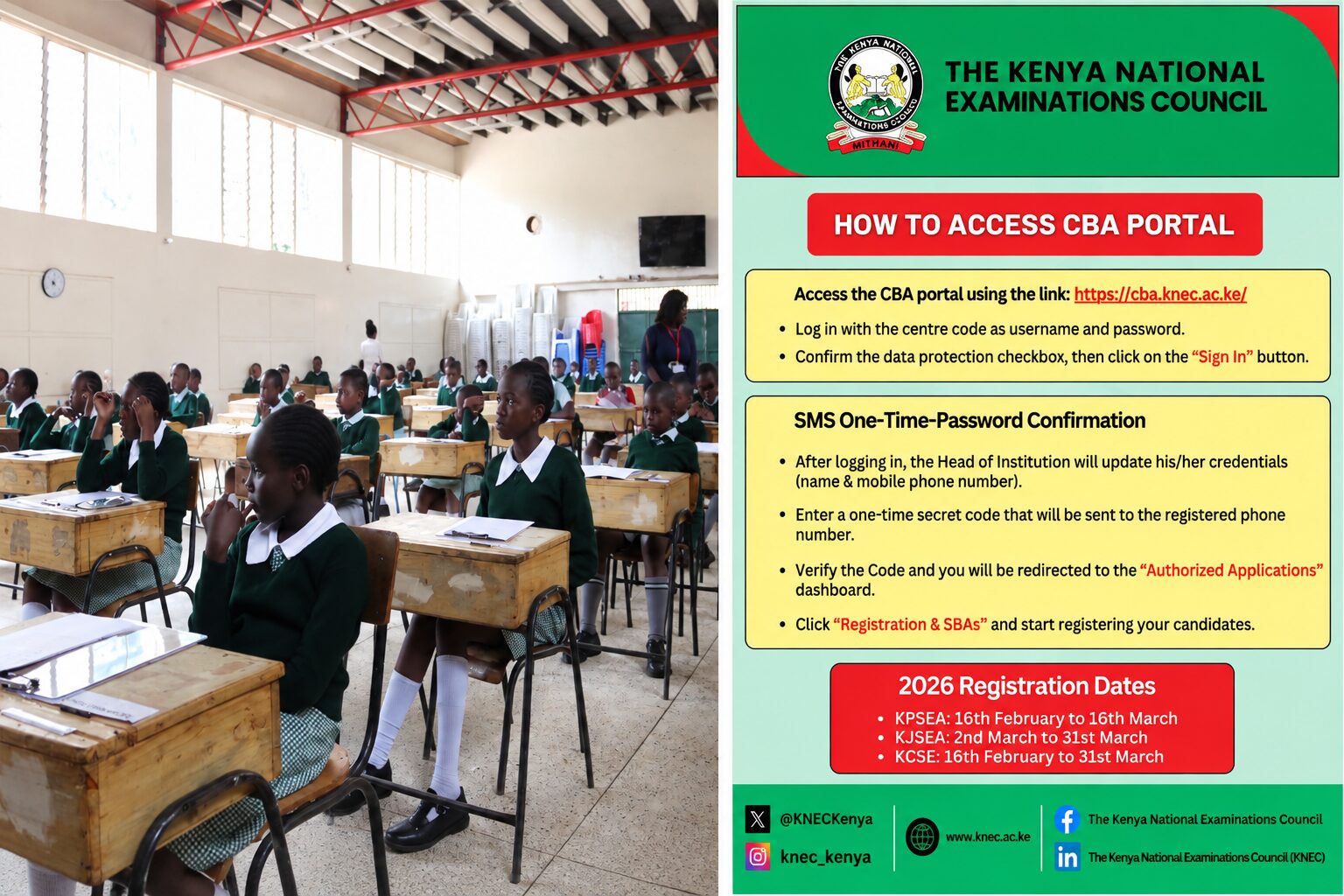
- Schools have until September 30 to correct missing or incomplete School-Based Assessment records for learners.
- The exercise places Heads of Institutions at the centre of verifying KPSEA and KJSEA assessment data.
- Accurate digital records are critical to ensuring learners are not disadvantaged by administrative omissions.
The Kenya National Examinations Council (KNEC) has reopened its Competency-Based Assessment (CBA) portal, giving schools a fresh opportunity to correct missing or incomplete School-Based Assessment (SBA) records for learners undertaking the Kenya Primary School Education Assessment (KPSEA) and Kenya Junior School Education Assessment (KJSEA).
Heads of Institutions (HOIs) have until September 30, 2026, to upload pending assessment scores and address gaps in candidate records. The extension offers schools an important final opportunity to ensure learners’ assessment profiles are complete before the examination and assessment cycle advances.
The reopening comes after schools were previously required to verify and ensure that SBA scores for eligible KPSEA and KJSEA candidates had been uploaded. Earlier guidance had placed a July 30 deadline for verification of the records.
The latest intervention therefore places renewed responsibility on school administrators to audit their records rather than assume that previously entered data is complete.
Under Kenya’s competency-based assessment framework, assessment is not confined to a single end-of-cycle examination. Learners are evaluated progressively through school-based activities, projects, practical tasks and written assessments.
KNEC’s CBA system provides the digital platform through which schools record and submit these assessments. Official KNEC guidance requires schools to access the CBA portal, administer assessments, score learners and upload the outcomes within prescribed timelines.
This makes accurate data entry an increasingly important part of school administration.
A missing score may appear to be a minor administrative omission, but assessment data contributes to the learner’s official academic record. Where records are incomplete, schools may face difficulties establishing a complete picture of a learner’s performance when assessment information is consolidated.
The issue is therefore bigger than simply filling an empty box on an online portal. It is about protecting the integrity of learner records.
Heads of Institutions under pressure
The September 30 deadline puts HOIs at the centre of the verification exercise.
School administrators should not wait until the final days to begin checking their records. They need to establish whether every eligible learner has the required SBA entries, identify missing components and correct errors before the portal closes.
The audit should cover candidate registration details, assessment entries and any outstanding project or practical assessment records.
Where a learner legitimately missed an assessment activity, administrators should follow the prescribed KNEC reporting procedure rather than leaving the field blank.
This is particularly important because a blank field and a documented absence do not necessarily communicate the same information to an assessment system.
KNEC’s current guidance also places responsibility on Heads of Institutions for accurate and timely registration and management of candidate information.
Digital assessment demands stronger school management
The latest reopening also exposes a broader challenge facing Kenya’s transition to Competency-Based Education (CBE): schools are increasingly dependent on accurate digital administration.
Teachers may perform assessment activities correctly in classrooms, but that work must eventually be captured accurately in the official system.
The responsibility therefore does not end with the teacher marking a project or practical activity. Schools need functioning internal systems for recording, checking, verifying and submitting assessment information.
Headteachers, principals, assessment coordinators and teachers must work together to prevent data gaps from reaching the final stages of the assessment cycle.
This requires schools to conduct routine audits instead of treating portal deadlines as emergency exercises.
Parents should not assume that assessment information is exclusively a school-management issue.
KNEC currently provides a parent portal through which parents and guardians can check learners’ registration and assessment status after verification.
Where schools provide opportunities for parents to verify learner information or communicate assessment concerns, parents should take advantage of them. They should also raise concerns promptly where a learner’s assessment record appears incomplete or inconsistent.
Early identification of a missing record is far easier to resolve than attempting to reconstruct an assessment history after a portal has closed.
KNEC’s window should not become another last-minute rush
The reopening of the CBA portal is a welcome intervention because it gives schools another opportunity to correct administrative gaps.
But the extension should also serve as a warning.
Kenya’s assessment reforms are increasingly dependent on reliable digital records. A system in which schools repeatedly wait for portals to reopen before correcting missing information creates unnecessary pressure on administrators and, more importantly, risks shifting the consequences of administrative mistakes towards learners.
Schools should therefore use the period before September 30 to undertake a comprehensive candidate-by-candidate audit.
KNEC, on its part, should continue providing clear technical guidance and timely communication whenever assessment windows are opened, closed or extended. Schools need sufficient notice to correct genuine errors, particularly where technical difficulties rather than negligence are responsible for missing data.
The immediate priority, however, rests with institutions.
Every school should treat the September 30 deadline as a firm operational deadline, verify every relevant candidate record and resolve outstanding SBA gaps without waiting for another extension.
READ ALSO: KEMIS glitches put Grade 10 selection under pressure as schools seek more time
The ultimate objective should be simple: no learner should lose the benefit of a legitimately completed assessment because of an avoidable administrative or data-entry gap.
By Hillary Muhalya
Get more stories from our website: Education News
To write to us or offer feedback, you can reach us at: editor@educationnews.co.ke
You can also follow our social media pages on Twitter: Education News KE and Facebook: Education News Newspaper for timely updates.
>> Click here to stay up-to-date with trending regional stories