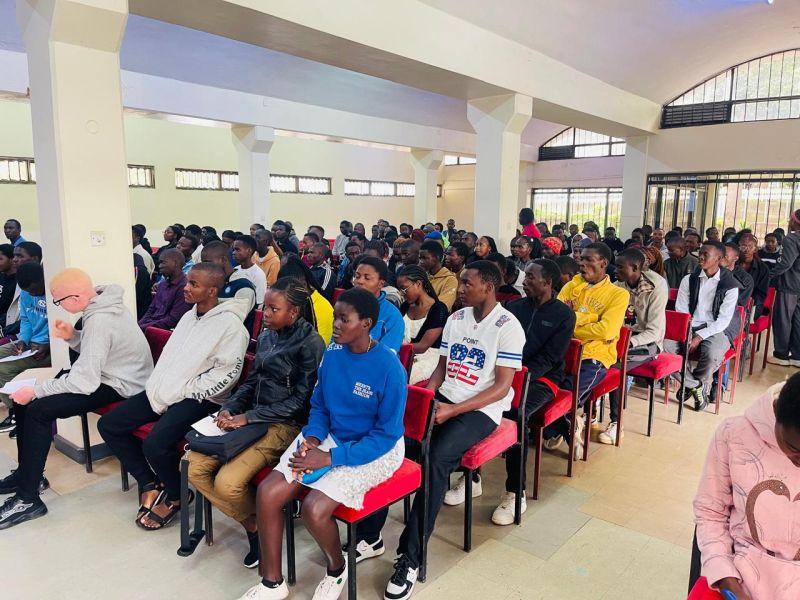
- A total of 270,508 candidates attained C+ and above in the 2025 KCSE examination.
- While 202,133 secured degree placements, another 8,915 opted for non-degree programmes.
- That leaves 59,460 outside those reported categories, raising questions about Kenya’s post-KCSE transition tracking.
Some 270,508 qualified for university. 202,133 were placed in degree programmes. 8,915 chose non-degree pathways. Then comes the uncomfortable number: 59,460.
Kenya has become remarkably good at counting how many young people pass examinations. It knows how many sit KCSE, how many attain C+, how many qualify for university and how many receive placement.
But there is a more important question the country must now confront:
What happens to them after the results?
The 2025 KCSE cohort has produced a number that should trigger a serious national conversation.
A total of 270,508 candidates attained C+ and above, making them eligible for consideration for degree programmes. Of these, 202,133 were placed in degree programmes, while another 8,915 university-qualified students opted for non-degree programmes.
That gives 211,048 students with an identifiable pathway within those two reported placement categories.
The arithmetic leaves 59,460.
That is roughly one in every five students who attained C+ and above.
The figure should not be sensationalised as 59,460 young people who have “disappeared” from Kenya. That would go beyond what the placement figures actually establish.
Some may have secured admission independently in private universities or other institutions. Others may have joined colleges or TVET institutions outside the reported placement categories. Some may have deferred admission, entered employment, started businesses or chosen completely different pathways.
But that caveat makes the question more compelling, not less:
Where exactly are they?
A modern education system should be able to answer that question.
Kenya counts qualifiers—but does it track destinations?
For years, Kenya’s education debate has been dominated by examination results.
Schools celebrate mean scores.
Parents celebrate grades.
Candidates celebrate university qualification.
The media publishes lists of top performers.
Then the spotlight moves elsewhere.
But the most consequential part of a young person’s educational journey may begin precisely at that point.
A C+ is an academic achievement.
It is not a university admission guarantee.
And a university placement is not an employment guarantee.
The real test of education is whether a young person can successfully transition from secondary school into another meaningful stage of life.
That could be university.
It could be TVET.
It could be a diploma or certificate programme.
It could be an apprenticeship.
It could be employment.
It could be entrepreneurship.
The destination does not necessarily have to be university.
But there must be a destination.
The 59,460 are a question—not a verdict
The 59,460 should therefore be treated as a transition gap, not automatically as a population of idle or abandoned young people.
The country needs to distinguish between students who deliberately chose another pathway and those who were unable to continue.
That distinction is critical.
A student who says, “I chose TVET because I want a technical career,” represents the success of a diversified education system.
A student who says, “I wanted university but my family could not afford it,” exposes a financing problem.
Both can appear in the same statistical category.
Their realities, however, are completely different.
This is where the issue intersects directly with Kenya’s higher-education financing reforms.
A student can achieve C+ and still face enormous barriers.
An admission letter does not pay tuition.
A university placement does not pay accommodation.
It does not buy food, books, transport or other necessities.
For a financially secure household, these challenges may be manageable.
For a poor household, they can determine whether the student proceeds at all.
That is why the 59,460 must be interrogated through a socio-economic lens.
How many are from households unable to finance further education?
How many deferred because of financial difficulties?
How many accepted alternative programmes because they were cheaper?
How many entered employment because they could not afford another year of schooling?
These questions are far more important than simply asking why every C+ student did not become a university undergraduate.
University is not the only measure of success
Kenya must also resist the temptation to interpret the figures as evidence that every C+ student should have gone to university.
That would undermine one of the most important principles of a modern education system: different learners need different pathways.
Kenya needs engineers and teachers.
But it also needs electricians, plumbers, mechanics, builders, agricultural technicians, ICT specialists, designers, artisans, entrepreneurs and thousands of other skilled workers.
A technically trained young Kenyan is not a failed university student.
They are potentially exactly what the economy needs.
That is why the 8,915 university-qualified students who opted for non-degree programmes deserve attention.
Their choices could signal a changing perception of TVET and other middle-level institutions.
But government needs to know why they made those choices.
Were they pursuing their preferred careers?
Were they attracted by employment prospects?
Or were they pushed into those programmes by financial limitations?
The employment elephant in the room
Even the 202,133 who have been placed in degree programmes are not guaranteed a job at graduation.
This brings the entire debate back to Kenya’s labour market.
The country cannot solve youth unemployment simply by increasing university admissions.
If university enrolment expands faster than the economy creates productive jobs, Kenya risks producing increasingly qualified young people who still struggle to find employment.
The answer is not to discourage education.
The answer is to build a stronger bridge between education, skills and livelihoods.
Universities must increasingly respond to labour-market demand.
TVET institutions must provide skills that translate into actual economic opportunities.
Apprenticeships must become more accessible.
Entrepreneurship must become more than a slogan.
Industry must work more closely with education institutions.
And young people must have credible alternatives to waiting for formal employment.
The teacher paradox
The same problem is visible elsewhere in Kenya’s education system.
The country has thousands of trained teachers seeking employment while schools continue to face staffing needs in various areas.
That contradiction illustrates a larger problem: education and employment do not automatically connect themselves.
Kenya can train people.
It can certify them.
It can produce qualifications.
But the economy ultimately has to create productive spaces where those qualifications can be used.
The lesson is equally relevant to the 270,508 KCSE candidates who attained C+ and above.
Their success should not end with a placement letter.
It should lead somewhere.
CBE’s biggest test may come after KCSE
This is also where competency-based education faces one of its biggest real-world tests.
CBE is built around competencies, abilities and multiple pathways rather than treating academic examination performance as the sole measure of potential.
But pathways only have meaning when they are accessible and connected to opportunity.
A learner with technical talent needs a technical pathway.
A learner with entrepreneurial ability needs access to enterprise opportunities.
A learner with strong academic ability needs access to higher education.
A learner with creative talent needs a pathway into the creative economy.
The objective should therefore not be to push every learner into university.
It should be to ensure that every learner has a credible next step.
Kenya needs a ‘Where did they go?’ system
The solution begins with better tracking.
Kenya needs a comprehensive post-KCSE transition database capable of showing what happens to each cohort after secondary school.
Six months after KCSE, policymakers should know how many have entered university, TVET, colleges, apprenticeships, employment or entrepreneurship.
One year later, the figures should be updated.
Three years later, policymakers should know how many completed training, secured employment, created enterprises or progressed to another level.
Such a system would transform education planning.
It would reveal whether university places are adequate.
It would show whether TVET is genuinely attracting students.
It would expose financial barriers.
It would reveal regional and socio-economic inequalities.
It would help institutions align courses with labour-market demand.
And it would answer the question now hanging over the 2025 KCSE cohort:
Where did the 59,460 go?
The bigger question is not university—it is the future
Ultimately, this is not a story about 59,460 students failing to enter university.
It is a story about whether Kenya has built a reliable bridge from school to opportunity.
The country has successfully counted those who qualified.
It has counted those who were placed.
It has counted those who chose alternative programmes.
Now it must account for the rest.
Not to shame them.
Not to label them failures.
Not to suggest that university is the only respectable destination.
But to understand what is happening to an entire generation at the point where education meets adulthood.
Some of the 59,460 may already be pursuing excellent careers.
Some may be studying elsewhere.
Some may be working.
Some may be building businesses.
Some may be waiting.
And some may have been forced out of the education pipeline by circumstances beyond their control.
Kenya needs to know the difference.
Because the success of an education system cannot be measured only by how many young people it gets into an examination hall.
It must also be measured by how many it successfully moves into further learning, skills, work, enterprise and productive citizenship.
270,508 qualified.
202,133 were placed in degree programmes.
8,915 chose non-degree pathways.
59,460 remain outside those reported categories.
The number is not necessarily a crisis.
But the lack of a clear national answer about their destinations should be.
The question is no longer simply who passed KCSE.
READ ALSO: Nyakongo Boys elevated to C1 national school status
The question is where they went—and whether Kenya gave them somewhere meaningful to go.
By Hillary Muhalya
You can also follow our social media pages on Twitter: Education News KE and Facebook: Education News Newspaper for timely updates.
>>> Click here to stay up-to-date with trending regional stories
>>> Click here to read more informed opinions on the country’s education landscape