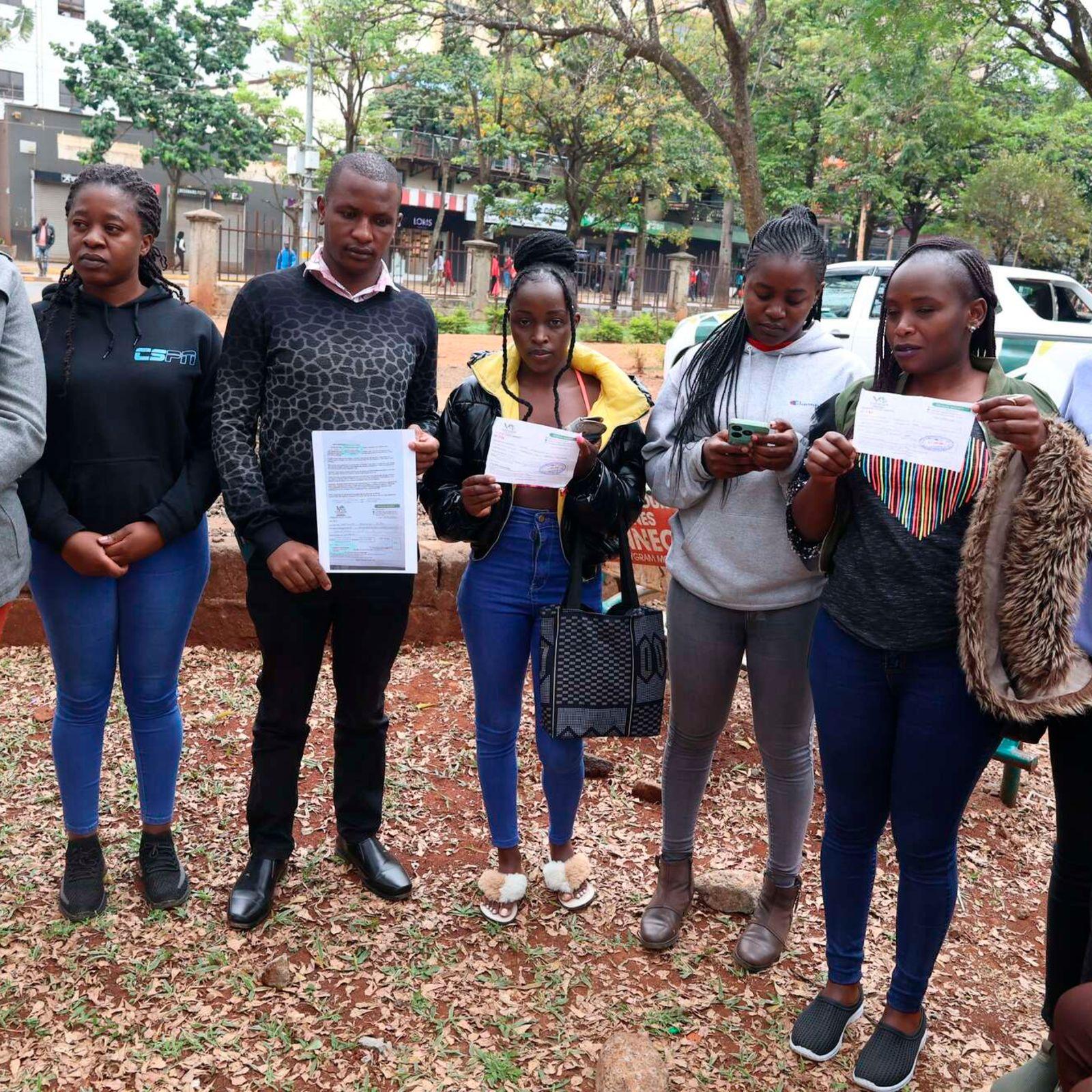
- Promising overseas jobs are increasingly becoming gateways into trafficking networks that force victims into online criminal operations.
- More than 1,100 Kenyans have reportedly been rescued or repatriated from suspected scam compounds in Myanmar, Cambodia and Laos.
- Hillary Muhalya examines how fake recruitment works, the dangers facing job seekers and why Kenya needs stronger safeguards.
What begins as a promising overseas job opportunity is turning into a nightmare for an increasing number of Kenyan job seekers, as international criminal networks exploit unemployment and the search for better livelihoods to recruit victims into forced online criminality.
The International Organization for Migration (IOM) has identified Kenya among countries significantly affected by a growing global trafficking crisis involving scam compounds in parts of Southeast Asia.
The networks operate through an increasingly sophisticated model. Victims are first approached through seemingly legitimate employment advertisements, recruitment agencies or online contacts. They are promised jobs, attractive salaries and opportunities to build better lives abroad.
But after travelling, many discover that the job they were promised does not exist.
Instead, they are taken to heavily guarded compounds where their passports and other travel documents may be confiscated, their movements restricted and their communication monitored.
They are then forced to participate in online fraud operations targeting unsuspecting victims across the world.
For those who resist, the consequences can be devastating.
Survivors have reported physical violence, threats, starvation, sexual abuse, debt bondage and solitary confinement. Some have been forced to work for extremely long hours under constant surveillance.
The crisis has transformed what might ordinarily be viewed as cybercrime into a much broader human-trafficking emergency.
The scale of the problem is becoming increasingly difficult to ignore.
Between 2022 and 2025, the IOM assisted more than 3,500 trafficking victims from 39 countries across Southeast Asia.
Among the nationalities significantly represented were Indonesians, Indians, Sri Lankans, Ethiopians, Kenyans and Bangladeshis.
The presence of East Africans among the rescued victims has prompted concern within international organisations because it signals a geographical expansion of trafficking networks that previously appeared concentrated in other regions.
IOM Regional Director for East, Horn and Southern Africa Frantz Celestin warned that the threat is no longer something Kenyans can regard as a distant international problem.
Criminal organisations, he said, are increasingly targeting job seekers in East Africa using false promises of employment abroad.
The warning comes at a time when many young Kenyans are actively searching for opportunities outside the country because of limited employment prospects and the attraction of foreign salaries.
That vulnerability is being exploited by sophisticated trafficking networks.
More than 1,100 Kenyans rescued from three countries
Kenya’s own experience demonstrates the magnitude of the crisis.
In May 2026, Prime Cabinet Secretary and Foreign Affairs Cabinet Secretary Musalia Mudavadi disclosed that more than 751 Kenyans had been rescued from suspected scam compounds in Myanmar.
Of these, 615 had been repatriated to Kenya.
Cambodia has also recorded a significant number of Kenyan victims.
Between January and April 2026, 393 Kenyans were rescued from suspected scam compounds in the country, while 304 were subsequently returned home.
Another 29 Kenyans have been repatriated from Laos.
Taken together, the reported figures point to more than 1,100 Kenyan nationals rescued or repatriated from three countries in Southeast Asia.
The numbers are particularly concerning because they may represent only victims who have been identified and rescued.
Others could still be trapped in compounds, while additional victims may remain reluctant to report their circumstances because of threats, fear, shame or uncertainty about whether authorities will help them.
The recruitment process often follows a familiar pattern.
A job seeker encounters an advertisement promising employment abroad. The opportunity may appear professional and convincing, sometimes complete with contracts, company profiles, travel arrangements and assurances about accommodation.
The applicant is encouraged to believe that they are on their way to a legitimate international career.
After arriving at the destination country, however, the reality can change.
Instead of being taken to an office, factory, hotel or technology company, victims may be transported to secured compounds.
Their passports can be taken away.
Their phones and communication may be restricted.
They may be informed that they owe money for recruitment, transportation, accommodation or other expenses.
The alleged debt then becomes a mechanism of control.
Victims can be forced to work for long periods while being threatened with violence if they fail to meet financial targets.
The work may involve impersonation, romance scams, cryptocurrency fraud, investment scams or other forms of online deception.
What appears on the surface to be a cybercrime operation is therefore, in many cases, powered by human trafficking.
Victims should not be treated as criminals
One of the most important issues raised by the IOM is how governments respond after victims are rescued.
People forced to commit online crimes under violence, threats or coercion should be recognised primarily as trafficking survivors rather than treated in the same way as voluntary participants in criminal networks.
IOM Director General Amy Pope has emphasised that individuals trapped inside scam compounds are victims when they are compelled to commit crimes through coercion.
That distinction is crucial for Kenya.
A rescued Kenyan who was forced to participate in fraud may require psychological support, medical assistance, legal protection, repatriation and reintegration rather than automatic criminal prosecution.
Failure to recognise that distinction could discourage victims from seeking help and potentially allow trafficking networks to remain hidden.
The seriousness of the situation was underscored in February 2026 when more than 600 Kenyans rescued from suspected compounds in Cambodia petitioned Kenya’s High Court.
The petitioners sought government assistance with repatriation and detailed circumstances in which they said they had been recruited through apparently genuine employment opportunities.
According to their allegations, they were subsequently confined, subjected to violence and compelled to operate online fraud schemes for extended periods.
The case highlighted a critical gap in the international recruitment chain: the journey from a Kenyan job seeker responding to an advertisement to a trafficking victim trapped thousands of kilometres away.
It also raised questions about how overseas employment opportunities are verified and monitored before Kenyan citizens travel.
The billions behind the scam economy
The human-trafficking crisis is being fuelled by the enormous financial returns generated by online scams.
Data from the United Nations Office on Drugs and Crime cited in the report estimates that scam operations across East Asia, Southeast Asia, Australia and New Zealand caused losses of between Sh11.4 trillion and Sh14.7 trillion in 2025 alone.
Such enormous financial flows provide criminal organisations with a powerful incentive to expand their operations and recruit more workers.
The compounds are consequently becoming more than isolated criminal hideouts.
They form part of sophisticated transnational networks involving recruitment, transportation, confinement, cybercrime and the movement of illicit proceeds across borders.
This makes international cooperation essential.
In response to the escalating threat, the IOM has launched its Regional Strategy Response to Trafficking in Persons for Forced Criminality in Asia and the Pacific for 2026–2030.
The strategy focuses on four critical areas: protecting victims, facilitating safe return, supporting reintegration and strengthening cross-border cooperation.
The approach recognises that trafficking for forced criminality requires a different response from conventional human-trafficking cases.
Victims may have entered another country voluntarily and even appeared to be travelling for legitimate employment. Their trafficking status emerges only after coercion and exploitation begin.
This makes early identification and cooperation between immigration authorities, embassies, law-enforcement agencies and recruitment regulators particularly important.
A warning to Kenyan job seekers
The growing number of Kenyan victims should serve as a powerful warning to anyone considering an overseas job.
Job seekers should be particularly cautious about recruiters who promise exceptionally high salaries for little experience, demand unexplained payments, refuse to provide verifiable contracts or pressure applicants to travel urgently.
Employment opportunities should be independently verified before any money is paid or travel arrangements are made.
Applicants should also ensure that relatives or trusted contacts know where they are travelling, who their employer is and how they can be contacted.
Most importantly, desperation should never override verification.
The promise of a lucrative foreign job can be powerful, particularly for a young Kenyan struggling to find employment. But criminal networks understand that desperation and deliberately design recruitment schemes around it.
The emerging trafficking crisis also demands stronger institutional safeguards.
Kenya needs more effective monitoring of overseas recruitment agencies, closer coordination between government departments and foreign missions, faster mechanisms for reporting suspicious recruitment and stronger public awareness campaigns.
Embassies in high-risk destinations should also have clear mechanisms for assisting Kenyan nationals who report coercion, confinement or exploitation.
Digital platforms have a role to play as well. Fraudulent employment advertisements can reach thousands of potential victims within hours, making online monitoring and rapid reporting mechanisms increasingly important.
The responsibility cannot, however, rest entirely on individual job seekers.
Recruitment companies, governments, social-media platforms, foreign employers and international organisations must work together to dismantle the networks before victims are transported across borders.
For thousands of people worldwide, the scam-compound crisis has revealed a disturbing reality: modern human trafficking does not always begin with physical abduction.
Sometimes it begins with a job advertisement.
A message on a phone.
A promise of a better salary.
A flight ticket.
And the hope of a better life.
For Kenyan job seekers, the growing number of rescues from Myanmar, Cambodia and Laos demonstrates that overseas employment requires more than ambition. It requires verification, protection and informed decision-making.
The international community must also ensure that people who are forced into criminality are recognised for what they are — victims of trafficking who need protection and rehabilitation.
As criminal networks continue to adapt to the digital economy, Kenya faces an urgent challenge: protecting its citizens not only from unemployment, but also from those who have turned the global search for work into a sophisticated human-trafficking business.
READ ALSO: 121 East African students win Sh3 billion global scholarships, putting education at heart of Africa’s future
The dream of working abroad should be an opportunity for a better future — not a one-way ticket into captivity.
By Hillary Muhalya
You can also follow our social media pages on Twitter: Education News KE and Facebook: Education News Newspaper for timely updates.
>>> Click here to stay up-to-date with trending regional stories
>>> Click here to read more informed opinions on the country’s education landscape