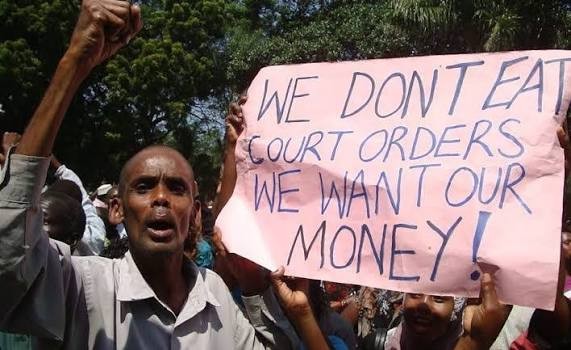
- Over 100,000 ECDE teachers across Kenya’s 47 counties have demanded improved remuneration, formal employment terms and professional dignity from county governments.
- Teachers have shared personal accounts of struggling to finance their own children’s education despite preparing other people’s children for the future.
- Some ECDE teachers have signalled they may contest elective seats or use their votes to hold legislators accountable in the 2027 General Election.
ECDE teachers across Kenya’s 47 counties are stepping up pressure on county governments to review their remuneration, improve working conditions and accord them professional recognition, in a growing nationwide push that organisers say can no longer be treated as an isolated employment dispute.
Kenya’s broader ECDE teaching workforce, spanning both public and private institutions, has historically been estimated at above the 100,000 mark, though an exact, consolidated 2026 national headcount is not currently available. Whether teaching in an urban centre or a remote rural community, the teachers involved perform the same foundational task of preparing children for the next stage of their education, and their concerns are being echoed across regions rather than confined to a single county.
“We Are Professionals and Parents Too”
At the centre of the campaign is a simple contradiction teachers say policymakers have overlooked: the people responsible for laying the foundation of the country’s education system are themselves struggling to finance their own children’s education.
A female ECDE teacher from the Coast region described the tension between her professional role and her responsibilities at home. “I spend my days preparing other people’s children for their future. But when I go home, I am a mother. My child also needs school fees, accommodation, food and books,” she said, adding that her frustration is less about the size of her salary than the sense that her professional responsibilities are not reflected in her pay. “We want dignity. We want our employers to recognise that we are professionals and parents. We want what is agreed to be written down and reflected properly in our payslips.”
A male ECDE teacher from the Rift Valley raised a similar concern, noting that the financial pressure becomes acute once his own children reach college or university age. “Every morning I report to school knowing that parents have entrusted their children to me. I take that responsibility seriously. But I also have children at home. When one reaches college or university age, the financial pressure becomes enormous,” he said. His demand, he added, is straightforward: “We are asking for remuneration that recognises our qualifications, workload and responsibilities. We want proper employment terms. We want what is agreed to be put in writing and reflected in our payslips. And we want to see a future in this profession.”
Teachers say the debate cannot end with verbal promises. Where county governments agree to improve ECDE remuneration, they are demanding that those improvements be formally documented in employment records and accurately reflected in payslips, which teachers describe as a professional statement of how their labour is valued rather than a mere monthly calculation.
The core demands include transparency around what teachers earn and are entitled to, properly documented employment terms, and remuneration structures that allow them to live and work with dignity — concerns teachers say should not require years of relying on verbal assurances to be resolved.
ALSO READ: Ruto’s education reset: Kenya needs a whole-system review, not another patchwork of reforms
County Governments Under Pressure to Act
Because ECDE is a devolved function, county governments sit at the centre of the welfare and management of many of these teachers, a responsibility that campaigners argue must extend beyond building classrooms and supplying learning materials to include the people who make those classrooms function. Teachers are calling on counties to examine remuneration disparities, listen to their concerns, and ensure that any agreed improvements are implemented legally and administratively rather than left as informal understandings.
Teacher unions and professional organisations are also being urged to strengthen their advocacy for the ECDE workforce, with campaigners arguing that the issue should move from a county-by-county conversation into a national one, addressed through peaceful petitioning and collective negotiation with county governments.
As frustration has grown, the conversation among some ECDE teachers has begun shifting beyond salaries and employment terms into political representation ahead of the 2027 General Election. Some teachers say they are considering contesting elective seats, arguing that if their concerns continue to go unaddressed, they may need to move from petitioning leaders to becoming leaders themselves.
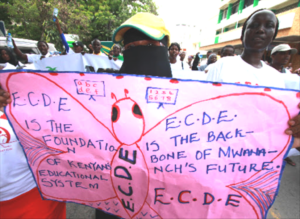
Others are issuing a more direct warning to legislators they believe have failed to listen to their concerns. “If our leaders cannot listen to us, then in 2027 we will use the ballot to make our voices heard,” one teacher said, with some going further to warn that legislators who ignore ECDE teachers’ concerns should be prepared to “be shown the door in 2027.” Teachers who are not considering elective office say they remain conscious of their collective political weight as voters, along with that of their families and communities, framing their message to legislators bluntly: “We teach in your schools today, but in 2027 we are voters. Do not assume that our votes are guaranteed.”
A National Test of How Kenya Values Its Teachers
Campaigners describe the ECDE remuneration debate as a broader test of whether Kenya genuinely values the workforce responsible for building the foundation of its education system. They argue that if the country believes every child deserves a strong educational foundation, it must also strengthen and adequately compensate the teachers who provide that foundation — while recognising that those same teachers are also parents whose own children’s futures depend on their ability to earn a living wage.
Teachers involved in the campaign say their demands are not a request for special treatment but a call for fairness: remuneration that reflects their qualifications and responsibilities, written employment terms, accurate payslips, and acknowledgement from county governments that behind every teacher is a family working to secure its own future.
ALSO READ: CS Ogamba defends new university funding model, says every student will get support
With the campaign spreading across counties from the Coast to western Kenya and beyond, organisers say teachers are now closely watching how county governments respond — whether petitions are heard or ignored, whether promises are converted into written agreements, and whether remuneration concerns are addressed or postponed. That scrutiny, they say, will increasingly extend into the political arena as 2027 approaches, with some teachers weighing candidacy and others weighing how to use their votes to hold legislators accountable.
County governments, teachers say, now have an opportunity to demonstrate that ECDE teachers are valued not merely through speeches but through fair remuneration, proper documentation, transparent payslips and meaningful engagement — before frustration that has already begun shifting from classrooms toward the ballot box hardens further.
By Hillary Muhalya
You can also follow our social media pages on Twitter: Education News KE and Facebook: Education News Newspaper for timely updates.
>>> Click here to stay up-to-date with trending regional stories
>>> Click here to read more informed opinions on the country’s education landscape