- MMUST has brought together international scholars, policymakers and disaster experts for a week-long International Summer School.
- The programme focuses on scientific solutions to geo-hydrological disasters worsened by climate change.
- Participants are expected to develop recommendations to strengthen regional collaboration in disaster risk management.
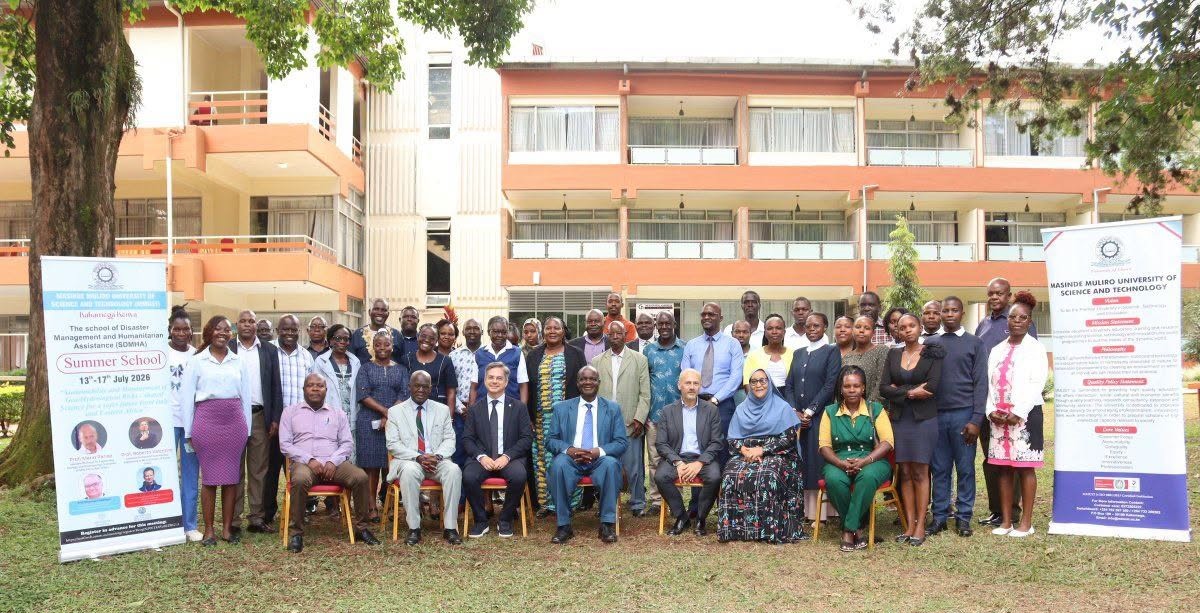
Masinde Muliro University of Science and Technology (MMUST) has brought together international scholars, policymakers, postgraduate students and disaster management practitioners for a week-long International Summer School aimed at strengthening collaboration in disaster risk management and promoting sustainable solutions to geo-hydrological hazards.
The programme, organised by the University’s School of Disaster Management and Humanitarian Assistance (SDMHA), is running from July 13 to July 17, 2026, under the theme, “Sustainability and Management of Geo-Hydrological Risks: Shared Science for a Safer Future from Italy and Eastern Africa.”
The Summer School focuses on advancing scientific research, knowledge exchange and regional partnerships to address the growing threat posed by floods, landslides, soil erosion and other geo-hydrological disasters, whose impacts have been exacerbated by climate change.
Speaking during the opening of the programme, organisers said the initiative seeks to strengthen the capacity of researchers, policymakers and disaster management professionals by creating a platform for sharing experiences, innovative technologies and best practices in disaster risk reduction.
Building international partnerships
The event is a continuation of partnerships established through three Transnational Education (TNE) programmes—WAGON2AFRICA, UNITAFRICA and ACHIEVE-IT—which have fostered academic cooperation between institutions in Kenya and Italy.
The collaborations have supported joint research, curriculum development, staff and student exchanges, and capacity building in disaster management and humanitarian assistance.
Participants are taking part in lectures, technical sessions and research discussions focusing on sustainable management of geo-hydrological risks and the application of science in building resilient communities.
The Summer School has attracted internationally renowned experts, including Prof. Mario Parise, Associate Professor of Engineering Geology and Hydrogeology at the University of Bari Aldo Moro, Italy, and Prof. Roberto Valentino, Associate Professor of Geotechnical Engineering at the University of Parma, Italy.
The two scholars are leading discussions on engineering geology, hydrogeology and geotechnical engineering while sharing experiences from Europe that could help inform disaster preparedness and mitigation strategies in Eastern Africa.
Organisers noted that the increasing frequency and intensity of disasters linked to climate change have underscored the need for stronger collaboration between universities, governments, humanitarian organisations and development partners in generating evidence-based solutions.
The forum is also providing postgraduate students and early-career researchers with an opportunity to interact with leading international experts, present research findings and establish networks for future academic and professional collaboration.
By hosting the International Summer School, MMUST continues to strengthen its position as a regional centre of excellence in disaster management education and research while reinforcing its commitment to international partnerships that address emerging global challenges.
READ ALSO: Western Region teams receive revised travel guidelines ahead of 2026 KSSSA National Games
The five-day programme is expected to conclude on Friday, with participants adopting recommendations aimed at enhancing regional cooperation, promoting scientific research and advancing sustainable disaster risk management practices across Eastern Africa.
By Godfrey Wamalwa
You can also follow our social media pages on Twitter: Education News KE and Facebook: Education News Newspaper for timely updates.
>>> Click here to stay up-to-date with trending regional stories
>>> Click here to read more informed opinions on the country’s education landscape
>>> Click here to stay ahead with the latest national news.