-
TSC will now recruit and register secondary school teachers qualified in just one teaching subject.
-
The move aims to scrap a longstanding requirement that had locked out specialists critical to Kenya’s competency-based education rollout.
-
The shift marks a formal departure from a policy that required all secondary school teachers to be trained in at least two teaching subjects before they could be registered and deployed by the commission.
The Teachers Service Commission (TSC) has announced it will now recruit and register secondary school teachers qualified in just one teaching subject, scrapping a longstanding requirement that had locked out specialists critical to Kenya’s competency-based education rollout.
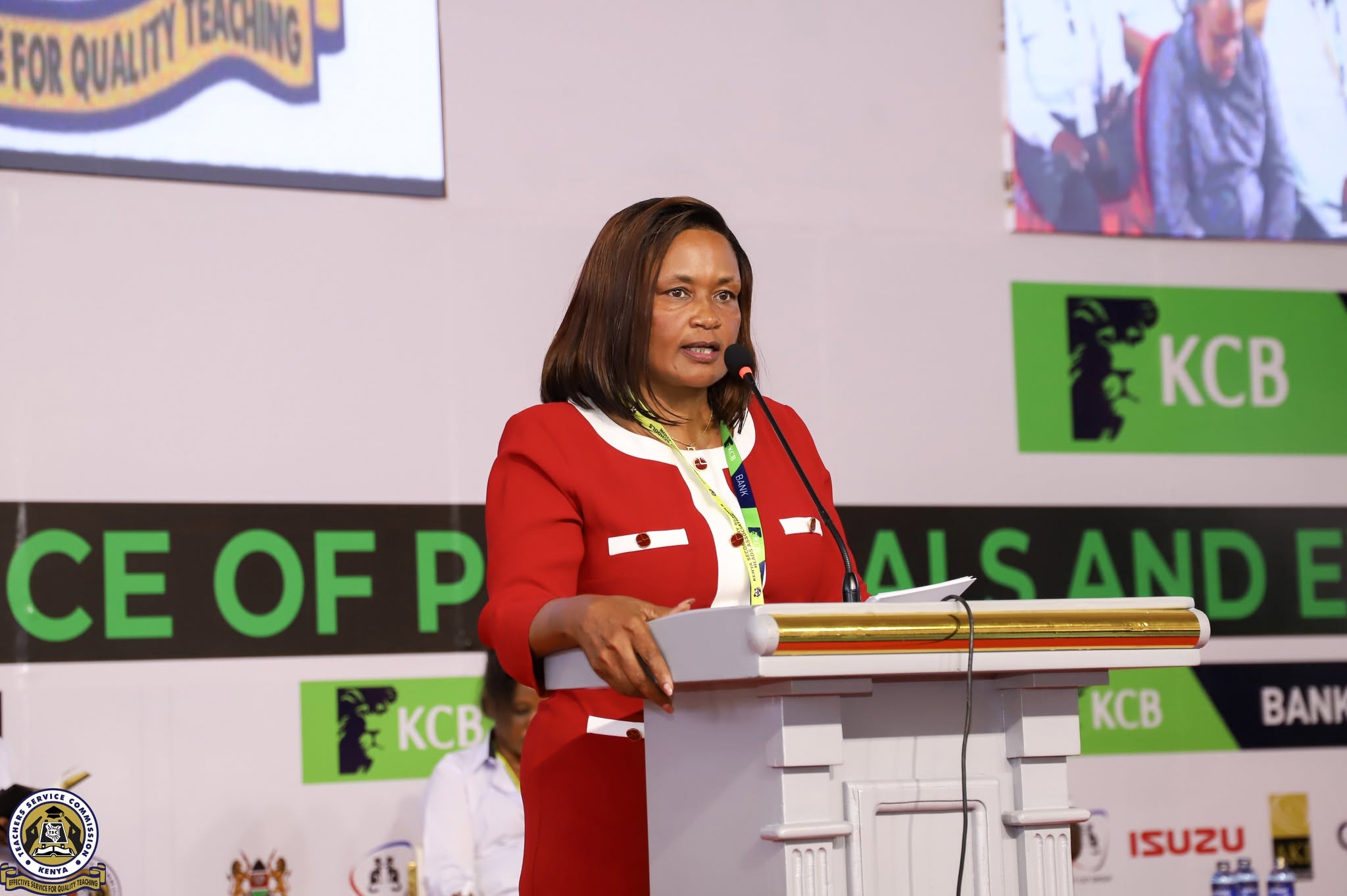
TSC Acting CEO Evaleen Mitei made the announcement on June 25, 2026, at the Kenya Senior School Heads Association (KESSHA) annual conference in Mombasa, signalling that the commission had already moved to revise the regulation underpinning teacher registration.
“The Legal Notice No. 50 is in the Code of Regulations. It is the legal notice that defines the requirements for registration of a teacher. To support CBE, the commission has reviewed that legal notice to be in compliance with CBE requirements,” Mitei said.
The shift marks a formal departure from a policy that required all secondary school teachers to be trained in at least two teaching subjects before they could be registered and deployed by the commission.
ALSO READ:
JSS: The trouble of being supervised by someone who does not fully understand your work
The announcement comes barely six months after more than 1.1 million learners transitioned into senior school, exposing severe staffing gaps in specialised subject areas introduced under the Competency-Based Education (CBE) framework.
Subjects such as aviation, building construction, electricity, marine and fisheries, media technology, theatre and film, sports science, fine arts and Mandarin have left schools struggling to find qualified instructors, with many principals reporting they cannot access trained personnel through conventional channels.
According to TSC data, 132,335 teachers are currently serving in senior schools. The Science, Technology, Engineering and Mathematics (STEM) pathway, which has absorbed approximately 677,144 learners, about 60 percent of the total senior school cohort, alone requires an estimated 35,111 teachers across 15,046 classes.
The Social Sciences pathway requires around 14,630 teachers, while Arts and Sports Science need a further 8,778.
KESSHA National Chairman Willie Kuria said the staffing deficit was one of the most urgent challenges confronting senior schools during the CBE rollout.
“We have a serious staffing deficit. Under CBE, we need qualified personnel for specialised subjects like aviation, marine technology and building and construction. Currently, we don’t have these staff. I doubt there is a school in the country that is fully equipped with these teachers,” Kuria said.
ALSO READ:
Last call for KCSE: KNEC opens final door for learners without KCPE certificates
He added that principals have been forced to hire instructors independently from outside the conventional teaching pool, a process made harder by scarcity in the broader labour market.
“Principals are forced to source these professionals independently because the Teachers Service Commission has yet to provide them. These specialists are scarce in the labour market; you have to literally ‘tarmac’ to find someone capable of teaching building construction,” he said.
The staffing shortfall has compelled many schools to dip into already strained budgets, using Boards of Management (BoM) funds to hire specialised instructors on their own.
Mitei said the single-subject reform was part of a broader package of changes intended to modernise teacher management and align the teaching service with the demands of the new curriculum.
“As a response to the needs of the new curriculum, that legal notice is also going to register teachers with one teaching subject so that we can address the challenges that we have in the new areas of the curriculum,” she said.
Beyond the subject requirement change, TSC has also revised entry requirements for primary school teaching, moving away from the old P1 certificate route and now requiring diploma-level training for entry into the profession. The commission has additionally introduced stage-based pathways for Special Needs Education (SNE) learners as part of the broader curriculum alignment effort.
Mitei said the reforms were expected to reduce teacher shortages, improve learner-to-teacher ratios, and support inclusion in marginalised and hard-to-staff areas.
By Benedict Aoya
You can also follow our social media pages on Twitter: Education News KE and Facebook: Education News Newspaper for timely updates.
>>> Click here to stay up-to-date with trending regional stories
>>> Click here to read more informed opinions on the country’s education landscape