Kenya’s education system is undergoing one of the most profound structural reforms in its modern history as the government accelerates the implementation of the Comprehensive School model under the Competency-Based Education (CBE) framework.
What is officially presented as an administrative and curriculum alignment reform is, in essence, a far-reaching redefinition of school governance, leadership eligibility, and professional progression across the basic education sector.
The scale of the reform
At the heart of this transformation lies a nationwide restructuring involving more than 23,000 basic education institutions. These include over 21,000 primary schools and approximately 1,900 junior secondary schools, alongside ECDE-linked units and special programmes attached to existing institutions.
Collectively, these institutions are being progressively reorganised into a unified Comprehensive School system, designed to integrate learning from foundational levels through junior secondary education under one institutional structure.
However, while the policy vision points toward a fully unified system, the reality remains transitional. Current implementation indicates that only an estimated 10,000 to 12,000 institutions are fully or partially operating under the Comprehensive School framework. The rest are still undergoing phased administrative alignment, reflecting both the scale of the reform and the complexity of restructuring an entire national education system without disrupting learning continuity.
This phased rollout highlights both the ambition of the reform and its most sensitive pressure point: leadership.
Experience versus academic qualifications
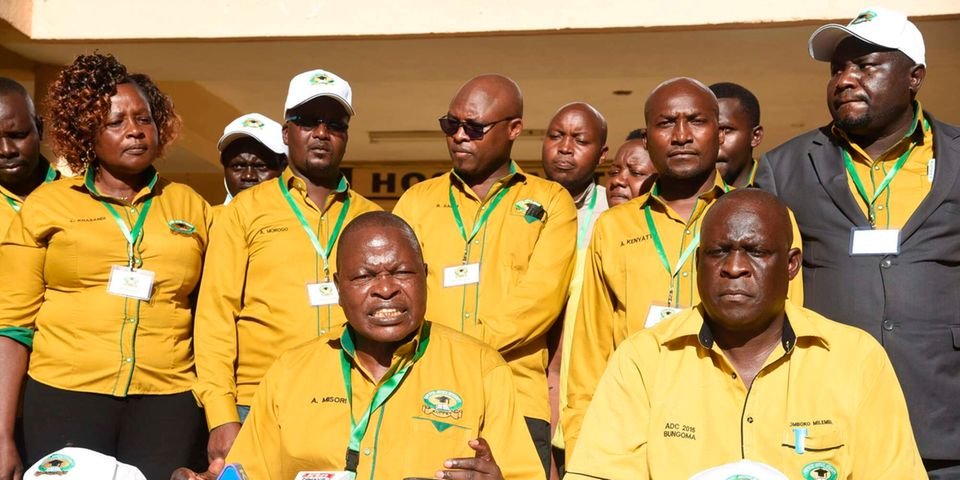
For decades, Kenya’s primary school headteachers have formed the backbone of basic education administration. Their rise into leadership positions has traditionally been anchored in classroom experience, professional competence, and incremental advancement under established career progression systems.
Many have served for long periods, building institutional stability, managing scarce resources, and sustaining community trust through practical problem-solving and lived experience rather than advanced academic certification.
The Comprehensive School model, however, introduces a fundamentally different leadership philosophy that places academic prowess and formal qualifications at the centre of institutional authority.
A new leadership structure
Under the new governance structure, each Comprehensive School is expected to operate under a single Board of Management, led by one Head of Institution and supported by two deputies—one overseeing the primary section and the other managing the junior secondary wing.
This model is designed to eliminate duplication, strengthen coordination, and ensure continuity in learning across education levels.
Yet while the structure appears streamlined in theory, it significantly expands the scope of leadership in practice.
The Head of Institution is no longer simply a primary school headteacher but the chief executive of a complex educational organisation. The role now includes strategic oversight of curriculum delivery across multiple levels, management of expanded human resource systems, financial accountability for larger institutional budgets, supervision of infrastructure development, and responsibility for performance outcomes under the Competency-Based Education framework.
Raising the qualification threshold
As leadership responsibilities expand, the qualifications required to occupy these roles are also being elevated.
Emerging policy directions linked to education reform proposals indicate that future Heads of Institution will be required to hold at least a Bachelor’s degree in Education or its equivalent, alongside a Master’s degree in Education, Educational Leadership, or a related field.
In addition, candidates will be expected to demonstrate proven experience in institutional leadership and administration.
This shift marks a decisive departure from the traditional model where experience and long service were often sufficient for progression into senior leadership positions.
The introduction of a Master’s degree requirement elevates academic certification as a central determinant of leadership legitimacy, shifting the balance of authority toward formal academic qualifications.
The workforce reality
The significance of this change becomes more evident when examined against the broader teaching workforce.
Across Kenya’s estimated 310,000 to 330,000 teachers, only about 6,000 to 8,000 hold Master’s degrees, representing roughly 2 to 3 per cent of the teaching population.
The majority of these postgraduate-qualified teachers are concentrated in secondary schools, teacher training institutions, and specialised education roles.
Within primary school leadership, the number is even smaller, with only a limited number of current headteachers holding Master’s degrees.
This means that the vast majority of serving school administrators do not currently meet the emerging academic threshold required for Comprehensive School leadership.
This creates a structural tension at the core of the reform: a system attempting to elevate academic standards while operating within a workforce where advanced academic qualifications remain relatively rare.
The transition phase
As the transition moves toward the post-July 2026 implementation phase, the Teachers Service Commission (TSC) is expected to roll out new administrative and deployment frameworks aligned with the Comprehensive School model.
This will likely include structured reassessment of current headteachers, competitive interviews for leadership positions, and redeployment processes intended to align personnel with the new institutional structure.
However, the process is not expected to operate as a sudden replacement of existing leadership.
Instead, it is likely to function as a managed transition mechanism that prioritises continuity while gradually introducing new qualification and competency requirements.
In practice, this means interviews and evaluations may take place, but with a strong emphasis on repositioning existing administrators within the new system wherever possible rather than immediate exclusion.
Bridging the leadership gap
The challenge becomes more pronounced when considering the gap between leadership requirements and the available pool of qualified personnel.
With over 23,000 institutions undergoing transformation and only a small fraction of teachers holding Master’s degrees, strict enforcement of postgraduate requirements at the outset would create a significant leadership deficit, particularly in rural and underserved regions.
For this reason, implementation is likely to rely on a combination of transitional strategies.
These may include temporary appointment of Bachelor’s degree holders as Heads of Institution during the transition period, retention of experienced headteachers under transitional clauses based on performance and institutional stability, and structured upgrading programmes aimed at increasing the number of postgraduate-qualified teachers over time.
Leadership roles within Comprehensive Schools may also be internally reconfigured to balance academic qualifications with experience. In such a model, Master’s degree holders would assume overall institutional leadership positions, while Bachelor’s degree holders could serve as deputies or sectional heads responsible for either primary or junior secondary divisions.
The policy dilemma
At a broader policy level, the reform reflects a deliberate shift toward professionalising school leadership in line with global education management trends.
The underlying argument is that Comprehensive Schools require leaders with advanced competencies in administration, curriculum integration, financial management, and institutional accountability—skills often associated with higher academic training.
However, this direction simultaneously raises a critical policy dilemma: should academic prowess outweigh practical experience in determining educational leadership?
Kenya’s education system has historically relied heavily on experienced educators whose leadership has been shaped through years of service, institutional problem-solving, and deep engagement with school communities.
This experience-based model has provided stability and continuity, particularly in resource-constrained environments.
The emerging framework now places this experiential foundation in tension with a new academically driven leadership model, where formal qualifications increasingly define eligibility.
Looking ahead
Ultimately, the success of the Comprehensive School reform will depend not only on the strength of its structural design but also on the balance it achieves between academic elevation and experiential continuity.
With more than 23,000 institutions undergoing transformation and only a small percentage of teachers holding Master’s degrees, the gap between policy ambition and workforce reality remains significant.
This means that the future of school leadership in Kenya will not be determined by academic policy alone, but by the system’s ability to harmonise academic prowess with lived experience—ensuring that reform strengthens rather than disrupts the human foundation of education.
The Comprehensive School revolution therefore stands at a defining intersection between two forces: academic certification and experiential leadership.
READ ALSO: Gekano Boys students ring school bell, demand to be sent home
How Kenya navigates this axis will determine not only the success of the reform, but also the stability of its entire basic education system for years to come.
You can also follow our social media pages on Twitter: Education News KE and Facebook: Education News Newspaper for timely updates.
>>> Click here to stay up-to-date with trending regional stories
>>> Click here to read more informed opinions on the country’s education landscape